For UAE enterprises replacing VMware, Sangfor HCI and Nutanix should be compared through supported configurations, workload testing, resilience design, licensing, migration effort and lifecycle cost. A smaller proposed cluster or lower initial quote does not by itself establish better total cost or enterprise fit.
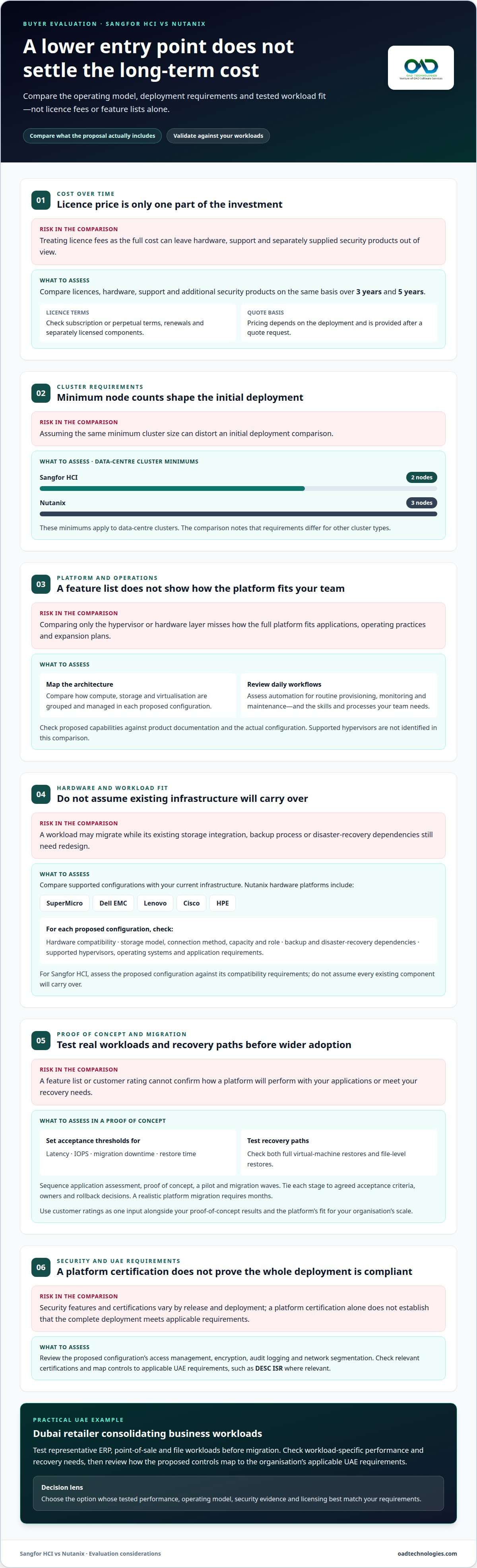
Licence fees are a sensible starting point when assessing a VMware alternative, but they are only part of the cost. Pricing depends on the deployment and is provided after a quote request. Compare licences, hardware, support and additional security products over three and five years to understand the broader investment.
This comparison covers licensing, platform features, hardware compatibility, cluster requirements, customer reviews and suitability for small and medium-sized businesses. It also explains how to assess each option against your workloads and growth plans, so the decision reflects operational needs as well as upfront requirements.
Key takeaways
- Compare licensing alongside hardware, support and additional security products to understand total cost over three and five years.
- Assess platform features against your workloads, management needs, migration plans and recovery requirements, not feature lists alone.
- Sangfor HCI combines compute, storage, networking and built-in security in one platform with a single management console, simplifying operations for lean UAE IT teams.
- Minimum node counts and resilience options vary by product version, architecture and protection model; confirm them in current vendor documentation and the supported proposal.
- Use customer ratings as one input alongside your own proof-of-concept results and the platform’s fit for your organisation’s scale.
Platform features and infrastructure consolidation
Sangfor HCI and Nutanix both consolidate virtualised workloads and supporting infrastructure in a managed platform. Their value depends on how well each fits your applications, operating practices and expansion plans. Compare the full operating model, not just the hypervisor or hardware layer.
For Sangfor, assess how the architecture groups compute, storage and virtualisation, and how administrators manage those resources. Map the same layers for the proposed Nutanix configuration. For both, review how automation supports routine provisioning, monitoring and maintenance. These workflows help clarify the skills your team needs and the processes to plan.
Security features and compliance certifications vary by release and deployment. Review product documentation for access management, encryption, audit logging and network segmentation, along with certifications relevant to the proposed configuration. UAE organisations should map controls to applicable requirements, such as DESC ISR where relevant. A platform certification alone does not establish that the complete deployment meets those requirements.
Licensing affects the economics of consolidation. Subscription and perpetual licences can have different renewal and budgeting implications, depending on the quoted configuration. Compare software, support and separately licensed components on the same basis. Check whether firewall functions and other security controls are included in the proposed design or require separate products. Do not assume they are bundled.
Use a proof of concept to test the architecture against real workloads. Set acceptance thresholds for latency, IOPS, migration downtime and restore time before testing. Test both full virtual-machine restores and file-level restores. These checks show whether consolidation maintains application performance and supports the recovery paths the business needs.
| Option | Structure | Team skills | Licensing review | Security review |
|---|---|---|---|---|
| Sangfor HCI | Map compute, storage and virtualisation layers | Assess administration and automation workflows | Identify subscription or perpetual terms in the proposal | Review controls and applicable certifications |
| Nutanix | Map the same layers across the planned configuration | Assess required operational skills and processes | Include renewals and separately licensed components | Review controls and applicable certifications |
For example, a Dubai retailer consolidating ERP, point-of-sale and file workloads can test representative applications before migration. This helps expose workload-specific performance and recovery needs. Reviewing how controls map to the organisation's applicable UAE requirements adds a governance perspective to the technical evaluation. The hyperconverged infrastructure overview provides context for evaluating consolidation within the wider environment.
Neither platform is the stronger choice for every UAE enterprise. Compare the capabilities actually licensed and supported, then test administration, security integration, failure handling and recovery against the organisation’s workloads.
Both platforms target virtualised workloads and supporting infrastructure, but suitability depends on your existing applications.
Migrating workloads should sequence application assessment, proof of concept, a pilot and migration waves rather than treating cutover as a single event. A realistic platform migration requires months for evaluation, proof of concept, pilot and migration waves. Keep those stages tied to agreed acceptance criteria, owners and rollback decisions, so each wave can confirm that the chosen design works before broader adoption. Validate proposed capabilities and terms against product documentation and the actual configuration.
Hardware compatibility and heterogeneous deployment
Hardware choices affect how Sangfor HCI and Nutanix fit your existing compute, storage and virtual environments. Compare supported configurations with your current infrastructure before planning a deployment.
Architecture and deployment approaches
Map each proposed platform architecture to the servers, storage and network already in use. Nutanix hardware platforms include SuperMicro, Dell EMC, Lenovo, Cisco and HPE. For Sangfor HCI, OAD maps the proposed configuration against existing servers so suitable hardware can be reused where supported.
Review existing storage separately. Record its model, connection method, capacity and role, then compare these details with the platform’s supported configuration. Include backup and disaster-recovery dependencies: a virtual workload may migrate successfully even if its existing backup process needs redesign. This helps identify integration work before deployment planning.
Hypervisors and workloads
Hypervisor and workload support depend on the platform release and deployment configuration. Use the relevant compatibility matrix to compare supported hypervisors, operating systems, application dependencies and virtual-machine requirements. Do not assume either platform is compatible with every workload.
For a UAE organisation running business applications and file services, classify each workload by operating system, resource profile and dependencies. This inventory makes the comparison practical by identifying which workloads are suitable for migration and which need a separate design or migration sequence.
Performance and scalability depend on workload behaviour, hardware sizing and configuration. Compare capacity and performance using representative workloads, then assess how each design supports planned growth. Results from one server or storage arrangement do not automatically predict performance in another.
Map current data paths and recovery processes to each proposed design. Compare storage allocation, backup integration and recovery operations. During a proof of concept, test full virtual-machine and file-level restores to represent both application recovery and individual-file retrieval.
Include your team’s day-to-day administration tasks in the deployment comparison, such as provisioning virtual machines, monitoring capacity and applying routine changes. Evaluate these workflows in the proposed configuration. Automation can reduce repeated manual steps, but its value depends on how well it fits existing processes.
Common risks include unsupported hardware combinations, overlooked storage dependencies, incompatible workloads and backup processes that do not transfer cleanly. Compare the exact release’s hardware, network, storage and hypervisor requirements with your intended design. Configuration-specific sizing is essential; there is no universal node specification.
Sangfor documents VMware virtual-machine migration tooling, but migration complexity still depends on guest operating systems, applications, network design, storage, downtime tolerance and the supported target configuration. Validate these factors in a proof of concept and rollback plan.
Treat published comparison data as a reference point rather than a substitute for checking current compatibility documentation. Before committing to a design, confirm that the selected hardware, hypervisor and workload combination remains supported for the intended deployment. Record any differences between the documented configuration and the estate under review, and resolve them through validation before migration begins.
Stretched cluster support and minimum cluster sizes
Cluster minimums can affect the entry point for UAE organisations planning local resilience or multi-site continuity. The required design depends on the protection model, site layout and compute capacity each workload needs.
For any standard data-centre cluster, confirm the current minimum supported topology, usable capacity after protection overhead and failure tolerance in the vendor’s documentation and final bill of materials. Treat node count as one design constraint, not a complete sizing decision.
Stretched-cluster requirements vary by platform and design. For a UAE organisation spanning Dubai and Abu Dhabi, validate site connectivity, latency, quorum, workload placement, failure scenarios and operations during a site outage before comparing proposals.
Protection models also affect minimum topology and usable capacity. Compare the supported replication or erasure-coding design, capacity overhead, rebuild behaviour and recovery objectives for the specific platform version.
For a small or medium-sized business, Sangfor’s compact cluster option is a practical starting point. A compact cluster may make a VMware alternative more accessible, but licensing, expansion plans and the cost of maintaining capacity matter too. A flexible design should support expected workload growth without an early rebuild or insufficient headroom.
Support arrangements are another operational consideration for UAE teams. Compare escalation routes, coverage terms, language needs and how technical issues are documented for each deployment. These factors affect how internal teams diagnose service risks, coordinate with specialists and restore normal operations.
Support reviews are most useful when they describe specific experiences, such as issue handling, clarity of guidance and follow-through. Distinguish product feedback from comments on implementation or support. A review of a different cluster design may not reflect your UAE organisation’s requirements.
Use cluster minimums to narrow the options, then compare the complete deployment plan:
- Standard cluster: confirm the current supported minimum and failure tolerance.
- Stretched cluster: validate site, latency and quorum requirements.
- Protection model: compare usable capacity and rebuild behaviour.
Cluster options should be assessed with a supported design, documented recovery objectives and lifecycle operating responsibilities. Local delivery support can help implementation, but it does not replace vendor support matrices or workload testing.
Customer ratings and reviews
Customer ratings can inform a Sangfor and Nutanix comparison, but a score alone says little about enterprise fit. Read each review in context, including server topology, workload mix, implementation scope and support arrangement. A small virtual environment and a multi-site database platform place different demands on HCI, so their experiences are not directly interchangeable.
Separate product feedback from comments on implementation and support. A review might praise an interface but describe a difficult migration, or describe support experiences after a deployment involving specific hardware. These points matter, but measure different things. Note whether each comment concerns the platform, deployment partner, server configuration or support process.
Look for operational detail in each review. Does it describe virtual-machine performance, capacity changes, patching, backup or disaster recovery? An account of restoring a database after an outage is more useful for recovery planning than a general satisfaction rating. A review that identifies its topology can also help you judge how closely that environment resembles your own.
Use the same categories to compare reviews for both platforms: implementation effort, daily administration, workload performance, hardware compatibility, support responsiveness and recovery experience. Treat these as evidence to consider, not a substitute for a proof of concept. A highly rated product may still be a poor fit if the reviewed configuration differs from your requirements.
- Deployment: note the platform, hardware and topology described.
- Operations: identify comments about administration and routine changes.
- Resilience: look for specific backup and disaster-recovery experiences.
- Support: distinguish product issues from response and resolution concerns.
For example, a UAE retailer comparing Sangfor and Nutanix could review feedback about branch workloads alongside its own store-server design. Accounts of a different topology may suggest useful questions, but should not decide the purchase. Use them to shape proof-of-concept tests for the retailer’s actual applications and recovery processes.
Review quality matters as much as quantity. Prefer detailed accounts that explain the environment and issue over uncontextualised praise or criticism. Check whether independent customer accounts report the same concern, and note whether they describe current operations or an earlier deployment. This helps distinguish a recurring operational issue from an isolated experience.
Ratings can also reflect different expectations. An enterprise team with dedicated HCI expertise may assess administration differently from a lean IT team managing infrastructure alongside other responsibilities. Compare reviews with your team’s skills, support model and planned workloads, then validate important claims in your own evaluation.
Use customer reviews to shape what you test, not to declare a universal winner. Measure both proposals against the same workload, topology, resilience, security and operational criteria.
Cost and suitability for small and medium-sized businesses
For a small or medium-sized business, HCI suitability depends on supported hardware, usable capacity, licensing, migration work, support and the skills needed to operate the platform. Compare all separate security products and services explicitly rather than assuming consolidation always reduces cost.
Assess Sangfor HCI’s total cost over three and five years, including licences, hardware, support and additional security products. Apply the same cost categories to the Nutanix proposal. A like-for-like comparison shows how subscription terms, renewals and separate products affect the budget over each period.
Build the comparison around your actual workloads. A UAE business might run finance virtual machines, file services and a customer database. List the hardware and software each workload depends on, then account for migration effort and integration with existing backup and security tools. These requirements can affect overall cost more than a headline licence figure.
Licensing models differ, so record what each proposal covers and how renewal terms affect future planning. Include support and any additional products needed for the intended design. If, for example, a separate security control is required, include it in both options rather than treating it as an unrelated expense.
A Sharjah-based distributor considering a VMware renewal could compare both platforms against its warehouse, finance and order-processing workloads. Organisations approaching a VMware renewal should begin evaluating alternatives well ahead of the renewal date. This allows time to assess the options, plan a proof of concept and account for migration work that takes months.
Set the same evaluation scope for both vendors. Use representative workloads, consistent cost categories and agreed operational criteria. A proof of concept should inform the business decision, not simply show that a virtual machine can run. Record dependencies, staff effort and integration work required for the planned design.
SMBs with limited infrastructure teams should consider operational capacity as well. Compare the administration tasks each platform requires, the skills already available and the support model in each proposal. A platform that meets current compute needs may still require additional processes or expertise as the business grows.
On lifecycle cost, migration effort and team capacity, the better fit is the platform that meets the tested requirements at an acceptable five-year cost and risk. Document assumptions for licences, renewals, hardware, support, migration, security controls and growth.
OAD Technologies
OAD Technologies provides enterprise-grade HCI and private-cloud Managed Technology Services on a Fully Managed, Defined Scope basis. Where Sangfor or Nutanix is proposed, supported hardware, licensing, migration, recovery, vendor support and day-to-day responsibilities are documented for the specific environment.
OAD Technologies also helps UAE organisations connect infrastructure decisions with practical cybersecurity needs. Once you’ve shortlisted an HCI platform, consider how its environment will fit your threat monitoring, data protection and risk assessment requirements. OAD Technologies provides Security Information and Event Management (SIEM), Managed Detection and Response (MDR), Vulnerability Assessment and Penetration Testing (VAPT), and Data Loss Prevention (DLP).
For example, a business planning a platform migration can assess how security events will be monitored and sensitive information protected across its systems. These cybersecurity capabilities complement an HCI decision; they do not replace workload, hardware or licensing evaluation.
Build the next phase around your workloads
Your Sangfor HCI vs Nutanix decision should support more than the next infrastructure refresh. Use it to align platform operations, security controls and business growth. A sound Sangfor HCI vs Nutanix comparison also considers how your teams will manage change after deployment.
OAD Technologies can help connect infrastructure planning with cybersecurity priorities. Its services include Data Loss Prevention (DLP) for sensitive information risks, Vulnerability Assessment and Penetration Testing (VAPT) to assess weaknesses, and Managed Detection and Response (MDR) for threat detection and response. These capabilities complement platform planning without replacing technical evaluation.
Bring workload priorities and security objectives into the same discussion. This joined-up view can help your organisation plan infrastructure changes with greater clarity.
Take the next step with a decision shaped around your business and its future needs.
Frequently asked questions
Why do UAE enterprises choose Sangfor HCI over Nutanix?
Sangfor HCI combines compute, storage and networking with documented security capabilities and VMware migration tooling. Whether that is preferable to Nutanix depends on the licensed edition, supported architecture, workload tests, operational model and lifecycle cost; OAD does not treat it as the default choice for every UAE enterprise.
How much do Sangfor HCI and Nutanix cost, including licensing and support?
Pricing depends on the deployment and is provided after a quote request. Compare licences, hardware, support and additional security products over three and five years, including renewal terms and separately licensed components.
What security advantages does Sangfor HCI offer?
Sangfor HCI integrates security capabilities such as a built-in next-generation firewall and endpoint protection into the platform, so protection is managed alongside compute and storage from one console. UAE organisations should still map the deployed controls to applicable requirements such as DESC ISR as part of the design.
Disclaimer
Content by OAD Technologies is for general informational purposes only and does not constitute professional or cybersecurity advice. No warranties are made regarding accuracy or completeness; reliance is at your own risk. OAD Technologies shall not be liable for any direct or indirect losses arising from use of this content.