
Would your enterprise be ready to report a data breach to the UAE Data Office in under 72 hours if a single over-shared Drive link triggered a leak today? With the UAE Personal Data Protection Law (PDPL) now in full enforcement, the margin for error has vanished. Securing data in Google Workspace is no longer just about checking a few boxes in the Admin console; it's a high-stakes race against sophisticated identity-based attacks and the silent spread of Shadow IT.
You likely recognize that while Google’s infrastructure is world-class, the responsibility for how your team handles sensitive information rests entirely on your shoulders. We'll help you master the transition from basic cloud settings to a robust, compliance-aligned security posture that protects your intellectual property without slowing down your operations. This strategy provides a clear roadmap for hardening your environment and aligning with UAE national compliance frameworks. We'll explore how to prevent data leaks by integrating sophisticated DLP and IAM controls that empower your people while maintaining rigorous engineering standards for your digital assets.
Key Takeaways
- Define the Shared Responsibility Model to clarify the critical distinction between Google’s infrastructure security and your organization’s accountability for data access.
- Establish a modern perimeter by integrating sophisticated Identity and Access Management (IAM) frameworks tailored for a distributed, cloud-first enterprise environment.
- Address the limitations of native tools by deploying automated classification and advanced DLP strategies for securing data in Google Workspace.
- Ensure full alignment with UAE PDPL and national compliance standards through strategic data residency management and rigorous governance protocols.
- Transform cybersecurity from a restrictive barrier into a business enabler by leveraging expert-led technical hardening and customized security integrations.
The Google Workspace Shared Responsibility Model
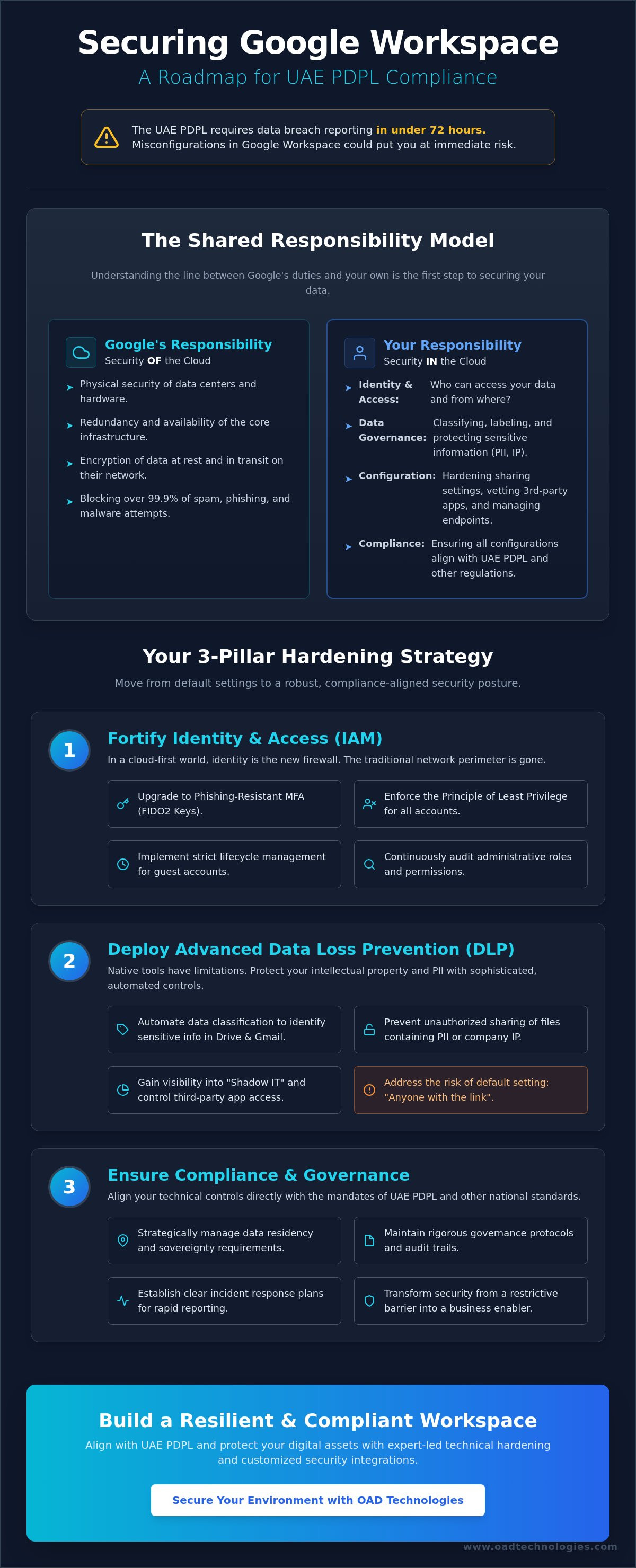
Many enterprise leaders view cloud migration as a total transfer of risk. They assume that because they've moved to a world-class provider, the burden of security moves with it. This is a fundamental misunderstanding of the Shared Responsibility Model. In a SaaS environment, the provider manages the physical and logical security of the host, but the customer always retains ownership of what they put inside that host. Effectively securing data in google workspace requires you to recognize exactly where Google’s duty ends and yours begins.
Your responsibility as an enterprise customer rests on three specific pillars: Identity, Data, and Configuration. While Google’s AI-powered defenses block over 99.9% of spam and malware in Gmail, identity-based attacks remain the primary driver of incidents in these environments. Assuming that "built-in is enough" is a primary catalyst for data breaches. For a broader context on how the suite has evolved to its current scale, this Google Workspace overview provides a look at the platform's history and core features. Relying solely on native infrastructure without custom hardening creates a gap that sophisticated actors are ready to exploit.
Infrastructure vs. Information: Where the Line is Drawn
Google’s role is to maintain the "Security of the Cloud." They handle physical data center security, server redundancy, and the encryption of data at rest and in transit. Your role is to manage the "Security in the Cloud." This involves governing user permissions, vetting third-party app access, and maintaining strict data classification. Google is responsible for the security of the cloud, while you're responsible for the security of your data in the cloud.
The Risk of Default Settings in Enterprise Environments
Most "out of the box" settings in cloud productivity suites favor collaboration over security. Google Workspace is designed to help teams move fast, which often means default sharing permissions are set to "anyone with the link." In a corporate context, this is a significant vulnerability. These defaults don't account for the nuances of your specific intellectual property or the strict requirements of the UAE PDPL.
Misconfigurations are more than just administrative oversights; they're active entry points for data exfiltration. The April 2026 Vercel incident highlighted how a compromised third-party AI tool's OAuth application could be used to pivot into production infrastructure. When you leave settings at their default state, you're essentially choosing convenience over compliance. Without a customized strategy for securing data in google workspace, accidental exposure of PII becomes a matter of "when," not "if."
Hardening Identity and Access Management (IAM)
The traditional network perimeter has dissolved. In a cloud-first enterprise, identity is the new firewall. When your workforce is mobile and global, the security of your environment depends entirely on who is accessing your systems and from what device. Successfully securing data in google workspace requires moving beyond simple password policies toward a comprehensive identity and access management framework that treats every login attempt as a potential risk.
Identity-based attacks remain the primary driver of security incidents. To counter this, organizations are transitioning from standard Multi-Factor Authentication (MFA) to phishing-resistant security keys. While Google provides robust AI security in Gmail to block malicious attempts, human error still exists. FIDO2-compliant keys eliminate the risk of "push fatigue" or intercepted SMS codes. Managing external contributors adds another layer of complexity. You must establish strict lifecycle management for "Guest" accounts, ensuring that temporary access doesn't become a permanent backdoor into your sensitive Drive folders. As you refine these protocols, strengthening your IAM posture through a professional audit can reveal hidden vulnerabilities in your cloud permissions.
Enforcing the Principle of Least Privilege
Granting excessive administrative power is a common enterprise pitfall. You should audit and restrict administrative roles to the absolute minimum required for a user's job function. Utilize the "Super Admin password reset" alert, which as of June 2026 covers all administrator roles, to maintain visibility into privileged account changes. Context-Aware Access (CAA) further hardens this by allowing you to create granular policies. For example, you can block access if a user attempts to log in from an unauthorized IP address or a device that doesn't meet your encryption standards. Automated offboarding is equally vital. It ensures that "orphan accounts" are deactivated immediately when an employee departs, preventing legacy access to proprietary data.
Zero Trust Architecture in the Google Ecosystem
A resilient strategy assumes that no user or device is inherently trustworthy, regardless of whether they're inside the corporate office. You must shift to per-request verification. This means every request to access a file or application is evaluated based on real-time signals, including user identity, location, and device security posture. By integrating Endpoint Detection and Response (EDR) signals into your access decisions, you ensure that only healthy devices can interact with your data. Zero Trust prevents lateral movement after a credential compromise by requiring continuous authentication for every unique resource access. This architecture ensures that a single compromised account doesn't grant an attacker the keys to your entire digital kingdom.
Advanced Data Loss Prevention (DLP) for Drive and Gmail
While native tools provide a baseline for security, they often struggle to meet the rigorous demands of highly regulated sectors. For an enterprise handling massive volumes of proprietary information, a binary "allow or block" approach is insufficient. Successfully securing data in google workspace requires a nuanced strategy that distinguishes between routine collaboration and high-risk data movement. This level of control is a core component of a broader data loss prevention posture, ensuring that your most valuable digital assets remain within your control at all times.
Manual oversight of thousands of Drive files is impossible for modern IT teams. You need automated data classification systems that scan for sensitive information without human intervention. By identifying and tagging data based on its sensitivity level, you can apply granular protection policies that prevent unauthorized exfiltration through Gmail attachments or external Drive sharing. This proactive approach ensures that even if an employee makes a mistake, your technical safeguards prevent that error from becoming a compliance disaster.
Beyond Keywords: Contextual Data Classification
Simple Regular Expression (regex) matching often leads to false positives or, worse, missed leaks. Transitioning to AI-driven document fingerprinting allows your systems to understand the context of the data they're protecting. This is particularly critical for identifying UAE-specific data types, such as Emirates ID numbers or regional financial records, which must be handled in strict accordance with the UAE PDPL. Real-time scanning must cover both "data at rest" within your storage buckets and "data in motion" as it's being shared or sent. This dual-layered visibility ensures that protection follows the data, regardless of its location or state.
Mitigating Third-Party App and API Risks
Shadow IT remains a persistent threat to cloud environments. When employees grant permissions to third-party apps via OAuth tokens, they often bypass traditional security controls, creating invisible backdoors into your corporate data. You should establish a "Whitelist-only" policy for the Google Workspace Marketplace, ensuring that only vetted and approved integrations can interact with your environment. Beyond simple whitelisting, conducting regular technical security assessments on these connected apps is essential. These evaluations help you identify if a seemingly harmless tool has excessive permissions or vulnerabilities that could be exploited to exfiltrate your intellectual property. By treating every API connection as a potential risk, you maintain a hardened perimeter that supports innovation while prioritizing securing data in google workspace.
Compliance and Governance: Aligning with UAE Standards
Global cloud strategies often fail when they hit local regulatory borders. For organizations operating in the Middle East, securing data in google workspace requires a precise alignment with the UAE Personal Data Protection Law (PDPL). This federal mandate, alongside sector-specific rules from NESA or the Central Bank, dictates how information is stored, processed, and protected. You must move beyond generic global policies to a framework that respects national sovereignty over data. Integrating a robust governance risk and compliance strategy ensures your cloud environment isn't just secure, but legally resilient.
Data residency is a critical pillar of this alignment. While Google Workspace allows you to select specific data regions for primary storage, you must verify that these configurations meet the specific requirements of your industry. Failure to properly localize data can lead to significant regulatory friction and potential fines of up to AED 5 million. Maintaining a clear map of where your information resides is the first step toward long-term viability in an increasingly regulated market.
Navigating the UAE Personal Data Protection Law (PDPL)
Compliance in the cloud demands active management of data subject rights and consent protocols. Under the UAE PDPL, organizations must notify the UAE Data Office of a data breach within 72 hours of discovery. You should configure your Workspace alerts to ensure your security team has the visibility needed to meet this tight deadline. Before migrating sensitive workloads, conducting a Data Protection Impact Assessment (DPIA) is essential. This process helps you identify potential risks to personal data and implement the necessary technical safeguards to mitigate them, ensuring that securing data in google workspace remains a priority during every stage of the lifecycle.
Audit Logging and SIEM Integration
Native logs within the Admin console are useful for day-to-day troubleshooting, but they often lack the retention depth required for forensic investigations or long-term compliance. To bridge this gap, you should export your Workspace logs to a centralized SIEM platform. This integration allows you to correlate cloud activity with signals from your endpoints and network, providing a holistic view of your security posture. Centralized logging accelerates incident response during a suspected breach by providing a single source of truth for all telemetry. If you're ready to align your cloud environment with national standards, consult our compliance experts to build a tailored governance framework today.
Building a Resilient Workspace: The OAD Technologies Approach
Cybersecurity shouldn't be a restrictive barrier that stifles innovation. Instead, we view it as a strategic business enabler that provides the confidence to scale. While Google provides the foundation, the nuances of enterprise risk management require a more surgical touch. Effectively securing data in google workspace involves bridging the gaps between native capabilities and the complex requirements of a modern, compliant business. We don't just implement tools; we design resilient systems that protect your intellectual property while your team remains agile.
Moving from a reactive "firefighting" mindset to a proactive, strategic posture is the hallmark of a mature organization. This transition requires a partner that understands the technical intricacies of cloud productivity suites and the regulatory pressure of the UAE market. By partnering with us, you gain access to a solution-oriented mindset backed by rigorous engineering standards. We act as an extension of your team, ensuring that your digital evolution is both rapid and secure.
Customized Security Architectures
A "one-size-fits-all" approach to cloud security inevitably fails in the UAE enterprise market. Every organization has a unique risk profile, data footprint, and compliance burden. Our methodology begins with a deep assessment of your existing environment to identify hidden vulnerabilities. We then harden your configuration, focusing on high-impact areas like identity governance and data exfiltration paths. This process relies on the synergy between human insight and technological capacity. While automated tools handle the scale of securing data in google workspace, our experts provide the strategic oversight to ensure those tools align with your long-term business objectives.
Continuous Monitoring and Incident Response
Visibility is the cornerstone of resilience. You cannot protect what you cannot see. Our Managed Detection and Response (MDR) service provides the 24 X 7 oversight necessary to identify and neutralize cloud-based threats before they escalate. Rather than waiting for a breach notification to trigger a response, we monitor your data assets in real time. This continuous vigilance ensures that your organization remains compliant with UAE PDPL standards and is prepared for the sophisticated identity-based attacks of 2026. If you're ready to master your transition to a robust security posture, contact OAD Technologies for a comprehensive security assessment to secure your digital future.
Strategic Resilience in the Google Ecosystem
The landscape of cloud productivity is shifting toward an identity-centric model where perimeter defense is no longer enough. By mastering the Shared Responsibility Model and deploying advanced DLP controls, your organization moves from a vulnerable default state to a hardened, compliance-aligned posture. Successfully securing data in google workspace requires more than just technical settings; it demands a strategic alignment with national frameworks like the UAE PDPL and a commitment to continuous monitoring. Relying on native features is your foundation, but true resilience is built through customized integration and rigorous engineering standards.
As a UAE-based strategic cybersecurity partner, we bring deep expertise in GRC and national compliance frameworks to your digital transformation. Our advanced DLP and MDR capabilities provide the 24 X 7 visibility needed to protect your most sensitive assets. Secure your enterprise cloud with OAD Technologies and transform your security from a restrictive barrier into a strategic business enabler. Your journey toward a resilient cloud environment starts with a single proactive step. Let's build a secure future for your enterprise together.
Frequently Asked Questions
Is Google Workspace compliant with the UAE Personal Data Protection Law (PDPL)?
Google Workspace provides the necessary infrastructure for compliance, but the final responsibility rests with your organization. You must actively configure data regions, consent management, and breach notification alerts to meet the specific requirements of the UAE PDPL. Ensuring your environment is aligned with the 72-hour notification window is a critical step in securing data in google workspace effectively.
How can I prevent employees from sharing sensitive Google Drive files externally?
You should implement Data Loss Prevention (DLP) rules that automatically scan for sensitive information. By setting up policies that identify patterns like financial records or Emirates ID numbers, you can block external sharing or restrict it to specific trusted domains. This automated approach prevents accidental over-sharing without disrupting your team's internal collaborative workflows.
Does Google Workspace provide enough DLP for a financial services firm in the UAE?
While native DLP tools offer a strong baseline, financial services often require more sophisticated hardening to meet Central Bank and NESA standards. You'll likely need to integrate advanced document fingerprinting and context-aware access policies. These additional layers ensure that your most sensitive financial data remains protected against complex exfiltration attempts that basic keyword matching might miss.
What is the risk of allowing third-party apps to access my Google Workspace data?
The primary danger is the silent spread of Shadow IT through OAuth tokens. These integrations can bypass traditional security perimeters, creating invisible backdoors that attackers use to exfiltrate intellectual property. You should establish a "Whitelist-only" policy in the Marketplace and conduct regular security assessments on every connected app to ensure they don't have excessive permissions.
How do I integrate Google Workspace logs with my existing SIEM solution?
You can export your Workspace telemetry using the Google Cloud Pub/Sub service or the Admin SDK API. Centralizing these logs within your SIEM allows your security team to correlate cloud activity with signals from your network and endpoints. This holistic view is essential for securing data in google workspace and accelerating your response during a suspected breach.
Can I restrict Google Workspace access to only company-managed devices?
Yes, you can enforce this through Context-Aware Access (CAA) policies. By defining specific rules, you ensure that only devices meeting your security criteria, such as active encryption or company-issued serial numbers, can access corporate data. This effectively prevents users from accessing sensitive files from unmanaged or potentially compromised personal devices.
What is the difference between Google Workspace native security and enterprise DLP?
Native security focuses on infrastructure protection and basic keyword detection. Enterprise-grade DLP goes much further by utilizing AI-driven classification to understand the context of your information. This allows for more precise protection of UAE-specific data types and ensures that your security policies adapt to how your team actually handles sensitive documents in real-time.
How often should we conduct a VAPT on our cloud productivity environment?
We recommend performing a Vulnerability Assessment and Penetration Testing (VAPT) at least once a year. It's also vital to conduct a new assessment after any major change to your organizational structure or cloud configuration. Regular testing identifies hidden weaknesses in your IAM and DLP settings before they can be exploited by sophisticated threat actors.
Disclaimer
Content by OAD Technologies is for general informational purposes only and does not constitute professional or cybersecurity advice. No warranties are made regarding accuracy or completeness; reliance is at your own risk. OAD Technologies shall not be liable for any direct or indirect losses arising from use of this content.