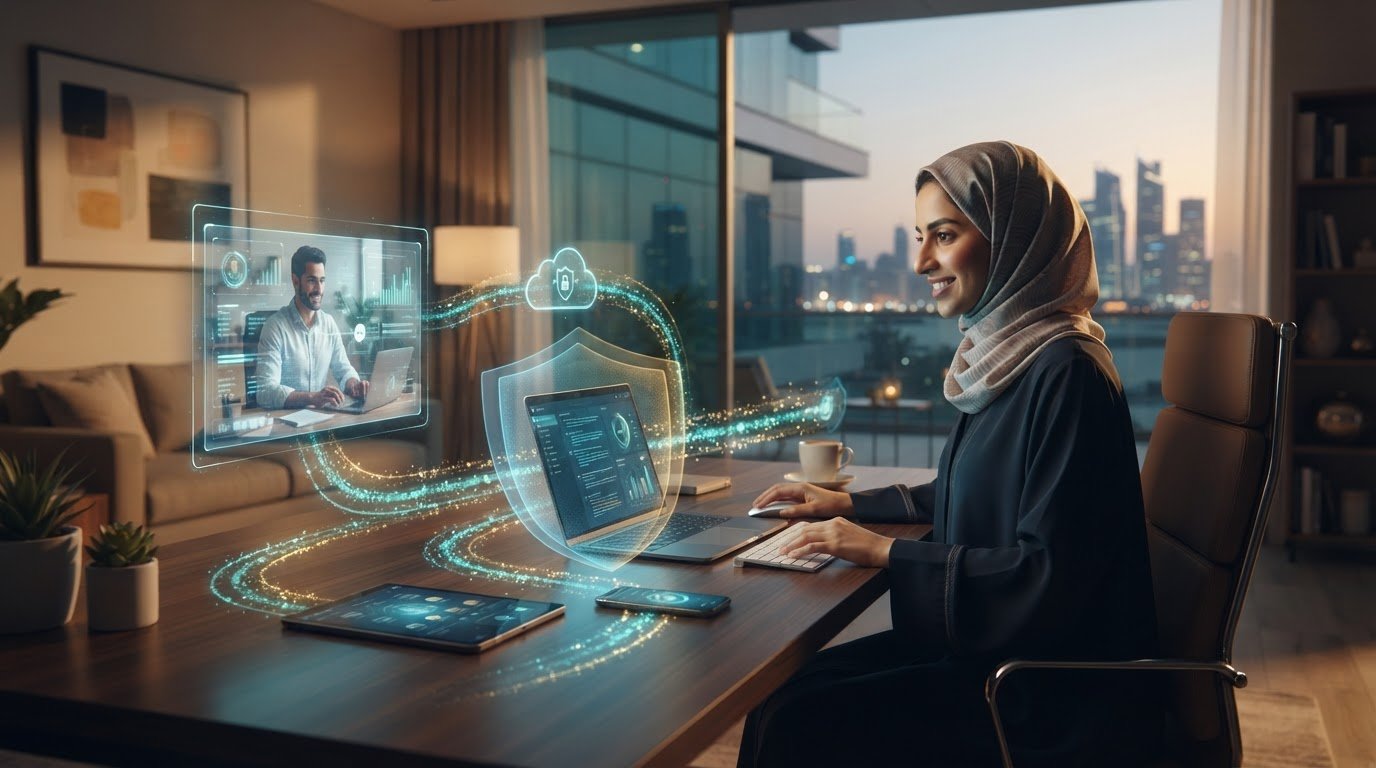
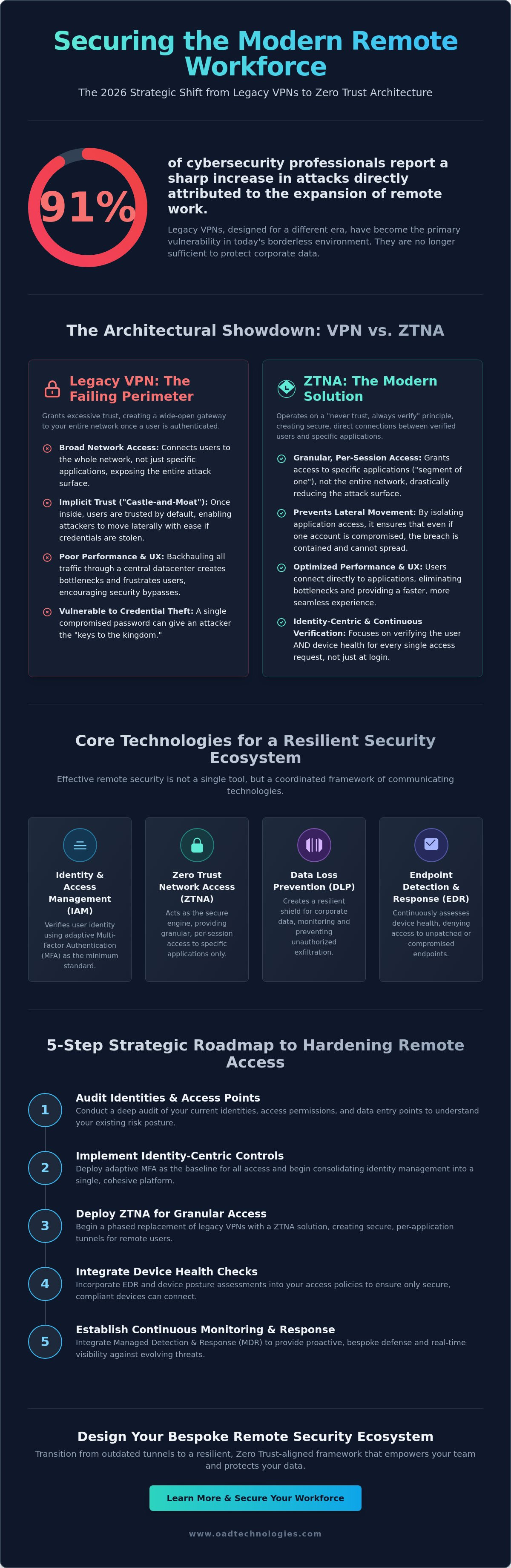
91% of cybersecurity professionals report a sharp increase in attacks directly attributed to the expansion of remote work. If you're still relying on legacy VPNs to manage your borderless environment, you've likely noticed they're no longer sufficient. These aging systems are often slow, vulnerable to credential theft, and unable to effectively govern unmanaged personal devices accessing sensitive applications. Securing remote workforce access in 2026 has evolved into a strategic imperative that demands a shift from perimeter-based connectivity to a sophisticated, identity-centric architecture.
We agree that a robust security posture shouldn't hinder the momentum of your team. This article provides a roadmap to help you transition from outdated tunnels to a resilient, Zero Trust-aligned framework that protects corporate data without compromising the user experience. You'll discover how to build a scalable architecture that incorporates the latest NIST CSF 2.0 standards, ensuring your hybrid operations remain compliant and secure. We'll examine the specific steps needed to reduce your attack surface while empowering your employees to work from anywhere with total confidence.
Key Takeaways
- Shift your strategy from perimeter-based connectivity to an identity-centric model that eliminates the lateral movement risks found in legacy VPNs.
- Explore how a holistic ecosystem of Identity and Access Management (IAM) and Data Loss Prevention (DLP) creates a resilient shield for your corporate data.
- Master the five-step strategic roadmap for securing remote workforce access, beginning with a deep audit of your current identities and access points.
- Compare the performance and security benefits of Zero Trust Network Access (ZTNA) against traditional architectures to ensure granular, per-session control.
- Learn how integrating Managed Detection and Response (MDR) with your core security framework provides a proactive, bespoke defense against evolving 2026 threats.
The 2026 Remote Landscape: Why Legacy Access Models are Failing
The Vulnerability of the 'Always-On' VPN
Many enterprises still rely on legacy Virtual Private Networks (VPNs) to bridge the gap between remote workers and corporate resources. While these tools once served a purpose, they weren't designed for the permanence of today's hybrid models. VPNs often grant excessive trust once a user is authenticated, providing broad access to the entire network segment. This creates a "castle-and-moat" vulnerability where a single compromised credential allows an attacker to roam freely. Lateral movement remains the primary risk of legacy remote access. Additionally, the performance bottlenecks caused by backhauling all traffic to a central data center frustrate employees and often lead them to bypass security measures entirely.
BYOD and the Shadow IT Challenge
The rise of Bring Your Own Device (BYOD) policies has introduced a complex layer of unmanaged hardware into the corporate ecosystem. When employees use personal laptops or smartphones to access corporate SaaS applications, it creates significant visibility gaps for IT teams. You can't protect what you can't see. These unmanaged devices often lack necessary security patches, making them easy targets for sophisticated credential-based attacks. Securing remote workforce access requires a strategy that balances individual privacy with the need for deep visibility into every access request. Without this balance, shadow IT flourishes as users adopt unauthorized third-party tools that simplify their workflow but expose the business to severe data breaches.
Cybercriminals have refined their tactics, moving away from brute-force attempts toward highly targeted social engineering and session hijacking. In 2026, a stolen session token can be just as damaging as a leaked password. For IT leaders, securing remote workforce access isn't just about encryption; it's about continuous authentication and real-time risk assessment. We see this shift as an opportunity to move beyond standardized security and design a bespoke infrastructure that empowers people while safeguarding every digital interaction.
Core Technologies for Securing Remote Workforce Access
Effective security in 2026 requires more than a single tool. It demands a coordinated ecosystem where different technologies communicate in real time to validate every request. We define secure remote access as the convergence of Identity and Access Management (IAM), Data Loss Prevention (DLP), and Zero Trust Network Access (ZTNA). This integrated approach ensures that securing remote workforce access isn't just about allowing a connection, but about governing the entire lifecycle of a user's interaction with corporate data.
Zero Trust Network Access (ZTNA) serves as the engine of this framework. Unlike legacy systems that trust a user once they enter the network, ZTNA provides granular, per-session access. It creates an encrypted "segment of one" between the user and a specific application. This isolation prevents lateral movement and ensures that if one account is compromised, the damage is contained. To support this, Multi-Factor Authentication (MFA) has transitioned from a luxury to the absolute minimum entry requirement for securing remote workforce access. We recommend adaptive MFA, which adjusts the level of verification based on risk factors like location or time of day.
Verifying the user is only half the battle. We must also verify the device. By integrating Endpoint Detection and Response (EDR), organizations can assess device health before granting access. If a remote laptop lacks current patches or shows signs of malware, the system can automatically deny access or quarantine the session. This proactive stance ensures that compromised hardware doesn't become a gateway into your environment.
Identity and Access Management (IAM) as the Foundation
A resilient security posture starts with knowing exactly who is on your network. Implementing the Principle of Least Privilege (PoLP) ensures that remote users only have access to the specific resources required for their roles. This limits the potential blast radius of any security incident. Additionally, leveraging Single Sign-On (SSO) reduces the attack surface by eliminating the need for multiple sets of credentials. You can explore our deep dive into the identity and access management framework to see how these policies scale for enterprise needs.
Data Loss Prevention (DLP) for the Borderless Office
When employees work from various locations, data often moves across unmanaged networks. Robust data loss prevention policies are essential to prevent sensitive information from being exfiltrated from remote endpoints. These tools monitor data in motion, securing file transfers and cloud uploads while identifying unauthorized attempts to move intellectual property. DLP acts as the final safety net for remote access by ensuring that even if a session is authorized, the data itself remains governed. If you're looking to refine your current strategy, a comprehensive vulnerability assessment can help identify gaps in your existing remote access architecture.
VPN vs. ZTNA: Choosing the Right Architecture for Your Enterprise
Deciding between a legacy Virtual Private Network (VPN) and Zero Trust Network Access (ZTNA) isn't merely a technical choice. It's a strategic pivot that determines your organization's long-term resilience. While VPNs provided the initial foundation for securing remote workforce access, they often fail to meet the demands of modern, distributed environments. VPNs operate on a principle of broad network trust, which is inherently risky. Once a user clears the gate, they often have visibility into the entire subnet. ZTNA, by contrast, adopts a "never trust, always verify" stance, granting access only to specific applications rather than the whole network. This shift reduces your attack surface by making internal resources invisible to unauthorized users.
Technical Comparison: Access Control and Visibility
VPNs provide network-level access, which often results in limited visibility into what a user does once they're connected. This lack of granular logging makes it difficult to detect anomalous behavior until it's too late. ZTNA offers application-level access, providing deep visibility into every session. This granular control doesn't just improve security; it optimizes the user experience. By connecting users directly to the applications they need, you eliminate the "frustration factor" caused by high latency and dropped VPN connections. Your team stays productive, and your security team gains the telemetry needed to make informed decisions.
Transitioning to a Zero Trust Model
Most enterprises won't abandon their existing infrastructure overnight. A hybrid approach allows you to manage the transition while maintaining business continuity. We recommend starting with a baseline audit of your current environment. Conducting a comprehensive vulnerability assessment and penetration testing (VAPT) helps identify which legacy access points are most at risk. Once you've identified these high-risk assets, you can prioritize them for immediate ZTNA migration. This phased implementation ensures that securing remote workforce access remains a controlled, manageable process rather than a disruptive overhaul. By slowly offloading applications from the VPN to a Zero Trust framework, you build a resilient ecosystem that supports the future of work.
A Strategic Roadmap: 5 Steps to Hardening Remote Access
Transitioning from a legacy model to a hardened architecture isn't an overnight task. It requires a deliberate, step-by-step approach that aligns technical controls with business objectives. By following a structured roadmap, organizations can systematically close the gaps that attackers exploit. This ensures that securing remote workforce access becomes a core operational strength rather than a lingering liability.
- Step 1: Audit Remote Access Points and User Identities. Begin by mapping every entry point into your network, including legacy portals, cloud gateways, and third-party integrations.
- Step 2: Implement Adaptive MFA and Robust IAM Policies. Move beyond static passwords. Use risk-based authentication that evaluates the context of every login attempt.
- Step 3: Deploy Unified Endpoint Security (EDR). Monitor the integrity of every device connecting to your resources to prevent infected hardware from compromising the network.
- Step 4: Establish DLP Rules for Remote Connections. Define clear policies for how data can be moved, shared, or stored by off-site employees.
- Step 5: Ensure Continuous Monitoring. Leverage managed detection and response (MDR) to provide 24 X 7 oversight of your remote environment.
Step 1 & 2: Identity and Access Hardening
Auditing dormant or "ghost" accounts is a critical first step. These forgotten credentials often serve as the path of least resistance for threat actors. Once you've cleaned your directory, implement risk-based conditional access. This means authentication requirements change based on location, time of day, or device health. Effective governance risk and compliance (GRC) plays a vital role here. It provides the policy framework that dictates who should have access to what, ensuring your technical controls align with both regulatory mandates and internal risk appetites.
Step 5: The Role of Continuous Visibility
A secure architecture is only effective if you can see what's happening within it. Integrating your access logs into a siem platform allows for real-time threat detection across the entire enterprise. MDR teams use this data to identify anomalous behavior, such as a user suddenly accessing sensitive files at 3:00 AM from an unusual IP address. This approach creates a powerful synergy between human expertise and AI-driven monitoring. While AI identifies patterns at scale, human analysts provide the strategic context needed to respond to sophisticated threats. If you're ready to begin this journey, contact our security architects to design your customized roadmap for securing remote workforce access.
OAD Technologies: Designing Bespoke Remote Security Ecosystems
Standardized security solutions often fail because they ignore the unique architectural nuances of your business. At OAD Technologies, we reject the "one-size-fits-all" approach in favor of highly customized, resilient frameworks. Securing remote workforce access requires more than just deploying tools; it demands a master designer who can weave disparate technologies into a single, cohesive shield. We act as your strategic partner, ensuring that every component of your security stack works in synergy to protect your most valuable digital assets.
Our methodology focuses on the convergence of Identity and Access Management (IAM), Data Loss Prevention (DLP), and Managed Detection and Response (MDR). By integrating these functions, we eliminate the silos that often lead to visibility gaps. This unified framework doesn't just block unauthorized entries; it monitors the entire lifecycle of data as it moves through your distributed environment. For UAE-based organizations, this level of precision is essential for maintaining long-term digital relevance and complying with regional data sovereignty mandates.
Our Specialized Remote Access Solutions
We provide the technical authority needed to solve complex digital challenges. Our team focuses on three core areas to ensure your remote environment is impenetrable yet productive:
- Customized IAM and ZTNA: We design identity-centric architectures tailored to your specific infrastructure. This ensures the Principle of Least Privilege is enforced across every session, effectively neutralizing the risk of lateral movement.
- Advanced DLP Configurations: Our experts implement granular policies to protect sensitive UAE corporate assets. We ensure that data remains governed even when accessed from unmanaged remote endpoints or personal devices.
- Proactive Threat Hunting: Through our Managed Detection and Response (MDR) services, we provide 24 X 7 oversight. We don't just wait for alerts; we actively hunt for anomalous behavior to stop threats before they impact your operations.
A Partnership for Strategic Expansion
We believe that security should be an enabler of growth, not a barrier to it. OAD Technologies empowers your workforce by providing a seamless, high-performance user experience backed by rigorous engineering standards. We bridge the gap between high-level innovation and practical business results, turning complex security challenges into strategic advantages. This proactive mindset ensures your organization remains agile as you expand into new markets. Our commitment to long-term viability means we don't just solve today's problems; we help you shape a secure future. Contact OAD Technologies to secure your remote workforce access today.
Building a Resilient Infrastructure for the Distributed Era
The shift toward a permanent hybrid model demands a departure from the "castle-and-moat" security strategies of the past. Identity is now the true perimeter. Success in 2026 depends on your ability to replace broad network trust with granular, application-level control. By integrating continuous monitoring with robust data governance, you create an environment where security empowers rather than obstructs your workforce. Securing remote workforce access isn't just a technical requirement; it's the foundation of your organization's long-term digital relevance.
As a Dubai-based cybersecurity partner, OAD Technologies offers the master-level design needed to build these complex ecosystems. Our specialized GRC and VAPT services provide the baseline for a strategy that includes comprehensive DLP and MDR integration. We don't just deploy tools. We architect bespoke solutions that bridge the gap between high-level innovation and practical results. Secure Your Remote Workforce with OAD Technologies' Strategic Solutions today. Your team's future is built on the strength of the systems you design now, and we're ready to help you lead the way.
Frequently Asked Questions
What is secure remote access and why is it important for 2026?
Secure remote access is the strategic combination of technology and policy that allows off-site employees to connect to corporate resources safely. It's critical in 2026 because the traditional perimeter has dissolved, and 91% of cybersecurity professionals report a surge in attacks targeting remote environments. This framework ensures your team remains productive while protecting sensitive data from sophisticated, credential-based threats.
Is a VPN enough to secure a remote workforce in the current threat landscape?
No, a standard VPN is no longer enough to protect a modern enterprise. Legacy tunnels often grant broad network-level access, allowing attackers to move laterally once they bypass the initial gate. In the current threat landscape, securing remote workforce access requires a shift toward identity-centric models that verify every user and device request individually rather than trusting the connection.
How does Zero Trust Network Access (ZTNA) differ from a traditional VPN?
ZTNA differs from a traditional VPN by providing application-specific access instead of broad network entry. A VPN trusts a user once they're connected to the tunnel, but ZTNA follows the "never trust, always verify" principle. It creates an encrypted session directly between the user and the application, keeping the rest of the network invisible and secure from lateral movement.
What role does Data Loss Prevention (DLP) play in remote work security?
DLP serves as the final safety net by monitoring and governing the movement of sensitive information. It prevents unauthorized data exfiltration during remote sessions by identifying and blocking high-risk file transfers. This ensures that even if an access point is authorized, the data itself remains protected from being moved to unmanaged cloud storage or personal devices.
How can I secure remote access for employees using personal devices (BYOD)?
To secure BYOD access, you should implement Endpoint Detection and Response (EDR) to verify device health before granting a connection. Combining this with ZTNA allows you to isolate the user's session, ensuring that unmanaged hardware only interacts with specific applications. This approach protects corporate assets without requiring full control over an employee's personal device or compromising their privacy.
What are the common challenges when implementing secure remote access?
Organizations frequently struggle with visibility gaps and the technical complexity of migrating away from legacy systems. Another major challenge is the "frustration factor," where overly restrictive security measures hinder employee productivity. Overcoming these hurdles requires a bespoke approach that integrates IAM and DLP into a single, high-performance framework that balances rigorous engineering with a seamless user experience.
How does Multi-Factor Authentication (MFA) improve remote security?
MFA improves security by adding layers of verification beyond simple passwords, which are easily compromised. Modern adaptive MFA evaluates contextual signals like login location, time of day, and device integrity. This ensures that securing remote workforce access remains resilient even if a user's primary credentials are stolen, as the system will demand additional proof based on the risk level.
Why is continuous monitoring (MDR) necessary for a remote workforce?
Continuous monitoring through MDR is essential because automated defenses can't catch every sophisticated threat. MDR teams provide human-led threat hunting, identifying anomalous behavior in remote sessions that might signal a breach. This proactive oversight is vital for a distributed workforce where access patterns are varied, ensuring that your organization's digital relevance is never compromised by an undetected intrusion.
Disclaimer
Content by OAD Technologies is for general informational purposes only and does not constitute professional or cybersecurity advice. No warranties are made regarding accuracy or completeness; reliance is at your own risk. OAD Technologies shall not be liable for any direct or indirect losses arising from use of this content.