
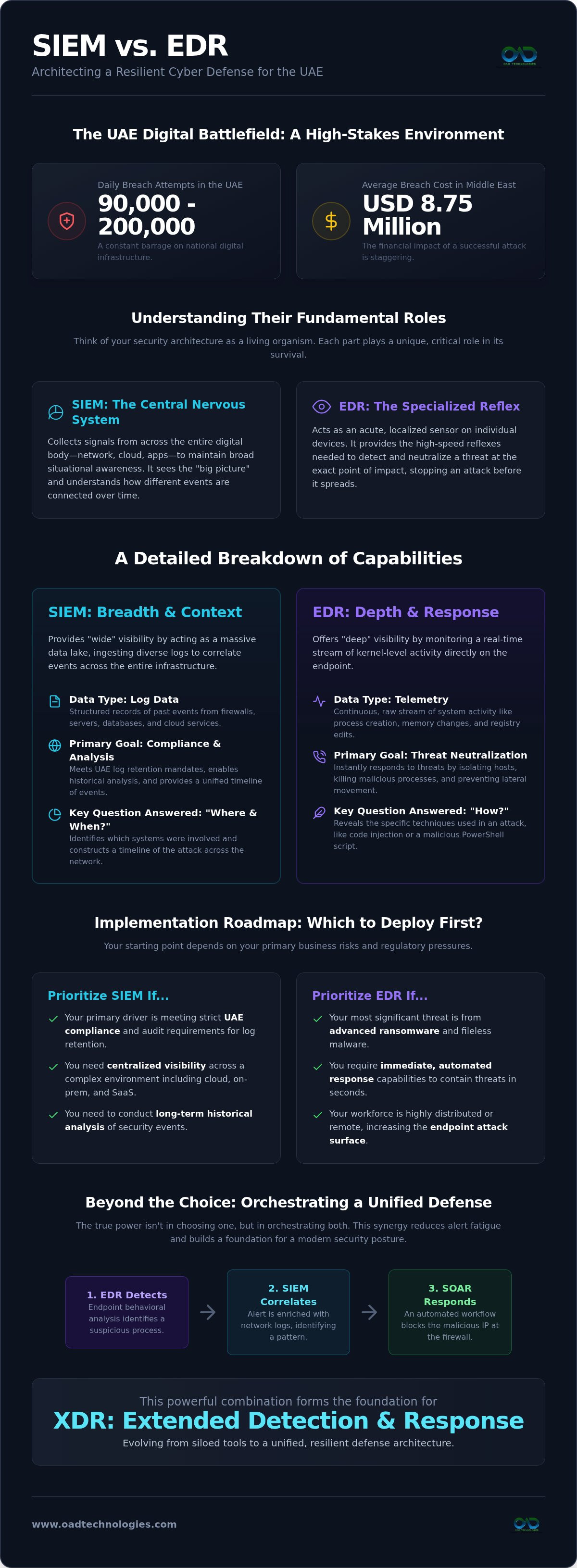
With the UAE's digital infrastructure facing between 90,000 and 200,000 breach attempts every single day in 2026, the debate over siem vs edr has shifted from a matter of preference to a critical architectural decision. You're likely already feeling the strain of alert fatigue from disconnected tools while facing immense pressure to align with UAE national compliance standards. It's exhausting to manage complex SOC tools when your internal resources are already stretched thin and the cost of a data breach in the Middle East has reached an average of USD 8.75 million.
This guide will clarify the technical distinctions and strategic roles of each solution, helping you determine the optimal deployment sequence for your specific enterprise needs. We'll provide a clear decision-making framework to integrate these technologies, ensuring your security posture remains resilient and compliant with the latest UAE regulations. We're going to explore how to bridge the gap between high-level innovation and practical business results, turning these individual tools into a cohesive, managed defense system that empowers your team rather than just replacing your processes.
Key Takeaways
- Understand why SIEM acts as the central nervous system for enterprise compliance while EDR provides the specialized, deep visibility required for rapid response at the device level.
- Identify the fundamental differences in siem vs edr data methodologies to determine if your 2026 strategy requires broad infrastructure oversight or granular endpoint protection first.
- Develop a structured implementation roadmap based on your organization's primary threat surface and specific UAE regulatory mandates for log retention and data sovereignty.
- Discover how to orchestrate both solutions into a unified defense architecture to reduce alert fatigue and evolve toward a more resilient Extended Detection and Response (XDR) model.
- Learn how a managed approach bridges the gap between complex security architectures and practical business results, ensuring your technology stack remains aligned with national standards.
Understanding the Fundamental Roles of SIEM and EDR
In 2026, a fragmented security posture is a significant liability. Think of your security architecture as a living organism. Security Information and Event Management (SIEM) serves as the central nervous system, collecting signals from across the entire body to maintain situational awareness. Meanwhile, Endpoint Detection and Response (EDR) acts as a specialized sensor, providing the acute, localized reflexes needed to stop a threat at the point of impact. Understanding the technical nuances of siem vs edr is essential for building a defense that doesn't just see threats but actively neutralizes them before they escalate.
The core distinction lies in the type of data they process. SIEM focuses on log data, which are structured records of events that have occurred across your network. EDR captures telemetry, a continuous stream of raw system activity from the device level. For modern threats like advanced ransomware, this difference is the gap between knowing you were breached and stopping the encryption process in its tracks.
The Scope of Security Information and Event Management (SIEM)
SIEM platforms excel at breadth. They ingest log data from firewalls, servers, databases, and cloud environments to create a unified timeline of events. This cross-stack aggregation is vital for historical analysis and meeting the strict log retention requirements mandated by UAE national standards. Modern Next-Gen SIEM has evolved beyond simple log storage. It now incorporates User and Entity Behavior Analytics (UEBA), which uses machine learning to identify anomalies that traditional rule-based systems might miss. It's the primary tool that proves you're compliant while giving you the "big picture" of your network's health.
The Depth of Endpoint Detection and Response (EDR)
If SIEM is the wide-angle lens, EDR is the microscope. It focuses exclusively on the endpoint, monitoring processes, memory, and registry changes on laptops and servers. Unlike traditional antivirus that relies on known signatures, EDR uses behavioral detection to spot the "living off the land" techniques common in sophisticated attacks. The "Response" in EDR is its defining feature. It empowers your team to isolate a compromised host or kill a malicious process instantly. This granular control is what prevents a single infected device from turning into a full-scale enterprise breach. When evaluating siem vs edr, remember that EDR provides the immediate tactical response that SIEM lacks.
SIEM vs. EDR: A Detailed Breakdown of Capabilities
Navigating the siem vs edr debate in 2026 requires looking beyond surface definitions to analyze how these tools process information. SIEM provides "wide" visibility, acting as a massive data lake that ingests diverse logs from SaaS applications, network hardware, and identity providers. This broad aggregation aligns with Gartner's definition of SIEM, which focuses on the correlation of events from disparate sources to uncover complex attack chains. In contrast, EDR offers "deep" visibility, functioning as a real-time stream of kernel-level telemetry and file system changes occurring specifically on the endpoint.
Data Collection: Breadth vs. Depth
The distinction in data processing is stark. SIEM correlates structured logs to find patterns, such as a login from an unusual IP followed by a firewall rule change. EDR monitors raw system activity, such as a PowerShell script attempting to inject code into a legitimate process. SIEM tells you who entered the building; EDR tells you what they did once they opened a laptop. This depth is critical because EDR captures the "how" of an attack, while SIEM captures the "where" and "when" across your entire digital estate. Relying on one without the other leaves significant blind spots in your visibility.
Incident Response and Remediation Capabilities
Response speed is where EDR excels. It offers immediate, automated actions like isolating a host from the network or rolling back a malicious file change. These localized reflexes prevent lateral movement in seconds. SIEM provides the necessary context for multi-stage investigations that span multiple days or systems. It often triggers Security Orchestration, Automation, and Response (SOAR) workflows, allowing your team to block a malicious domain at the firewall level based on an endpoint alert. This synergy ensures that a localized threat detected by EDR informs your global defense strategy.
Without proper orchestration, both systems can contribute to significant alert fatigue. Managing these high-volume streams requires a disciplined approach to rule tuning and false-positive reduction. Designing a customized architecture that balances these capabilities is essential for long-term resilience, a process where OAD Technologies provides strategic guidance. By treating these tools as a unified system rather than isolated silos, you ensure that your security investments deliver maximum ROI while maintaining strict compliance with UAE standards.
The Implementation Roadmap: Which Should You Deploy First?
Choosing between siem vs edr as your first line of investment isn't about which tool is "better" in a vacuum. It's about which one addresses your most immediate vulnerability in 2026. For organizations with a highly distributed workforce, EDR often provides the fastest time-to-value by securing the laptops that move beyond the corporate firewall. Conversely, for those managing critical infrastructure or sensitive data within the UAE, the requirement for centralized oversight often makes SIEM the logical starting point. Your roadmap should balance tactical protection with long-term strategic resilience.
Step 1: Assessing Your Organizational Risk Profile
Start by mapping your critical assets. If your primary threat surface consists of cloud-based workloads and mobile endpoints, EDR provides the granular visibility needed to stop process-level attacks. Analyze your past incident reports. If visibility gaps occurred at the device level, prioritize EDR. This assessment should integrate with your broader Identity and Access Management (IAM) strategy, as compromised credentials often lead to endpoint activity that EDR is uniquely positioned to catch.
Step 2: Aligning with UAE Regulatory Compliance
Compliance is often the deciding factor in the siem vs edr prioritization. National regulations like NESA and SIA mandate strict log retention and incident reporting timelines. SIEM acts as the definitive source of truth for these audits, aggregating data from firewalls, servers, and applications that EDR doesn't touch. If your organization operates within critical sectors, you can't ignore the long-term log management requirements. For a comprehensive alignment with these standards, consult our GRC Pillar to ensure your tool selection supports national compliance.
SOC Maturity and Operational Reality
Be honest about your internal resources. A SIEM is a powerful engine, but it requires a mature SOC team to tune rules and manage the data lake. If your team is small, an unmanaged SIEM can quickly lead to crippling alert fatigue. EDR is generally easier to operationalize quickly. However, the most resilient enterprises in 2026 recognize that managing these complex systems requires a strategic partner. OAD Technologies bridges this gap, providing the expertise to manage these tools so your team can focus on core business objectives. It's about finding the synergy between human insight and technological capacity to ensure long-term viability.
Beyond the Choice: Orchestrating SIEM and EDR for Unified Defense
The debate of siem vs edr often implies a binary choice, but true enterprise resilience in 2026 stems from their orchestration. When these tools operate in silos, they generate noise. When integrated, EDR telemetry enriches SIEM logs, providing the granular evidence needed to validate broad network anomalies. This synergy is the foundation of Extended Detection and Response (XDR), a model that breaks down data silos to provide a unified security narrative. Managing this output requires a sophisticated Managed Detection and Response (MDR) framework to ensure that high-fidelity alerts don't get lost in the volume of raw data.
Strategic integration also extends to Data Loss Prevention (DLP). By feeding DLP events into your SIEM and correlating them with EDR activity, you can identify if a sensitive file transfer was a legitimate business process or an exfiltration attempt by a compromised endpoint. This cross-tool visibility ensures your data remains protected even as threats evolve.
The Power of Correlation: Turning Logs into Intelligence
Intelligence isn't just about collecting data; it's about connecting it. Imagine your IAM system flags a failed login attempt from an unusual geographic location. On its own, this might be a minor alert. However, if your EDR simultaneously detects an unauthorized process execution on an executive's laptop, the correlation signals a high-priority breach. This integrated workflow drastically reduces your Mean Time to Detect (MTTD). While automation handles the initial heavy lifting, human insight remains essential to refine these correlation rules and validate complex threats that bypass standard logic.
Building a Resilient Security Operations Center (SOC)
A modern SOC in 2026 cannot function effectively with only one of these tools. The choice of siem vs edr shouldn't be a competition for budget but a strategy for coverage. The shift from reactive log monitoring to proactive threat hunting requires both the wide visibility of SIEM and the deep forensic capabilities of EDR. To ensure your stack is performing as expected, utilize VAPT to simulate real-world attacks. These tests reveal where your correlation rules might be weak or where your endpoint sensors are failing to trigger.
Choosing the right tools is only half the battle; the real value lies in how they are managed and integrated into your unique business context. For a security architecture that transforms technical complexity into operational performance, partner with OAD Technologies to design your managed defense.
Strategic Security with OAD Technologies: Managed SIEM and EDR
The technical nuances of the siem vs edr debate often mask a fundamental business reality: tools alone don't provide security; orchestration does. OAD Technologies acts as a master designer of systems, moving beyond the simple provision of software to create highly customized architectures. We reject standardized, one-size-fits-all security models in favor of strategies that reflect your specific risk profile and operational goals. Our role is to bridge the gap between high-level innovation and practical business results, ensuring your organization remains resilient in a 2026 threat environment where infrastructure experiences up to 200,000 breach attempts daily.
Our approach is grounded in the belief that security should be a strategic partnership. We don't just deploy tools; we manage the inherent complexity of modern SOC environments so you don't have to. By positioning OAD as an extension of your own team, we provide a proactive mindset backed by rigorous engineering standards. This ensures that your investment in security technology translates directly into operational performance and strategic expansion, rather than becoming another source of management burden.
The OAD Advantage: Human-Centric Managed Security
Technology is a force multiplier, but human insight remains the definitive line of defense. OAD empowers your internal team by filtering the overwhelming noise of raw telemetry and delivering only actionable intelligence. This approach combines the expertise of our EDR specialists with our Managed SIEM professionals to build a proactive hunting environment. We focus on long-term viability and digital relevance, specifically tailored to the UAE's unique regulatory landscape. Our local expertise ensures that your security stack isn't just a cost center but a strategic asset that aligns with NESA and SIA requirements.
Next Steps: Securing Your Digital Future
A successful security transformation begins with a rigorous technical assessment, not a purchase order. Before acquiring new tools, it's essential to understand where your current visibility ends and your vulnerabilities begin. OAD specializes in integrating SIEM, EDR, and DLP into a cohesive, managed defense system that protects your data at rest, in motion, and at the point of interaction. This unified approach eliminates the silos that attackers exploit to hide their lateral movement. Contact OAD Technologies today for a strategic consultation on your national security compliance needs and take the first step toward a more resilient, future-proof enterprise architecture.
Mastering Your Enterprise Defense Architecture
The choice in the siem vs edr debate isn't about selecting a winner; it's about architecting a layered defense that balances broad visibility with deep, localized reflexes. You've seen how SIEM provides the essential log aggregation required for UAE national compliance, while EDR offers the granular detection needed to stop modern ransomware at the endpoint. True resilience in 2026 requires moving beyond these individual tools to achieve a state of orchestrated synergy where human insight and automated detection work in tandem.
Building this level of sophistication doesn't have to be a solo journey. By leveraging a managed approach, you can eliminate the burden of alert fatigue and ensure your infrastructure meets the rigorous standards of NESA and SIA. OAD Technologies brings Red Dot level design to security architecture, providing a managed SOC with 24 X 7 response capabilities and deep UAE regulatory expertise to ground your technology in practical business results.
Consult with OAD Technologies for a customized SIEM and EDR strategy to secure your digital future. Your organization's long-term viability starts with a proactive, tailored defense that evolves as fast as the threats you face.
Frequently Asked Questions
Do I need a SIEM if I already have an EDR solution?
Yes, you still need a SIEM because EDR provides visibility only at the device level. While EDR is exceptional for stopping threats on laptops and servers, it cannot see activity on your firewalls, cloud infrastructure, or identity providers. A SIEM aggregates logs from these disparate sources to detect multi-stage attacks that span your entire network. Without a SIEM, you lack the centralized "source of truth" required for comprehensive visibility and historical compliance auditing across your digital estate.
How does EDR differ from traditional antivirus software?
EDR differs from traditional antivirus by focusing on behavioral detection rather than static signatures. Traditional antivirus software compares files against a database of known threats, which often fails against zero-day attacks. EDR monitors system telemetry in real-time to identify suspicious patterns, such as unauthorized process injections or lateral movement. It also provides response capabilities like host isolation and file rollback, allowing your security team to actively neutralize threats that have already bypassed initial perimeter defenses.
Can SIEM and EDR be integrated into a single platform?
Yes, SIEM and EDR can be integrated to create a more resilient security architecture. This integration allows EDR telemetry to enrich SIEM alerts, significantly reducing false positives by providing granular context. In 2026, many organizations achieve this through Extended Detection and Response (XDR) models or by utilizing open APIs to feed endpoint data directly into a centralized data lake. This synergy ensures that a localized endpoint alert can automatically trigger broader defensive actions across your network firewalls and cloud workloads.
What are the main benefits of using a Managed Security Service Provider (MSSP) for SIEM and EDR?
The primary benefit of an MSSP is the reduction of operational complexity and the elimination of alert fatigue. Managing the siem vs edr output requires specialized expertise that many internal teams lack. An MSSP like OAD Technologies provides 24 X 7 monitoring, proactive threat hunting, and expert rule tuning. This ensures that your security tools are always optimized for your specific risk profile. It also bridges the gap between technical innovation and practical business results without the overhead of building an in-house SOC.
How do SIEM and EDR help with UAE national compliance standards?
SIEM and EDR are foundational for meeting UAE national compliance standards like NESA and SIA. SIEM addresses the strict requirements for long-term log retention and centralized auditing, acting as the definitive record for compliance inspections. EDR supports these standards by providing the detailed incident reporting and rapid response capabilities necessary to mitigate risks to critical information infrastructure. Together, they ensure that your organization maintains digital relevance while adhering to the specific data sovereignty and reporting mandates of the UAE.
What is the difference between EDR and XDR in 2026?
In 2026, the difference lies in the scope of data ingestion. EDR is a specialized tool that focuses exclusively on endpoint activity. XDR, or Extended Detection and Response, is the evolution of this technology. It breaks down data silos by integrating telemetry from endpoints, network traffic, cloud workloads, and email security into a single pane of glass. While EDR provides deep visibility into devices, XDR offers a holistic view of the entire attack chain, allowing for coordinated responses across different security layers.
Is EDR effective against advanced ransomware attacks?
EDR is highly effective against advanced ransomware because it detects the behavioral indicators of an attack rather than just the file signature. It monitors for suspicious activities like unauthorized volume shadow copy deletion or rapid file encryption. Once these patterns are identified, EDR can automatically isolate the infected host to prevent the ransomware from spreading laterally through your network. This proactive response is critical in 2026, where ransomware attacks have become increasingly coordinated and multi-step in their execution.
How much data does a typical SIEM require for effective threat detection?
The effectiveness of a SIEM depends more on the diversity of data than the sheer volume. For robust threat detection, a SIEM requires logs from your firewalls, identity providers, cloud environments, and endpoint sensors. While data volumes vary based on enterprise size, the focus should be on high-fidelity logs that represent critical touchpoints. In the context of siem vs edr orchestration, feeding EDR telemetry into the SIEM ensures you have the necessary depth to validate network-level anomalies with device-level proof.
Disclaimer
Content by OAD Technologies is for general informational purposes only and does not constitute professional or cybersecurity advice. No warranties are made regarding accuracy or completeness; reliance is at your own risk. OAD Technologies shall not be liable for any direct or indirect losses arising from use of this content.