
With nearly half of cybersecurity leaders recently exiting their roles due to work-related stress, it's clear the true crisis isn't just technical. The emotional impact of a data breach on a company creates a ripple effect that persists long after the 241-day average lifecycle of an incident has ended. You likely recognize the immediate panic of a breach, but the long-term erosion of trust between departments and the resulting leadership burnout are often the most difficult costs to recover from.
Discover how data breaches traumatize organizations beyond financial loss and how to build emotional resilience through strategic security. We'll examine the psychological toll on your IT teams, the mechanics of organizational trauma, and how sophisticated tools like Managed Detection and Response (MDR) can serve as a foundation for employee peace of mind. By shifting your perspective from mere compliance to human-centric protection, you can transform security into a pillar of stability rather than a source of constant anxiety.
Key Takeaways
- Identify why a cybersecurity incident is a psychosocial event that shatters internal stability and transforms technical glitches into perceived personal failures.
- Explore the "Second Victim Syndrome" affecting IT teams and the specific strategies needed to prevent leadership burnout during high-stress recovery windows.
- Evaluate the emotional impact of a data breach on a company, focusing on the "Paranoia Effect" that damages employee productivity and internal trust.
- Learn to build a human-first incident response plan that leverages governance, risk, and compliance (GRC) to reduce organizational uncertainty.
- Position your security strategy as a tool for peace of mind by partnering with experts who prioritize both technical excellence and emotional resilience.
Defining the Organizational Trauma of a Cybersecurity Breach
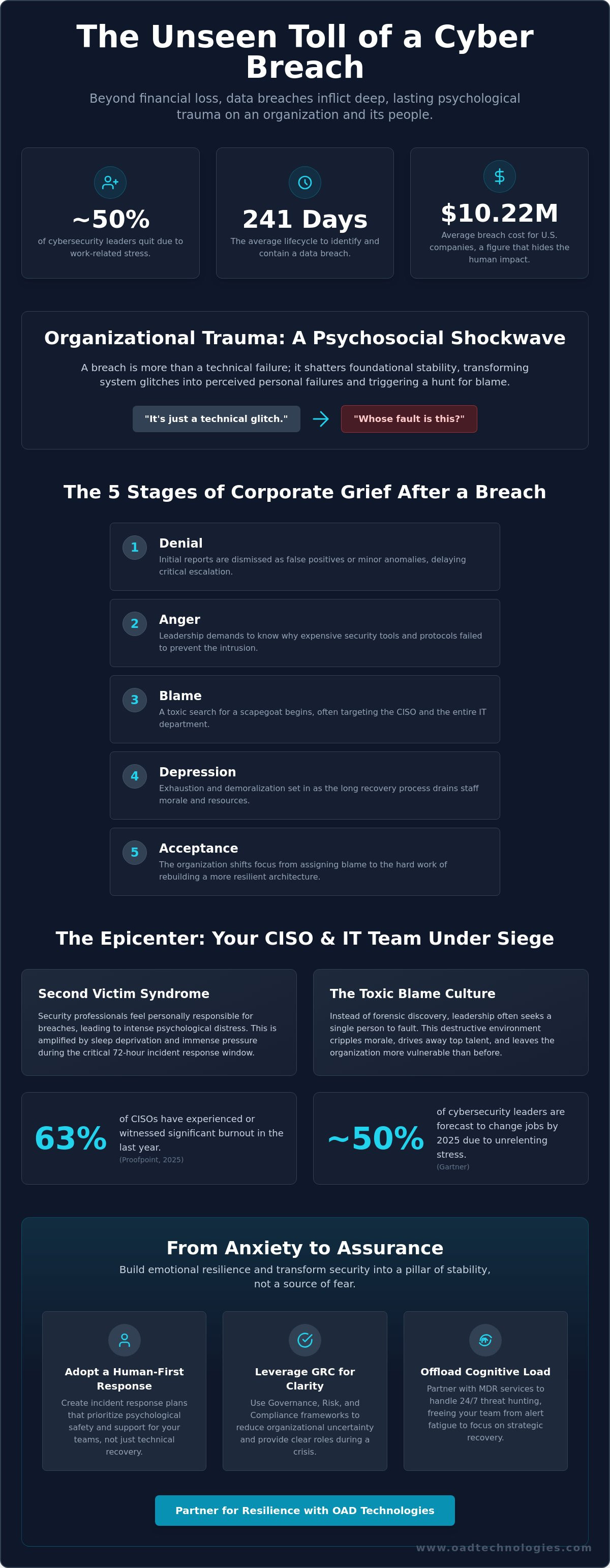
Cybersecurity incidents are often quantified by the average $10.22 million cost seen in the United States in 2025; however, these figures fail to capture the collective shock that follows a system compromise. When a network is violated, the organization enters a state of organizational trauma. This isn't merely a technical disruption; it's a sudden loss of the foundational stability that allows a workforce to function. The shift from seeing a "technical glitch" to a "personal failure" happens almost instantly. Stakeholders, from the board to the junior staff, stop looking at logs and start looking for a culprit to blame for their newfound vulnerability.
Recovery is rarely linear. Most companies move through five distinct stages of corporate grief after a breach is discovered:
- Denial: Initial reports are dismissed as false positives or minor anomalies that don't require escalation.
- Anger: Leadership demands to know why expensive security stacks failed to stop the intrusion.
- Blame: A toxic search for a scapegoat begins, often targeting the IT team or the CISO.
- Depression: Realization sets in as the average 241-day lifecycle of identifying and containing a breach begins to exhaust the staff.
- Acceptance: The organization finally stops looking backward and begins the hard work of rebuilding a more resilient architecture.
Organizational trauma is a psychosocial risk that impacts long-term productivity.
The Shift from Technical to Human Loss
The emotional impact of a data breach on a company often mirrors a personal bereavement for its founders and long-tenured executives. Their professional reputation, built over decades, can feel dismantled overnight by a single phishing link. This loss is compounded by public scrutiny. Under the 2026 California Data Breach Notification Law, businesses must notify residents within 30 days, forcing a private crisis into the public eye. When employees feel the weight of this public shame, it impacts their identity and pride. This "shame factor" is dangerous; it creates a culture where staff hide future mistakes to avoid further embarrassment, significantly increasing the risk of recurring incidents.
The Anatomy of a Corporate Identity Crisis
A breach creates profound cognitive dissonance. When the internal mantra of "we are a secure company" is proven false, the social contract between leadership and staff begins to fray. Employees may feel that the company failed to protect their own biometric or government identification data, especially given the expanded definitions in the 2026 Oklahoma Data Breach Notification Law. This breakdown leads to a crisis of confidence where staff no longer trust the tools or the people managing them. Long-term brand protection is not just about external perception; it's about maintaining the internal belief that the company's digital evolution is grounded in safety. Without that belief, strategic expansion slows, and decision paralysis becomes the new operational standard.
The CISO and IT Team: Managing Burnout and Blame
While the financial ledger records the losses, the emotional impact of a data breach on a company is most visible in its server rooms and executive suites. Security professionals often suffer from "Second Victim Syndrome," a psychological state where they feel personally responsible for a breach, regardless of the actual cause. This burden is amplified during the critical 72-hour incident response window. During this time, analysts face sleep deprivation and intense pressure to contain the threat. According to a 2025 Proofpoint report, 63% of CISOs have experienced or witnessed burnout in the last year. Gartner even forecasts that nearly half of cybersecurity leaders will change jobs by 2025 due to this unrelenting stress.
When a breach occurs, a toxic "Blame Culture" often takes root. Instead of focusing on forensic discovery, leadership may look for a single person to fault. This environment drives away top-tier talent, leaving the organization more vulnerable than before. Implementing managed detection and response (MDR) is a strategic way to reduce this cognitive load. By offloading the heavy lifting of threat hunting, your internal team can focus on recovery without the weight of 24 X 7 manual monitoring.
The Burden of Constant Vigilance
Security analysts deal with thousands of notifications daily, leading to "Alert Fatigue." This numbness can cause critical signals to be missed, which only increases the anxiety of the team. Modern SIEM and EDR tools act as a vital safety net, but they aren't a cure for the psychological toll. Technical teams frequently report symptoms similar to PTSD after major incidents. To protect your workforce, you must treat cybersecurity as a human-centric discipline that values staff well-being as much as uptime.
Mitigating the Blame Cycle
Leadership must pivot toward a "No-Blame" culture to survive the aftermath of an attack. The emotional impact of a data breach on a company is lessened when the focus remains on systemic improvement rather than individual error. Proactive measures are essential here. Regular vulnerability assessment and penetration testing (VAPT) can significantly reduce stress by identifying gaps before they're exploited. When you treat security as an ongoing evolution rather than a series of pass/fail tests, you empower your team. Pairing technical authority with emotional intelligence is the hallmark of a resilient 2026 enterprise. If you're looking to strengthen your team's resolve, consider how partnering with a strategic security firm can provide the necessary external support.
Internal Morale and the Erosion of Employee Trust
The emotional impact of a data breach on a company extends far beyond the server room, permeating the daily lives of every staff member. This shift often manifests as the "Paranoia Effect." Suddenly, a routine internal request for a file or a message from a manager is viewed with intense suspicion. While a healthy level of skepticism is necessary for modern security, constant hyper-vigilance leads to cognitive fatigue. When employees are afraid to click any link or open any attachment, productivity stalls. The flow of information, which is the lifeblood of a modern enterprise, begins to dry up as fear replaces collaboration.
Post-incident security measures often feel like a punishment rather than a protection. If new protocols are perceived as intrusive or obstructive, they can trigger a wave of "Quiet Quitting." Employees who feel monitored rather than supported lose their sense of agency. Strategic identity and access management (IAM) serves as a sophisticated solution to this friction. Instead of creating a culture of suspicion, IAM provides clear, automated boundaries. It empowers employees by removing the guesswork of who should have access to what, turning security from a series of hurdles into a transparent framework that supports their workflow.
The Loss of Psychological Safety
Psychological safety is the belief that one can work and take risks without fear of negative consequences. In a digital context, this safety evaporates after a breach. Employees often feel vulnerable in their personal lives, fearing that their own data or identities are now at risk. HR departments must play a proactive role here. By communicating cybersecurity as a form of employee care, leadership can shift the narrative. It isn't just about protecting the company's financial assets; it's about safeguarding the people who drive the organization's success.
Rebuilding the Corporate Culture
Leadership faces a delicate balance between transparency and panic during recovery. Sharing too little information breeds toxic rumors, while sharing too much without a clear plan can cause paralysis. The most resilient companies use a breach as a catalyst for a more security-aware culture. This involves highlighting the synergy between human insight and technological capacity. When staff see that their intuition is valued alongside automated defenses, trust begins to return. Rebuilding culture requires a steady, deliberate pace that prioritizes long-term stability over quick fixes. By positioning security as a tool for peace of mind, you can restore the internal social contract and ensure your team remains focused on your strategic goals.
Strategic Recovery: Building Emotional Resilience
Recovering from a cybersecurity incident involves more than just restoring backups and patching vulnerabilities. To truly mitigate the emotional impact of a data breach on a company, leadership must prioritize the psychological recovery of the workforce. A "Human-First" incident response plan integrates mental health support directly into technical recovery phases. This approach ensures that the "second victims" identified earlier, the responders and analysts, have the resources to process the intense pressure of the breach lifecycle. Regular Cyber-Resilience Workshops further bridge this gap, training staff on both technical defense and emotional readiness to handle high-stakes digital crises.
The Role of GRC in Reducing Uncertainty
Uncertainty is a primary driver of organizational trauma. When a breach occurs, the absence of a clear path forward leads to decision paralysis and heightened executive anxiety. Implementing a robust framework for governance risk and compliance (GRC) acts as an organizational anchor. It provides a pre-defined roadmap for communication, reporting, and remediation. For enterprises operating in the Middle East, aligning with UAE regulatory standards offers a sense of "doing things right," which reinforces a culture of accountability and precision. Transparent risk reporting through GRC tools allows leadership to visualize recovery progress, replacing panic with a structured, data-driven strategy for long-term viability.
DLP as Emotional Insurance
Human error remains a factor in 60% of data breaches according to 2025 Verizon data. This statistic creates a persistent "fear of the unknown" among employees who worry that a single mistake might end their careers. Strategic data loss prevention (DLP) acts as emotional insurance by serving as a quiet guardian. By automating policy enforcement, DLP prevents the accidental exfiltration of sensitive data, such as the government identification numbers protected under 2026 regulations. Automated DLP reduces employee cognitive load and stress by managing complex compliance requirements in the background. This allows your team to focus on innovation without the looming threat of an accidental violation. To build a more resilient and confident workforce, explore our customized security solutions that balance technical rigor with human insight.
Partnering for Resilience with OAD Technologies
The emotional impact of a data breach on a company is a profound challenge that requires more than just a software license to solve. At OAD Technologies, we view cybersecurity as a strategic partnership designed for long-term stability rather than a series of quick fixes. We understand that a breach shatters the internal social contract and creates a climate of uncertainty. Our approach balances technical rigor with strategic business resilience, ensuring your organization can withstand the psychosocial pressures of the modern threat landscape. We don't just protect your data; we protect the people who manage it and the reputation you've spent years building.
Our presence as a UAE-based expert provides a grounded, reassuring presence for national enterprises. We navigate the specific regulatory requirements of the region, such as the evolving data protection standards, with precision. This local expertise allows us to act as an extension of your own team. We provide the technical authority needed to solve complex digital challenges while maintaining a visionary style that looks toward your future growth. By choosing a partner that values human insight as much as technological capacity, you transform your security posture into a source of organizational confidence.
Beyond the Firewall: A Holistic Security Perspective
We reject the standardized, "faceless" security approaches that often leave internal teams feeling overwhelmed and unsupported. OAD Technologies prioritizes customized solutions that align with your unique operational goals. Our focus is on empowering your people through advanced tools like Managed Detection and Response (MDR) and Endpoint Detection and Response (EDR). These technologies don't replace your staff; they provide the clarity and support needed to reduce cognitive load. This synergy between human insight and technological capacity is essential for maintaining psychological safety in a volatile digital landscape. A reliable, forward-thinking partner ensures that your security stack acts as a pillar of stability rather than a source of constant anxiety.
Your Roadmap to a Secure Future
Starting your journey toward emotional and technical resilience today is the best way to prevent the trauma of tomorrow. To truly mitigate the emotional impact of a data breach on a company, you must invest in solutions that offer long-term viability. We help you move from a reactive state of "firefighting" to a proactive state of strategic expansion. Our master designers build systems that are not only secure but also scalable and resilient. This ensures your digital relevance remains intact even as market conditions and threat vectors shift. Your cybersecurity investment should provide peace of mind, not just a checkbox for compliance. Contact OAD Technologies to secure your organizational future and begin building a more resilient enterprise today.
Building a Culture of Digital Resilience
We have explored how a cybersecurity incident is far more than a financial line item. It's a psychosocial event that can fracture internal trust and lead to widespread burnout across your leadership and technical teams. Effectively managing the emotional impact of a data breach on a company requires a shift from reactive firefighting to a human-centric security framework. By implementing structured GRC roadmaps and automated DLP protections, you provide your staff with the emotional insurance needed to innovate without the constant fear of accidental error.
As a Dubai-based technical authority, OAD Technologies serves as a strategic partner in this evolution. Our specialized GRC and DLP consultancy, combined with strategic Managed Security Services (MSSP), ensures that your digital infrastructure supports your people rather than overwhelming them. We bridge the gap between high-level technical rigor and long-term business viability. Secure your organization’s future with OAD Technologies’ Strategic Cybersecurity Solutions.
You don't have to face the complexities of the 2026 threat landscape alone. With the right systems and a collaborative partner, you can build an organization that is both technically impenetrable and emotionally resilient.
Frequently Asked Questions
How long does the emotional impact of a data breach last on a company?
The emotional impact of a data breach on a company typically persists for over a year, often outlasting the technical remediation process. While the average time to identify and contain a breach is 241 days, the psychological recovery of the workforce follows a different timeline. Employees may remain in a state of hyper-vigilance or anxiety for 12 to 18 months as they wait for the potential fallout of public scrutiny or regulatory penalties.
Can a data breach lead to permanent changes in corporate culture?
A data breach often catalyzes permanent shifts in corporate culture, for better or worse. If handled poorly, it can cement a culture of paranoia and decision paralysis. Conversely, a transparent response can transform an organization into a security-aware entity where safety is a shared value. The long-term viability of the brand depends on whether leadership views the incident as a technical failure or a catalyst for cultural evolution.
What is the most effective way to support an IT team after a security failure?
Supporting an IT team after a security failure requires a no-blame environment and immediate mental health resources. Since 63% of CISOs reported burnout in 2025, leadership must prioritize workload management and provide external support through Managed Detection and Response (MDR). This reduces the cognitive load on internal staff and allows them to focus on strategic recovery without the weight of 24 X 7 manual threat hunting.
How does a company rebuild trust with its employees after their personal data is leaked?
Rebuilding trust requires absolute transparency regarding what happened and what specific steps are being taken to protect staff in the future. Organizations must address the emotional impact of a data breach on a company by providing identity protection services for affected employees. Under the 2026 Oklahoma Data Breach Notification Law, personal information now includes biometric data, making the protection of employee privacy a critical pillar of the internal social contract.
Is 'blame culture' really that damaging to cybersecurity efforts?
Blame culture is exceptionally damaging because it incentivizes employees to hide mistakes and leads to the resignation of top-tier talent. When technical teams fear being scapegoated, they're less likely to report anomalies quickly, which extends the average 181-day identification window. A healthy organization replaces blame with forensic curiosity, focusing on systemic gaps rather than individual errors to ensure long-term digital relevance.
How can DLP tools improve employee morale?
Data Loss Prevention (DLP) tools improve morale by acting as a safety net that prevents accidental, career-ending mistakes. By automating compliance and policy enforcement, these tools remove the fear of the unknown from daily tasks. Employees can work with greater confidence knowing that the system will catch accidental data leaks before they cause harm. This reduces cognitive fatigue and allows the team to focus on high-value innovation.
What role does HR play in cybersecurity incident response?
HR acts as the primary bridge between technical security requirements and employee well-being during an incident. They manage internal communications, provide mental health support for traumatized teams, and ensure that security policies are framed as a form of employee care. HR is also responsible for managing the high turnover risks that follow breaches, particularly when 92% of CISOs attribute data loss to departing employees.
Can emotional resilience be measured as part of a GRC framework?
Emotional resilience can be integrated into a Governance, Risk, and Compliance (GRC) framework through specific human-centric metrics. Organizations can track employee turnover rates post-incident, the results of internal trust restoration surveys, and engagement levels in Cyber-Resilience Workshops. By quantifying these hidden human costs, a GRC strategy provides leadership with a clear roadmap for building an organization that is as psychologically stable as it is technically secure.
Disclaimer
Content by OAD Technologies is for general informational purposes only and does not constitute professional or cybersecurity advice. No warranties are made regarding accuracy or completeness; reliance is at your own risk. OAD Technologies shall not be liable for any direct or indirect losses arising from use of this content.