
Your MDR provider might guarantee 99.9% uptime for their dashboard, but that metric is effectively worthless if a ransomware strain encrypts your database while the "lights are on." Most security contracts are built on the legacy of IT availability rather than the reality of active defense. You've likely noticed that "rapid response" often translates to an automated email notification rather than actual threat neutralization. This lack of accountability leaves your organization vulnerable and your compliance status at risk, especially with the March 31, 2025, mandatory deadline for PCI DSS 4.0 now in the rearview mirror. Using a rigorous mdr service level agreement checklist is no longer optional; it's a strategic necessity for any business serious about operational resilience.
We'll help you master the technical and strategic requirements of these contracts to ensure your provider delivers real threat containment. You'll gain clarity on the vital difference between Mean Time to Detect (MTTD) and Mean Time to Respond (MTTR). This guide also provides a definitive list of technical requirements to align your security posture with the 2026 NIST CSF 2.0 revisions. By the end, you'll have the framework needed to transform your SLA from a document of uptime into a guarantee of outcome-based security.
Key Takeaways
- Learn why traditional uptime metrics fail in modern security and how to pivot toward containment-focused outcomes that protect your bottom line.
- Access a comprehensive mdr service level agreement checklist to audit your provider’s visibility, log ingestion rates, and 24 X 7/365 coverage guarantees.
- Understand the critical distinction between detection and response to ensure your vendor actively neutralizes threats before they escalate into data breaches.
- Discover how to map your security service levels directly to specific regulatory requirements, including the UAE PDPL and Information Assurance Standards (ISR).
- Shift from a generic MSSP model to a bespoke security architecture that prioritizes infrastructure integration and long-term operational resilience.
Why Generic IT SLAs Fail Managed Detection and Response (MDR)
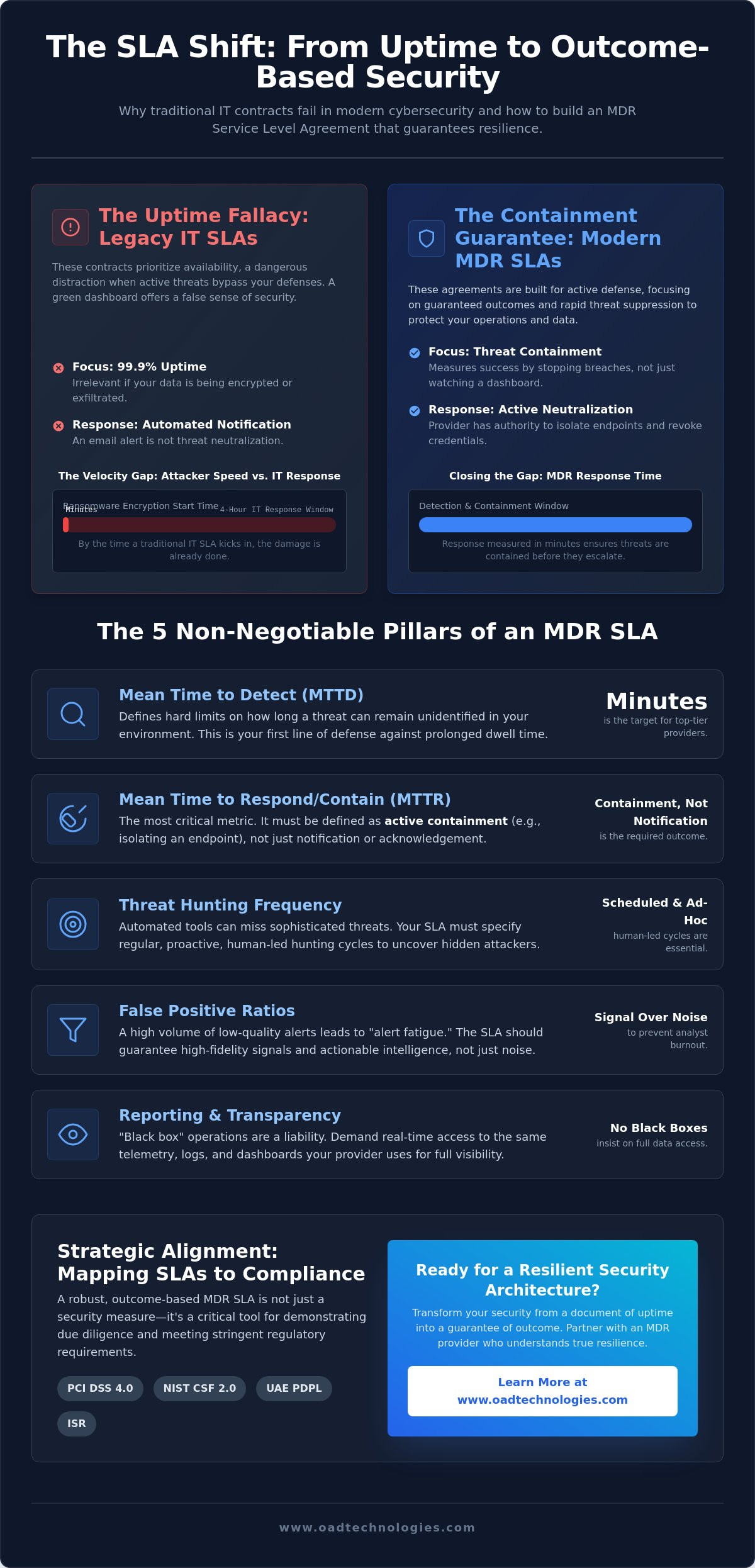
Traditional Service Level Agreements (SLAs) were designed for an era where the primary concern was server availability. If the website was up, the IT provider had fulfilled their duty. In 2026, this "Uptime Fallacy" is a dangerous distraction. A security dashboard showing 99.9% availability is irrelevant if a sophisticated threat actor has been siphoning data for weeks. Modern security operations require a shift from "best effort" administrative tasks to "guaranteed outcomes" focused on threat suppression. When reviewing an mdr service level agreement checklist, you'll find that generic uptime metrics provide no legal or financial protection during a high-stakes breach. Ambiguous language often hides the fact that a provider is only responsible for notifying you of an incident, rather than actually stopping it.
The Velocity Gap: Why Seconds Matter
Standard IT contracts often cite a four-hour response window for "critical" tickets. In the context of modern ransomware, which can begin encrypting files within minutes of initial access, four hours is an eternity. There's a massive difference between network latency and threat dwell time. Dwell time is the total duration an unauthorized actor persists within your environment before they're detected and successfully removed. While IT teams worry about millisecond delays in packet delivery, security leaders must focus on reducing dwell time to minutes. Relying on obsolete response windows in your contract creates a strategic vulnerability that attackers are eager to exploit.
Accountability Beyond the Dashboard
Many organizations suffer from "Green Dashboard Syndrome," a false sense of security where alerts are cleared without rigorous human investigation. A provider might meet their SLA by simply acknowledging an alert within the required timeframe, but this is a clerical victory, not a tactical one. True accountability requires defining "Response" as active containment. This means the provider has the authority and capability to isolate an infected endpoint or revoke a compromised credential immediately. This level of integration is a core component of the Managed Detection and Response pillar, ensuring that your provider acts as a proactive architect of your defense rather than a passive observer. Your mdr service level agreement checklist must explicitly differentiate between a notification and a verified containment action to bridge this accountability gap.
The 5 Non-Negotiable Pillars of an MDR Service Level Agreement
Constructing a robust mdr service level agreement checklist requires moving past the administrative metrics of traditional IT support. A modern Security Operations Center (SOC) must be measured by its ability to neutralize threats, not just its speed in answering the phone. To ensure your provider acts as a true strategic partner, your contract must anchor itself in five specific pillars of accountability. These pillars transform the agreement from a static document into a dynamic framework for resilience.
- Mean Time to Detect (MTTD): Your SLA should establish hard limits on how long a threat can exist before identification. In 2026, top-tier providers aim for an MTTD measured in minutes.
- Mean Time to Respond/Contain (MTTR): This is the most critical metric for limiting the blast radius of an attack. It must focus on containment, not just notification.
- Threat Hunting Frequency: Proactive defense isn't a one-time event. Your agreement should specify regular, human-led hunting cycles to find "living off the land" techniques that automated tools might miss.
- False Positive Ratios: High-fidelity signals are essential. An SLA that ignores the noise level risks burying your team in alert fatigue rather than providing actionable intelligence.
- Reporting and Transparency: You need real-time access to the same telemetry and log data your provider sees. Hidden black-box operations are a liability in a crisis.
Defining MTTR: Notification vs. Containment
The most common failure in managed security is confusing "Time to Acknowledge" with "Time to Remediate." If your provider meets their SLA by simply sending an email while an attacker moves laterally through your network, the agreement has failed you. Effective contracts set tiered response goals based on incident severity. For a P1 critical incident, containment should be near-instantaneous. Modern EDR solutions play a vital role here, enabling automated isolation of compromised hosts the moment a high-confidence threat is identified. If you're looking for deeper insights into these technical requirements, consider how OAD Technologies builds bespoke security architectures to bridge this gap.
Proactive Threat Hunting Requirements
A reactive SOC only waits for the alarm to sound. Your mdr service level agreement checklist must mandate proactive threat hunting. These human-led investigations look for subtle anomalies that bypass traditional signature-based defenses. Specify the number of monthly or quarterly hunts your provider will conduct. The output of these sessions shouldn't just be a report; it should include refined detection rules and the identification of previously unknown vulnerabilities. This intersection of human intelligence and machine capability ensures your defense evolves as quickly as the threat landscape.
The MDR Service Level Agreement Checklist: 2026 Edition
Translating high-level security strategy into a binding contract requires meticulous precision. An mdr service level agreement checklist serves as your blueprint for vendor accountability, ensuring that technical capabilities align perfectly with your business objectives. You must verify that your provider offers 24 X 7/365 visibility with guaranteed log ingestion rates. Without these specific guarantees, gaps in telemetry will inevitably lead to blind spots during a forensic investigation. It's not enough for a provider to simply "monitor" your environment; they must guarantee the integrity and continuity of the data they ingest.
Clarity on technology stack ownership is equally vital for long-term operational flexibility. Your agreement should specify who owns the EDR and SIEM licenses. If the provider owns the entire stack, you risk significant operational friction and "vendor lock-in" if you decide to migrate services in the future. Ensure you maintain ownership of your historical security data and that the data transition process is documented, tested, and cost-controlled. This foresight protects your digital relevance and ensures you aren't held hostage by a proprietary architecture.
Scrutinize exclusion clauses with a skeptical eye. Many providers hide exclusions for third-party cloud applications or specific legacy systems within the fine print. If these assets are critical to your supply chain, their exclusion represents a major unmanaged risk. Additionally, define clear escalation paths that identify the "Expert Architects" or Tier 3 investigators responsible for handling complex incidents. You need to know exactly who is on the other end of the line when a sophisticated threat bypasses your initial defenses.
Technical and Operational Readiness
A robust mdr service level agreement checklist must address the seamless integration of modern security frameworks. First, verify if the provider offers deep integration with your IAM frameworks to track lateral movement and identity-based attacks. Second, demand a clear verification of data sovereignty and storage locations to maintain compliance with regional privacy laws. Finally, insist on specific onboarding timelines. While some industry providers take up to 60 days to reach full visibility, a strategic partnership should aim for a "Time to Value" window of 15 to 30 days.
Legal and Financial Safeguards
Accountability requires financial consequences. Define service credits as a meaningful percentage of your monthly recurring revenue (MRR) rather than a symbolic gesture. Your contract must include clear terms for termination based on repeated SLA breaches, providing an exit strategy if the provider fails to meet response targets. To maintain a cycle of continuous improvement, mandate an annual VAPT assessment. This independent testing validates that your MDR service is actually detecting the threats it claims to monitor, ensuring your defense remains sharp and effective.
Strategic Alignment: Mapping SLAs to Regulatory Compliance
Regulatory compliance isn't a static checkbox. It's a moving target that requires your MDR provider to act as a legal safeguard. In the UAE, the Personal Data Protection Law (PDPL) demands rigorous control over data processing and incident reporting. Your mdr service level agreement checklist must reflect these legal realities by mandating specific telemetry retention and audit trails. Without this alignment, your security operations exist in a vacuum, detached from the governance requirements that protect your organization from heavy fines and reputational damage.
Aligning Mean Time to Respond (MTTR) targets with Information Assurance Standards (ISR) ensures that your response times meet government-mandated thresholds. This alignment is critical for passing GRC audits. When you present SLA reports to the board, you aren't just showing technical stats; you're providing evidence of "Reasonable Security" measures that mitigate liability. This level of transparency transforms the SOC from a cost center into a strategic asset that supports enterprise growth and resilience.
Compliance as a Service
Modern MDR telemetry can automate the tedious process of compliance reporting. By mapping incident response playbooks to specific regulatory notification windows, you ensure that your legal team has the data they need exactly when they need it. By early 2026, financial institutions are increasingly held to zero-trust reporting standards that mandate granular disclosure of supply-chain security incidents within hours of detection. Automating these workflows through your MDR contract reduces the risk of human error during a high-pressure crisis. If you need help bridging the gap between technical response and legal requirements, consult with our GRC experts at OAD Technologies.
Future-Proofing Your Security Contract
A rigid contract is a liability in an evolving threat landscape. Your SLA must be flexible enough to cover Cloud Security Posture Management (CSPM) and new log sources like OT or IoT devices without requiring a full contract renegotiation. As attackers adopt AI-driven techniques to accelerate their lateral movement, your response playbooks must adapt in kind. Ensure your agreement allows for the rapid integration of new detection rules and automated response actions. This future-proofing ensures your organization remains digitally relevant and secure, regardless of how the market or the adversary changes.
Partnering for Resilience: The OAD Technologies Approach to Bespoke MDR
Generic managed security services often leave organizations with a false sense of protection. While standard MSSPs provide a one-size-fits-all dashboard and a stream of contextless alerts, OAD Technologies operates as a strategic partner. We reject the "commodity" approach to security. Instead, we build tailored security architectures that integrate deeply with your unique infrastructure. This isn't a distant third-party service; it's a collaborative guardianship. When you apply a rigorous mdr service level agreement checklist to your current provider, you'll likely discover that standard contracts lack the depth required for active threat suppression. Our "Expert Architect" philosophy ensures that human intelligence directs advanced SIEM and EDR tools to neutralize threats before they can impact your bottom line.
True resilience requires more than just detection. It demands a provider that takes direct accountability for response outcomes. OAD Technologies guarantees these outcomes by moving beyond simple notifications. We focus on the intersection of human expertise and machine speed, ensuring that every alert is validated and every incident is contained with precision. This proactive stance allows your internal teams to focus on strategic growth while we safeguard the technical foundations of your digital transformation.
The OAD Difference: Outcome-Driven Security
Our methodology focuses on the fusion of sophisticated technology and human-led investigation. By integrating DLP strategies directly into our active response workflows, we ensure that sensitive data remains secure even during a sophisticated lateral movement attempt. Transparency is a core pillar of our service. You maintain real-time access to the same telemetry and investigation logs that our analysts use. This level of visibility has proven results. In recent deployments, our bespoke playbook automation has helped enterprise clients reduce their Mean Time to Respond (MTTR) by up to 70%, effectively shrinking the attacker’s window of opportunity from hours to mere minutes.
Secure Your Digital Future Today
The first step toward true accountability is auditing your existing framework. If your current mdr service level agreement checklist reveals ambiguous response windows or a lack of containment guarantees, your organization is at risk. OAD Technologies helps UAE enterprises navigate the complex GRC landscape by aligning technical performance with regional regulatory demands. We don't just provide security; we provide digital trust. Contact our team today for a comprehensive security assessment to identify the gaps in your current SLA and build a framework designed for 2026 and beyond. Your digital relevance depends on a foundation of rigorous engineering standards and unyielding accountability.
Architecting Your Strategic Resilience
Securing your organization's future requires a fundamental shift from monitoring availability to guaranteeing threat containment. Legacy uptime metrics are no longer sufficient; modern defense demands accountability through outcome-based metrics like Mean Time to Respond (MTTR). By applying a rigorous mdr service level agreement checklist, you ensure your provider delivers the technical depth and visibility necessary to withstand the evolving threat landscape of 2026.
OAD Technologies bridges the gap between high-level compliance and practical results. Our UAE-based SOC, staffed by 24 X 7 Expert Architects, ensures your operations align with ISR and PDPL regulatory standards. Through seamless EDR and SIEM integration, we reduce containment time from hours to minutes, transforming your security posture into a competitive advantage. It's time to move beyond generic contracts and build a bespoke defense framework that scales with your ambition.
Ready to redefine your security standards? Download our Bespoke MDR SLA Template and Schedule a Strategic Consultation to secure your digital relevance today.
Frequently Asked Questions
What is the difference between Mean Time to Detect (MTTD) and Mean Time to Respond (MTTR)?
Mean Time to Detect (MTTD) measures the duration from the initial moment of compromise until your security provider identifies the threat. Mean Time to Respond (MTTR) tracks the interval from that detection until the threat is fully neutralized or contained. While detection is a vital first step, the response metric is what ultimately determines the blast radius of an attack and the extent of potential data loss.
How much should an MDR service level agreement typically cost in the UAE?
MDR pricing in the UAE generally aligns with global benchmarks based on deployment scale and service depth. For a mid-size organization with 500 endpoints, endpoint-only services typically range between $8 and $35 per endpoint monthly, totaling $48,000 to $210,000 annually. Larger enterprises with over 10,000 endpoints often see annual costs between $400,000 and $1 million. You should also account for upfront onboarding fees ranging from $5,000 to $25,000.
Can I include custom response times in my MDR SLA for specific high-value assets?
Bespoke security architectures allow for tiered response times based on asset criticality. You can and should negotiate tighter containment windows for high-value targets such as core financial databases or executive identities. This ensures that your provider prioritizes resources where a breach would cause the most significant operational or regulatory damage. Strategic providers welcome this level of granularity as it aligns defense with business reality.
What happens if an MDR provider fails to meet their SLA targets during a breach?
Failure to meet agreed-upon targets usually triggers a system of service credits, which are financial penalties calculated as a percentage of the monthly recurring revenue. If breaches of the agreement are repeated or egregious, most contracts include a "termination for cause" clause. These legal safeguards ensure the provider remains financially accountable for operational lapses during a crisis.
Should threat hunting be included in the standard MDR SLA or as an add-on?
Proactive threat hunting should be a standard component of any modern security contract rather than an optional extra. Your mdr service level agreement checklist must specify the frequency and scope of human-led hunting cycles. This ensures the SOC doesn't just wait for automated alerts but actively searches for sophisticated "living off the land" techniques that bypass traditional signature-based detection tools.
How do I verify that my MDR provider is actually meeting their MTTR guarantees?
Verification requires real-time access to the provider’s investigation telemetry and detailed incident logs. You shouldn't rely solely on monthly PDF summaries provided by the vendor. A robust mdr service level agreement checklist includes the requirement for periodic "red team" exercises or independent VAPT assessments. These tests simulate real-world attacks to verify that detection and containment occur within the contractually mandated timeframes.
Does a strong SLA guarantee that my business will not be breached?
An SLA is a contract of accountability and operational performance, not a guarantee of invulnerability. No provider can promise that a breach will never occur in an evolving threat landscape. Instead, the agreement ensures that when an incident happens, the response is swift, professional, and effective. It manages the impact of a breach and ensures your provider is held to rigorous engineering standards.
What is the "Time to Contain" and why is it more important than "Time to Notify"?
Time to Contain measures how long it takes to stop an attacker's movement, while Time to Notify only tracks the administrative act of sending an alert. Notification is a passive clerical task that does nothing to stop encryption or data exfiltration. Containment is the superior metric because it represents active intervention, such as isolating a host or revoking credentials, which directly protects your digital assets.
Disclaimer
Content by OAD Technologies is for general informational purposes only and does not constitute professional or cybersecurity advice. No warranties are made regarding accuracy or completeness; reliance is at your own risk. OAD Technologies shall not be liable for any direct or indirect losses arising from use of this content.