
If your recovery strategy hasn't been tested against a total ransomware lockdown, it isn't a plan; it's a liability. Many organizations across the UAE find that while they have traditional backups, their business continuity planning for cyber attacks fails the moment a real-world simulation begins. You're likely feeling the pressure to not only protect your data but also to prove operational resilience to regulators who no longer accept "best efforts" as a valid defense.
We agree that aligning technical recovery with your most critical business operations is a difficult, high-stakes challenge. This article provides the strategic framework to transform outdated BCP models into a proactive, cyber-resilient system designed for today's destructive threats. You'll discover a clear roadmap to integrate cybersecurity into your continuity strategy, significantly reduce your Recovery Time Objective (RTO), and ensure full compliance with national security standards. We'll explore how to move from reactive restoration to a sophisticated, strategic posture that maintains your digital relevance through any crisis.
Key Takeaways
- Identify the critical deficiencies in traditional BCP that allow ransomware and logic bombs to bypass standard recovery infrastructure.
- Explore the technical requirements for building a resilient foundation using immutable data architectures and segmented recovery environments.
- Follow a structured 5-step roadmap for business continuity planning for cyber attacks to align your IT recovery with business-critical operations.
- Learn how to leverage Managed Detection and Response (MDR) as an early warning system to ensure your restoration process remains clean and secure.
- Understand the strategic importance of GRC in maintaining compliance with evolving UAE national security standards and operational resilience mandates.
Beyond Backups: Why Traditional BCP Fails Against Cyber Attacks
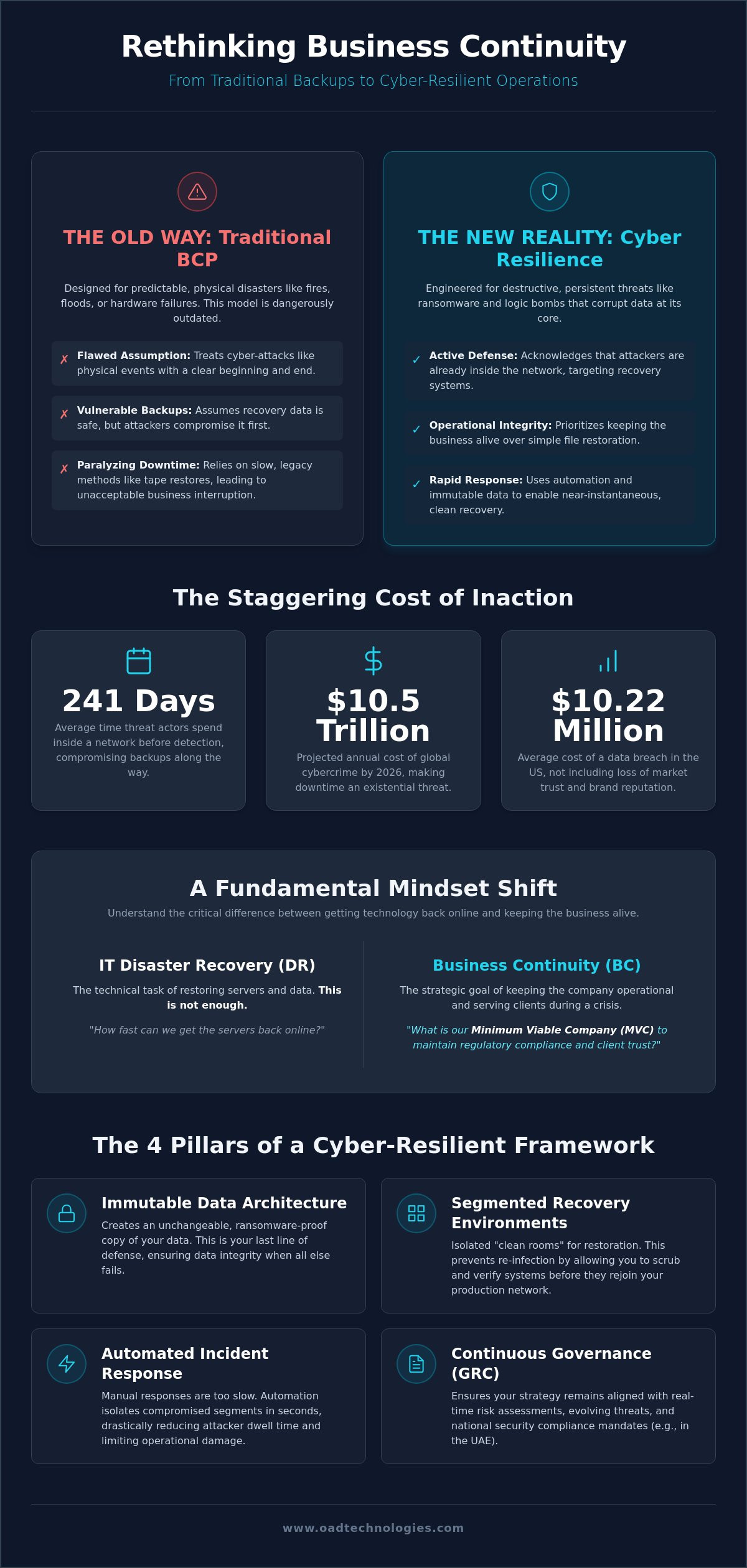
Most leaders view Business continuity planning (BCP) as a safeguard against physical disasters. Fires, floods, and hardware failures are predictable; they have a clear beginning and end. Cyber attacks don't follow these rules. A logic bomb or ransomware variant doesn't just stop a server; it corrupts the very data you rely on for recovery. When you apply a physical lens to a digital crisis, your strategy collapses. You're preparing for a broken pipe while an arsonist is already inside the building, systematically locking every exit.
Traditional backups often become the first casualty of modern breaches. Research shows that threat actors spend an average of 241 days inside a network before they're identified. During this window, they move laterally to locate and compromise recovery infrastructure. If your business continuity planning for cyber attacks assumes your backups are a safe haven, you're likely in for a shock. By the time the encryption starts, the "golden image" has already been poisoned, making a standard restore impossible without re-introducing the threat.
Relying on legacy methods like "restoring from tape" creates operational paralysis. In a world where global cybercrime costs are projected to reach $10.5 trillion by 2026, businesses can't afford days of downtime. The true cost isn't just the $10.22 million average cost of a US breach; it's the permanent loss of market trust when operations stay dark while competitors stay online. A disconnected continuity plan focuses on the wrong metrics, prioritizing file restoration over the preservation of the brand's digital relevance.
The Evolution of Destructive Cyber Attacks
We're seeing a shift from simple financial extortion to intentional data wiping. Nation-state actors and sophisticated cartels now target national infrastructure resilience, aiming to cause maximum disruption rather than just collecting a ransom. 2026 threats demand "warm" continuity sites that allow for near-instantaneous cutovers. Cold storage is a graveyard for data that you might never be able to verify as clean. You need an environment that's ready to take over the moment your primary systems are compromised.
IT Disaster Recovery vs. Business Continuity
There's a critical distinction between IT Disaster Recovery (DR) and business continuity. DR is about getting the servers back online. Business continuity is about keeping the company alive while the servers are down. You must define your Minimum Viable Company (MVC). What are the absolute bare-minimum functions required to serve clients and meet UAE regulatory expectations? Effective business continuity planning for cyber attacks prioritizes these functions over total system restoration. This ensures you remain operational even while the forensic investigation continues, protecting your revenue stream and your reputation simultaneously.
The Core Pillars of a Cyber-Resilient Continuity Framework
Effective business continuity planning for cyber attacks requires a shift from passive storage to active, resilient architecture. We don't just want to survive an event; we want to maintain operational integrity throughout it. This means moving beyond silos and integrating security directly into your recovery DNA. By building a framework based on technical precision, you ensure that your organization remains viable even when primary systems are under siege.
Immutable data architecture serves as your final safeguard. Unlike standard backups, immutable copies use technology that ensures once data is written, it can't be altered, encrypted, or deleted by unauthorized actors. This creates an unchangeable "last line of defense" that ransomware cannot touch. When you pair this with segmented recovery environments, you create a "clean room" for restoration. These isolated zones prevent re-infection by allowing you to scrub and verify systems before they ever touch your production network again.
Automation is the only way to beat the clock. With the average time to identify and contain a breach reaching 241 days in 2026, manual responses are simply too slow. Automated incident response playbooks can isolate compromised segments in seconds, drastically reducing the dwell time that leads to total operational failure. This speed is what separates a minor disruption from a catastrophic shutdown. To develop a robust business continuity plan, you must also implement continuous governance. This ensures your strategy stays aligned with real-time risk assessments and evolving regional GRC mandates, rather than sitting idle on a shelf.
Zero Trust as a Continuity Enabler
Modern resilience relies on sophisticated Identity and Access Management (IAM) to limit the blast radius of any breach. By enforcing the principle of least privilege, you ensure that even administrative recovery accounts don't have excessive permissions that could be exploited during an attack. Zero Trust ensures that even if a perimeter is breached, the attacker's path to critical recovery assets is blocked by constant verification requirements. This proactive stance turns identity into a powerful tool for maintaining business functions under pressure.
Data Integrity and Immutability
Redundancy isn't resilience. Having multiple copies of infected data doesn't help you recover; it only replicates the problem. In 2026, the "3-2-1-1-0" rule is the gold standard for data integrity:
- 3 copies of your data.
- 2 different media types.
- 1 copy off-site.
- 1 copy offline, air-gapped and immutable.
- 0 errors after automated backup verification.
Strategic Integration: Aligning BCP with Managed Detection and GRC
Resilience isn't a standalone project; it's the result of a unified strategy. Business continuity planning for cyber attacks shouldn't exist in a vacuum, separated from your active security stack. While previous sections focused on the architecture of recovery, true resilience begins with detection. By utilizing Vulnerability Assessment and Penetration Testing (VAPT), you can expose the continuity gaps in your network before an attacker does. These tests reveal how a breach might traverse your systems, allowing you to reinforce the specific pathways that lead to your most critical data assets.
The Role of MDR in Business Survival
Containment is often the most effective continuity strategy. By deploying Managed Detection and Response (MDR), you stop the spread of an attack before BCP activation becomes a necessity. 24 X 7 monitoring significantly reduces your Recovery Time Objective (RTO) by identifying the precise moment of compromise. This surgical precision allows your team to isolate affected segments immediately; it prevents the lateral movement that leads to enterprise-wide shutdowns. Integrating real-time threat intelligence into your continuity triggers ensures that your response is based on actual adversary behavior, not just generic alerts.
GRC: The Glue Between Security and Continuity
A sophisticated Governance Risk and Compliance (GRC) framework ensures that cyber-continuity isn't a one-time exercise. It involves mapping business-critical processes directly to technical assets, ensuring that your recovery efforts prioritize the functions that keep the lights on. This alignment is vital for meeting the requirements of the UAE Personal Data Protection Law (PDPL), where proving operational resilience through comprehensive business continuity planning for cyber attacks is a regulatory mandate. GRC automation streamlines the complex task of compliance reporting by instantly gathering the forensic data and audit trails required after a cyber incident occurs. Utilizing SIEM alongside your GRC tools provides the granular forensic trail needed to guarantee a clean recovery, ensuring you don't accidentally restore the very vulnerabilities that caused the breach.
5 Steps to Developing a Robust Business Continuity Plan for Cyber Attacks
Building a resilient organization requires more than just a list of emergency contacts. It demands a structured, engineering-led approach that anticipates the specific mechanics of a digital breach. Business continuity planning for cyber attacks must be a living strategy, refined through data and tested against the most aggressive threat models. By following these five steps, you can move from a state of vulnerability to one of strategic endurance.
The Cyber-Specific Business Impact Analysis
Traditional BIAs often overlook the nuances of a logic-based crisis. A cyber-specific Business Impact Analysis (BIA) starts by identifying your "Crown Jewel" assets; these are the essential data sets and digital services that must remain online to prevent total operational collapse. You must assess both upstream and downstream dependencies. For example, if your identity provider fails, how does that paralyze your customer-facing applications? In 2026, the global average cost of a data breach is $4.44 million, but for those without a prioritized recovery plan, the financial impact of a 24-hour total system lockout can be far higher. Quantifying these risks allows you to allocate resources where they'll most effectively protect your digital relevance.
Once your priorities are set, you must define your Cyber-Recovery Time Objectives (C-RTO) and Recovery Point Objectives (C-RPO). These metrics differ from standard disaster recovery because they account for the time needed to perform forensic cleaning. You cannot simply flip a switch; you must architect a "Clean Room" for isolated recovery. This environment allows your team to restore data and conduct forensic analysis simultaneously, ensuring that no dormant malware remains. Finally, develop a multi-channel crisis communication plan. If your primary email and VOIP systems are compromised, your leadership needs a secure, out-of-band method to coordinate the response and manage public perception.
Simulations and Tabletop Exercises
A plan is only as good as its last successful test. Effective simulations move beyond the IT department to involve legal, HR, and PR teams. You must simulate "worst-case" scenarios, such as a total identity provider failure or the discovery that your primary backups have been encrypted. Utilizing Vulnerability Assessment and Penetration Testing (VAPT) provides the real-world data needed to inform these simulation scenarios, making them grounded in your actual network weaknesses. In the UAE, where regulators increasingly demand proof of operational resilience, these exercises are no longer optional. They're the only way to ensure your team can execute the plan under the extreme pressure of a live event.
Ready to validate your resilience? Contact OAD Technologies today to design a cyber-continuity framework that meets the highest national security standards.
Building Operational Resilience with OAD Technologies
Operational resilience is the result of rigorous engineering and proactive management. At OAD Technologies, we don't treat business continuity planning for cyber attacks as a static document stored in a digital vault. We treat it as a dynamic system that requires constant refinement and technical precision. By integrating Managed Detection and Response (MDR), Security Information and Event Management (SIEM), and Endpoint Detection and Response (EDR), we create a unified defense layer that powers your continuity strategy. This integration ensures that your recovery infrastructure is never blind to the threats attempting to compromise it.
Our bespoke GRC consulting ensures your framework aligns perfectly with national UAE security standards and the Personal Data Protection Law (PDPL). We understand the unique pressures local enterprises face, and we design our solutions to meet these specific regulatory mandates without sacrificing operational performance. To guarantee your plan works when it matters most, we utilize expert VAPT services to stress-test your recovery environment. We identify potential failure points in your segmented restoration zones, ensuring that your "Clean Room" remains untainted during a real-world crisis. This synergy of human expertise and advanced technology is what safeguards your corporate digital assets against the most sophisticated adversaries.
Our Approach to Managed Resilience
We move beyond the traditional vendor relationship to act as a strategic extension of your own team. Our approach centers on proactive threat hunting, where our specialists identify and neutralize malicious activity before it can escalate into a full-scale continuity event. We don't believe in standardized, one-size-fits-all security. Every assessment we conduct is customized for the national enterprise landscape, taking into account your specific industry risks and digital architecture. This partnership model ensures that as your business evolves, your resilience framework grows with it, maintaining your digital relevance in a volatile market.
Next Steps: Securing Your Digital Future
The first step toward true resilience is understanding your current vulnerabilities. We help you move from reactive recovery to a state of strategic endurance by architecting a long-term roadmap for cyber-operational resilience. This involves more than just software; it's about building a culture of security that empowers your people and protects your legacy. By requesting a comprehensive security posture assessment, you gain the clarity needed to make informed investment decisions that drive long-term viability. Don't wait for a breach to reveal the gaps in your strategy. Consult with OAD Technologies to strengthen your Business Continuity Plan today and ensure your organization is ready for whatever the future holds.
Securing Digital Longevity in a Destructive Threat Landscape
True resilience requires moving beyond the checklist mentality of legacy disaster recovery. We've seen how integrating immutable data architecture and segmented recovery zones creates a reliable foundation that ransomware cannot easily compromise. By aligning your strategy with proactive detection and rigorous GRC standards, you ensure that your organization remains operational even under the most intense pressure. Effective business continuity planning for cyber attacks is the only way to safeguard your digital relevance while meeting the UAE's evolving regulatory demands.
OAD Technologies acts as your strategic partner in this evolution. As Dubai-based cybersecurity experts, we provide specialized GRC and technical security assessments designed for the unique challenges of national enterprises. Our comprehensive MDR and SIEM solutions empower your team with the visibility and precision needed to maintain a clean recovery environment. Secure your enterprise resilience with OAD Technologies' managed security services and take direct control of your operational future. You don't have to face tomorrow's threats with yesterday's plans; you're ready to build a more resilient tomorrow.
Frequently Asked Questions
What is the difference between a standard BCP and a BCP for cyber attacks?
Standard BCP focuses on physical threats like fires or power outages (often mitigated by maintenance providers like Fazal Technical Services), while a cyber-focused BCP addresses logical corruption and malicious intent. Standard plans assume that once hardware is replaced, your data is ready for use. In contrast, cyber-specific strategies recognize that the data itself may be the primary target or even a carrier for malware. This requires a shift from simple restoration to rigorous forensic verification before any system goes live.
How does the UAE Personal Data Protection Law (PDPL) impact business continuity planning?
The UAE PDPL requires organizations to implement technical measures that ensure the ongoing confidentiality and availability of personal data. This means your continuity strategy isn't just a business preference; it's a legal obligation. You must be able to prove to regulators that you can recover personal data within a reasonable timeframe after a breach. Failure to maintain this resilience can lead to significant administrative fines and reputational damage.
Why are traditional backups insufficient for recovering from ransomware?
Traditional backups fail because modern ransomware is designed to move laterally and encrypt recovery infrastructure before the main attack begins. If your backups are "hot" or always connected to the network, they're just another target for the adversary. True resilience requires immutable architecture where data cannot be changed once written. This ensures you have a clean, unalterable copy that remains immune to encryption during the initial breach phase.
What is a 'Clean Room' in the context of cyber recovery?
A 'Clean Room' is an isolated recovery environment where systems are restored and scanned for dormant malware before returning to the live network. It's a vital part of business continuity planning for cyber attacks because it breaks the re-infection cycle. This secure zone allows forensic teams to analyze the breach's root cause and scrub data without risking further damage to the enterprise's primary production operations.
How often should an enterprise conduct cyber-continuity tabletop exercises?
We recommend conducting tabletop exercises at least twice a year to maintain muscle memory across your leadership team. These simulations shouldn't be restricted to the IT department; they must include legal, PR, and HR representatives. Regular testing ensures that your crisis communication channels and decision-making hierarchies remain effective. It identifies gaps in the response chain that only become apparent when your team is faced with the high-velocity nature of a real event.
Can Managed Detection and Response (MDR) prevent the need for BCP activation?
Yes, a proactive MDR service can effectively stop a breach before it triggers your business continuity plan. By identifying suspicious behavior in seconds, MDR allows for immediate containment of affected endpoints. This surgical response prevents the lateral spread that typically leads to the total system lockouts that necessitate a full BCP activation. It keeps your business functions running by neutralizing threats before they can cause enterprise-wide disruption.
What are the most critical KPIs for measuring cyber-resilience?
The most vital KPIs are Cyber-Recovery Time Objective (C-RTO) and the "Mean Time to Contain." While traditional RTO measures how fast you can turn a server on, C-RTO measures how long it takes to restore a verified, malware-free service. Tracking these metrics helps you understand the actual window of operational downtime you face during a sophisticated attack. You should also monitor the percentage of successful, error-free restores during your bi-annual tests.
How do I ensure our third-party vendors don't compromise our business continuity?
You must integrate resilience requirements directly into your vendor contracts and Service Level Agreements (SLAs). This includes mandating that they maintain their own business continuity planning for cyber attacks and provide regular audit reports. Since your operations often depend on their digital services, their failure is your failure. This makes third-party risk management a core component of your framework; for instance, global businesses often use Warenous to source pre-screened logistics providers that meet high operational standards.
Disclaimer
Content by OAD Technologies is for general informational purposes only and does not constitute professional or cybersecurity advice. No warranties are made regarding accuracy or completeness; reliance is at your own risk. OAD Technologies shall not be liable for any direct or indirect losses arising from use of this content.