With the global cost of cybercrime projected to surpass $10.5 trillion in 2026, the margin for fiscal error in security has effectively vanished. Security leaders are no longer just defending networks; they're defending the balance sheet against an average US data breach cost of $10.22 million. This cybersecurity budget planning guide provides the strategic framework necessary to transition from reactive tool acquisition to a sophisticated, validation-first investment model that prioritizes long-term resilience.
We understand the friction of justifying rising personnel costs and managing software sprawl to a board that demands clear risk quantification. It's a complex challenge to align your spend with 2026 benchmarks while navigating the enforcement of the EU AI Act and the NIS2 Directive. This guide promises to equip you with the ROI frameworks and allocation models required to build a defensible, risk-aware budget. We'll explore how to optimize your technology stack, reduce operational drag, and demonstrate the tangible yield of your security investments to executive leadership through data-driven metrics.
Key Takeaways
- Leverage 2026 global benchmarks to align your fiscal strategy with a $240 billion spending landscape focused on operational continuity.
- Optimize resource distribution using the 30/40/30 rule to balance specialized personnel with integrated technology platforms and managed services.
- Quantify your "Security Yield" by using this cybersecurity budget planning guide to translate technical risk reduction into defensible financial metrics for board reporting.
- Identify high-priority investment gaps through technical validation and vulnerability assessments rather than relying on standardized tool acquisition.
- Streamline your security stack by conducting a rigorous tool audit that addresses software overlaps and facilitates necessary infrastructure transitions.
The 2026 Cybersecurity Fiscal Landscape: Global Benchmarks and National Priorities
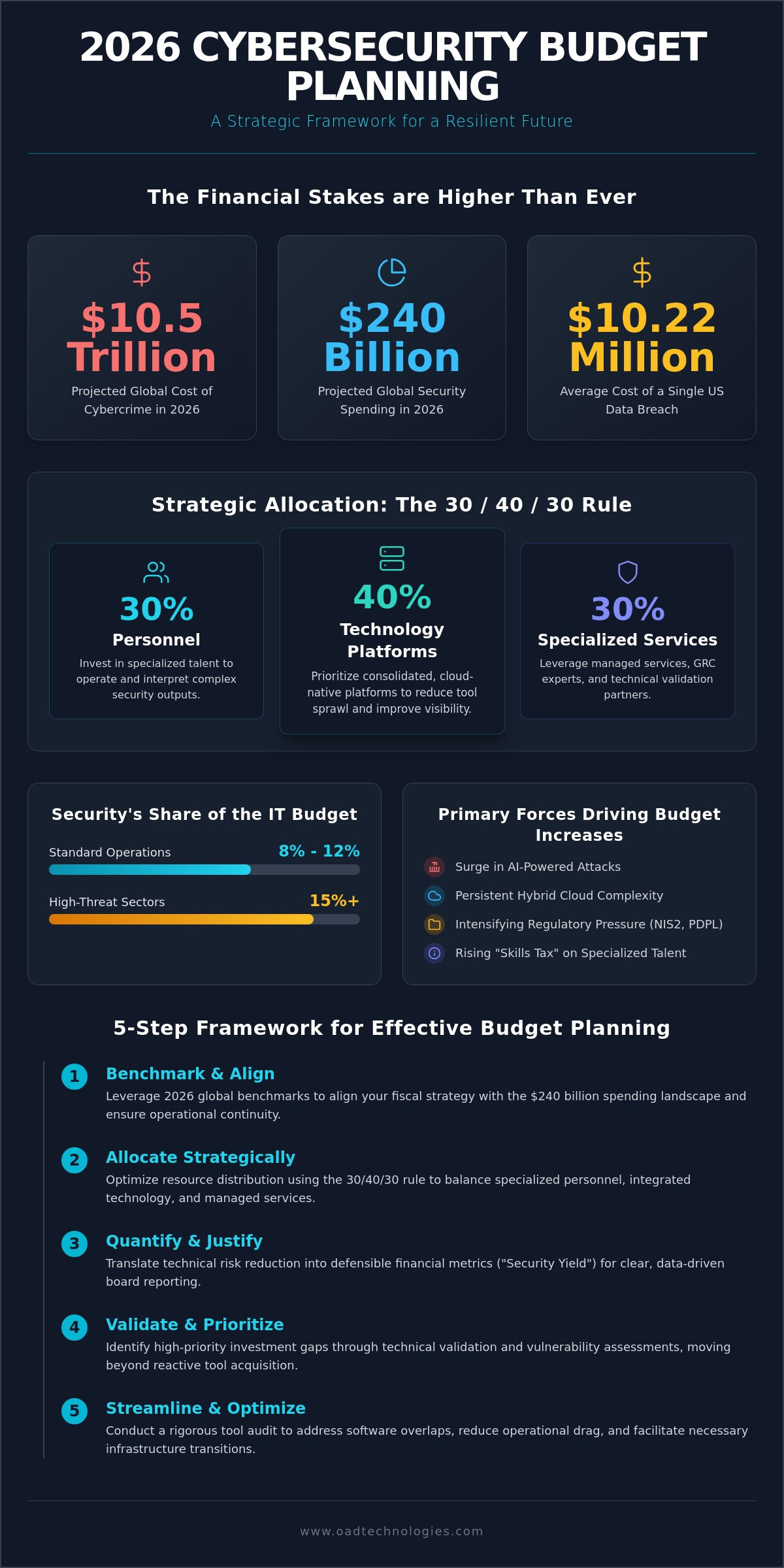
The 2026 cybersecurity budget has evolved beyond a defensive insurance policy. It now serves as a strategic investment in operational continuity. With global cybercrime costs projected to surpass $10.5 trillion this year, organizations are recognizing that digital resilience is a prerequisite for market relevance. Current forecasts from Gartner and other industry leaders suggest global security spending will reach between $212 billion and $240 billion in 2026. For UAE enterprises, these figures represent a call to action. Aligning with these benchmarks ensures that local businesses remain competitive in a landscape where a single breach can cost upwards of $10.22 million.
Most enterprises currently allocate between 8% and 12% of their total IT budget to security. This baseline is sufficient for standard operations, yet it's no longer the ceiling. This cybersecurity budget planning guide recommends that organizations in high-threat sectors, such as financial services and healthcare, target a 15% allocation. This higher threshold accounts for the specialized Information Security Management required to defend against sophisticated threat actors. Four primary forces drive these budget increases: the surge in AI-powered attacks, the persistent complexity of hybrid cloud environments, intensifying regulatory pressure, and the rising "skills tax" on specialized security talent.
Understanding the Shift to Fiscal Accountability
2026 is the year the CISO must justify every dirham of investment. The era of "black box" security spending is over. We've entered a period of strategic precision where security leaders act as business partners. They must prove how every tool and process enables business growth rather than just providing reactive protection. Because 53% of security leaders identify AI-powered attacks as their biggest challenge, budgets must now include specific contingency allocations for rapidly evolving ransomware economics and automated threat response.
Key 2026 Spending Trends for UAE Leaders
UAE enterprises are moving away from fragmented point solutions toward consolidated platforms. This shift aims to reduce operational drag and eliminate the "tool sprawl" that often leaves visibility gaps. There is also a significant rise in spending on sovereign cloud security and national data residency. As the UAE Personal Data Protection Law (PDPL) becomes more central to regional operations, GRC budgets are expanding. Leaders are prioritizing localized infrastructure to ensure compliance and maintain the trust of global partners while meeting strict national mandates like the NIS2 Directive enforcement deadlines throughout the year.
Strategic Allocation: Dividing the 2026 Security Budget Pillars
Effective allocation requires a departure from the "buy every tool" mentality. This cybersecurity budget planning guide advocates for a refined 30/40/30 rule: 30% for personnel, 40% for technology platforms, and 30% for specialized services. This balance ensures that advanced tools are operated by experts who can interpret complex outputs. While hardware once took a larger slice, the shift toward cloud-native architectures has redirected funds toward software and human intelligence. Analyzing recent Cybersecurity Investment Trends reveals that organizations are moving away from reactive spending toward proactive resilience.
At the core of this allocation should be identity and access management. It's the primary pillar of a Zero Trust architecture. Without robust IAM, even the most expensive firewall is a hollow defense. Simultaneously, protecting the integrity of your corporate assets requires a dedicated data loss prevention budget. This isn't just about compliance; it's about safeguarding the intellectual property that defines your market advantage. For those managing legacy environments, infrastructure modernization, specifically a strategic VMware replacement, has become a high-priority line item to reduce long-term licensing costs and improve agility.
Software and Cloud Security Investments
Modern visibility requires a tripartite investment in SIEM, EDR, and CSPM. In multi-cloud environments, Cloud Security Posture Management is no longer optional. It's the only way to catch misconfigurations before they're exploited. When evaluating your stack, consider the cost-efficiency of integrated platforms versus best-of-breed tools. Integrated stacks often reduce "integration debt" and simplify the training required for your internal team.
Managed Services: MDR and Outsourced Expertise
Building an in-house SOC that operates 24 X 7 is prohibitively expensive for most enterprises. Transitioning to a managed detection and response service often provides superior coverage at a fraction of the cost. These services mitigate the "skills shortage tax" by giving you instant access to veteran threat hunters. With the average lateral movement window now down to 48 minutes, having 24 X 7 monitoring is the only way to stop an intrusion before it becomes a catastrophe. If you're looking to optimize your current spend, our team can help you modernize your infrastructure to ensure every dollar works toward your strategic goals.
Justifying the Spend: ROI through Technical Validation and GRC
Securing approval for a multi-million dirham budget requires more than just fear-based narratives. It demands a shift toward "Security Yield," a metric that defines the tangible reduction in risk per dollar spent. By framing investments this way, CISOs can demonstrate how every allocation directly protects the bottom line. This cybersecurity budget planning guide emphasizes that the most effective way to identify high-priority gaps is through rigorous vulnerability assessment and penetration testing (VAPT). VAPT doesn't just find bugs; it provides the empirical data needed to justify why certain legacy systems require immediate replacement or why specific cloud controls need funding.
Integrating governance risk and compliance (GRC) frameworks further turns "security spend" into a form of "compliance insurance." In a landscape where 2026 Cybersecurity Statistics indicate a significant rise in global spending, the ability to map technical controls to legal requirements is vital. This is especially true for Brand Protection. Safeguarding your digital reputation isn't a luxury; it's a necessity to maintain market valuation and customer trust in an era of deepfakes and automated social engineering.
Proving ROI to the Board
Boards care about financial exposure, not technical minutiae. Move the conversation from the "number of blocked attacks" to the "reduction in potential breach impact cost." Use the results of continuous validation through VAPT to provide evidence for budget renewals, showing exactly how previous investments closed known vulnerabilities. Consider the cost-benefit of proactive data loss prevention versus the catastrophic expense of post-breach litigation and fines. It's much easier to justify a DLP budget than it is to explain a massive fine for a preventable leak.
Compliance as a Budget Catalyst
Aligning your budget with NIST CSF 2.0 and local UAE GRC requirements creates a clear roadmap for the board. We're seeing a massive push for automated compliance reporting to reduce the manual audit workloads that drain internal resources. In the UAE, the financial impact of non-compliance with the Personal Data Protection Law (PDPL) makes the investment in robust GRC tools a logical business decision. By automating these processes, you ensure long-term viability and free up your team to focus on strategic threat hunting rather than paperwork.
A 5-Step Framework for Effective 2026 Budget Planning
This cybersecurity budget planning guide moves beyond theoretical benchmarks to provide a sequenced, operational roadmap for the 2026 fiscal year. Successful budgeting requires a transition from simply maintaining systems to actively validating their efficacy. By following a structured framework, CISOs can eliminate wasteful spending while ensuring that every dirham allocated strengthens the organization's defensive posture. The goal is to build a budget that is not just a list of costs, but a blueprint for enterprise resilience.
- Step 1: Baseline Assessment & Tool Audit. Identify overlapping software licenses, underutilized "shelfware," and urgent infrastructure needs, such as specialized VMware replacement strategies.
- Step 2: Threat Modelling & Prioritisation. Align your spending with your specific industry risk profile to ensure you aren't over-investing in low-probability threats.
- Step 3: Technical Validation. Use rigorous vulnerability assessment and penetration testing to find exactly where current defenses are failing before committing to new purchases.
- Step 4: Strategic Allocation. Balance the cost of 24 X 7 MDR services with in-house GRC initiatives to maintain a hybrid model of technical and administrative control.
- Step 5: Board Presentation. Frame the final budget in terms of business resilience, risk reduction, and clear ROI metrics.
Step 1 & 2: Audit and Prioritise
Start by conducting a comprehensive tool audit to eliminate redundant licenses and software that no longer serves a purpose. It's common for enterprises to pay for overlapping features across different security suites; consolidating these can free up significant capital for more critical projects. Prioritize your assets based on their criticality to business revenue, focusing your highest protections on the "crown jewels" of your data architecture. The Principle of Least Privilege is a budget-saving IAM strategy that ensures users only have access to the specific resources necessary for their work, minimizing both risk and licensing costs.
Step 5: Communicating Value
When you reach the boardroom, translate technical vulnerabilities into business risk levels: Low, Medium, High, and Critical. This language bridges the gap between engineering and executive leadership. It's also vital to include a 10-15% contingency fund for emergency incident response, as 2026 threat landscapes remain highly volatile. Use data-rich visualizations from your SIEM and EDR reports to show stakeholders exactly how current threats are being mitigated and where the proposed budget will close existing gaps. If you're ready to modernize your stack, explore our VMware replacement services to streamline your infrastructure costs and improve long-term agility.
Optimising Your Investment with OAD Technologies
OAD Technologies is the partner of choice for UAE enterprises seeking strategic resilience in an increasingly volatile digital economy. While this cybersecurity budget planning guide provides the necessary theoretical framework, successful execution requires a partner who bridges the gap between high-level innovation and practical business results. We don't just provide software; we act as a master designer of systems, ensuring your infrastructure is both robust and agile. Our approach blends technical authority with a commitment to long-term strategic partnership, moving away from the transactional vendor model to become an extension of your internal team.
Our specialized Data Loss Prevention (DLP) and Managed Detection and Response (MDR) solutions are engineered to maximize your security yield. By integrating these tools into a cohesive strategy, we help you reduce the operational drag associated with tool sprawl and overlapping licenses. Furthermore, our customized GRC consulting ensures your organization remains in strict alignment with national regulatory mandates, including the UAE Personal Data Protection Law (PDPL). We focus on creating a defensible security posture that satisfies both technical requirements and board-level fiscal scrutiny.
Bespoke Solutions vs. Standardised Approaches
We believe every enterprise deserves a defense as unique as its data architecture. We reject the one-size-fits-all model in favor of tailored infrastructure protection that respects your specific industry risk profile. This customized approach ensures that your budget is allocated where it will have the most significant impact on risk reduction. Our technical security assessments represent the perfect synergy of human insight and technological capacity. Our experts identify nuanced vulnerabilities that automated tools often miss, providing a level of precision that standardized scans simply cannot match.
Securing Your Digital Future
Our commitment to your organization extends beyond immediate fixes. We position ourselves as the guardians of your ongoing digital relevance, ensuring your security investments provide long-term viability in an ever-changing market. A comprehensive security posture assessment is the first step toward a smarter, more efficient 2026 budget. By identifying your current strengths and weaknesses, we help you build a roadmap that prioritizes growth and precision over reactive spending. Don't leave your fiscal planning to chance. Schedule a strategic budget consultation with OAD Technologies to secure your enterprise for the challenges of tomorrow.
Securing Your Enterprise for the 2026 Digital Economy
Navigating the fiscal complexities of the coming year requires a fundamental shift from reactive protection to strategic precision. Successful budgeting hinges on the 30/40/30 allocation rule and the rigorous validation of existing tools through technical assessments. By prioritizing identity management and data loss prevention, you ensure that every dirham invested actively reduces your organization's financial exposure. This cybersecurity budget planning guide provides the foundation for building a defensible, risk-aware strategy that resonates with executive leadership and meets the rigorous demands of the UAE PDPL.
OAD Technologies stands ready to act as a strategic extension of your team. Our UAE-based GRC experts and specialized DLP and MDR portfolio provide the technical authority needed to solve complex digital challenges. We deliver sophisticated technical security assessments that go beyond standard scans to uncover genuine risk. It's time to transform your security spend into a catalyst for long-term operational continuity. Download our 2026 Cybersecurity Budget Template today to begin your journey toward a more resilient future. Your digital relevance is worth the investment.
Frequently Asked Questions
What is a typical cybersecurity budget for a UAE enterprise in 2026?
A typical budget for a UAE enterprise aligns with global trends showing an annual spending increase of 12.5% to 15%. While specific figures vary by organization size, most leaders are matching the projected $240 billion global spending benchmark to maintain regional competitiveness. This shift reflects a move toward proactive resilience rather than reactive spending.
How much of my IT budget should be allocated to cybersecurity?
Most organizations allocate between 8% and 12% of their total IT budget to security. Enterprises in high-threat sectors like financial services or healthcare should target a higher range of 10-15%. This allocation ensures sufficient coverage for modern cloud complexities and the rising costs of specialized security personnel.
What are the biggest mistakes in cybersecurity budget planning?
The most frequent mistake is tool sprawl, where businesses pay for overlapping software licenses without a clear validation strategy. Many organizations also fail to include a 10-15% contingency fund for emergency incident response. Neglecting the "skills tax" on internal HR budgets by underestimating the cost of specialized talent is another common pitfall.
How do I justify an MDR service to my finance department?
Justify Managed Detection and Response (MDR) by comparing its cost to the massive capital expenditure required to build a 24 X 7 in-house Security Operations Center (SOC). Highlight that MDR provides immediate access to veteran threat hunters. This reduces the potential financial impact of a breach, which reached an average of $10.22 million in 2025.
Should I prioritise software or personnel in my 2026 budget?
Effective 2026 planning requires a balanced 30/40/30 split between personnel, technology platforms, and managed services. Software provides the necessary visibility, but human insight is required to act on technical data; for enterprises with operations across Africa, Torch Services provides the specialized managed expertise needed to maintain this balance. Prioritizing one over the other creates visibility gaps or operational bottlenecks that threat actors can easily exploit.
How does the UAE PDPL affect my security budget?
The UAE Personal Data Protection Law (PDPL) mandates specific controls for data residency and sovereign cloud security. This regulation requires increased investment in GRC tools and Data Loss Prevention (DLP) to avoid non-compliance penalties. Following a cybersecurity budget planning guide helps you map these regulatory requirements to specific technical line items.
Is cyber insurance a necessary part of a cybersecurity budget?
Cyber insurance is a vital component of a modern fiscal strategy, but it's not a substitute for technical controls. Most insurers now require proof of robust defenses, such as EDR and IAM, before they'll issue a policy. Budgeting for these controls is often a prerequisite for obtaining coverage at a reasonable premium.
How can VAPT help in planning my security budget?
Vulnerability Assessment and Penetration Testing (VAPT) provides the empirical evidence needed to identify high-priority budget gaps. Instead of guessing where your defenses are weak, VAPT shows you exactly where current controls are failing. This allows you to allocate funds with precision, ensuring every dirham spent contributes to a measurable reduction in risk.
Disclaimer
Content by OAD Technologies is for general informational purposes only and does not constitute professional or cybersecurity advice. No warranties are made regarding accuracy or completeness; reliance is at your own risk. OAD Technologies shall not be liable for any direct or indirect losses arising from use of this content.