With the average cost of a data breach reaching $4.4 million, waiting for an alert to trigger before acting is no longer a viable business plan. You're likely exhausted by fragmented security tools that fail to communicate, leaving your team trapped in a cycle of reactive firefighting while attackers enjoy dangerously high dwell times. It's a high-stakes environment where the pressure to meet UAE PDPL and ISR compliance standards only adds to the operational complexity. We understand that your goal isn't just to buy more software, but to build a synchronized ecosystem that actually works.
This guide provides a definitive 2026 roadmap to transition your organization toward a proactive cyber defense strategy, moving beyond simple detection to a state of intelligence-led resilience. We'll explore how synchronizing Managed Detection and Response (MDR) with Data Loss Prevention (DLP) and robust GRC frameworks can automate threat neutralization before they impact your infrastructure. By the end of this article, you'll have a clear framework for reducing organizational risk and securing your digital assets against the sophisticated, AI-driven threats of the coming year.
Key Takeaways
- Shift from reactive firefighting to a visionary, intelligence-led posture that identifies and neutralizes threats before they impact your digital assets.
- Explore how the synchronization of MDR, EDR, and SIEM provides the 24 X 7 granular visibility required for sophisticated behavioral analysis.
- Learn why integrating DLP and IAM is essential for securing your core data and enforcing a robust proactive cyber defense strategy.
- Understand the strategic roles of VAPT and GRC in stress-testing your defenses and ensuring alignment with UAE PDPL and ISR compliance.
- Discover a structured roadmap for building customized, high-quality security architectures designed for long-term digital resilience.
What is a Proactive Cyber Defense Strategy?
A proactive cyber defense strategy represents a fundamental shift in how enterprises approach digital risk. Unlike traditional models that wait for a signature-based alert to trigger a response, a proactive posture involves the constant, pre-emptive search for vulnerabilities and active threats. It combines continuous monitoring, advanced threat hunting, and automated vulnerability management into a single, cohesive ecosystem. By "shifting left" in the security lifecycle, organizations aim to identify and neutralize malicious activity during the reconnaissance or initial access phases, long before an attacker can exfiltrate data or deploy ransomware.
In 2026, this approach is mandatory. Traditional firewalls and legacy antivirus tools are frequently bypassed by AI-driven polymorphic malware and automated phishing campaigns. Modern defense requires a Proactive Cyber Defense that anticipates these movements rather than merely documenting the damage. It's about outmaneuvering the adversary by making the cost of attack higher than the potential reward.
The Reactive Gap: Why Traditional Security Fails
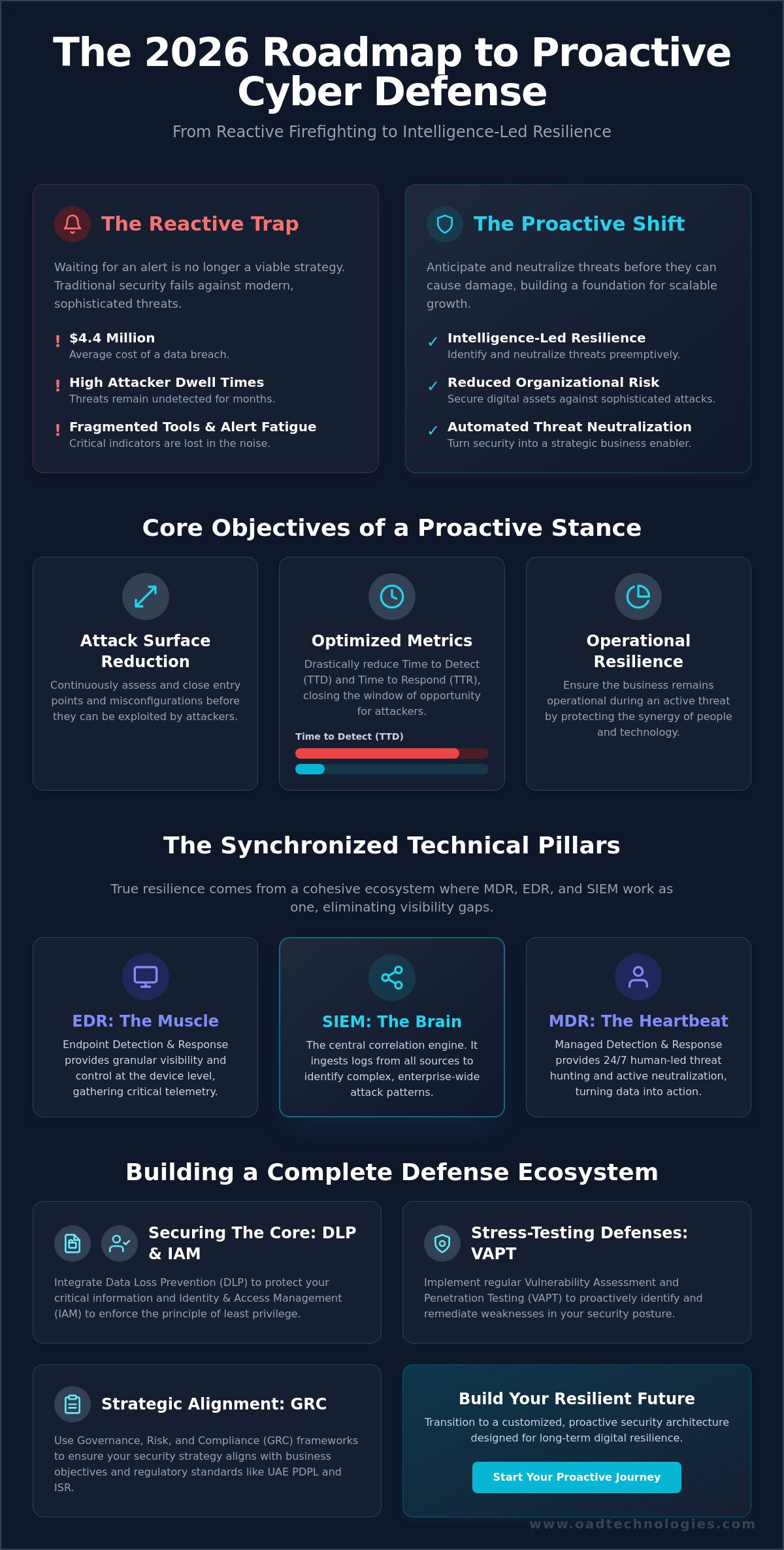
The primary failure of reactive security is the "Dwell Time" problem. In many legacy environments, attackers remain undetected for months, quietly mapping the network and escalating privileges. Relying solely on signature-based detection often leads to intense alert fatigue, where security teams are buried under thousands of low-level notifications. This noise allows critical indicators of a breach to slip through the cracks. The financial fallout is severe. IBM's 2025 report notes the average breach cost is $4.4 million, a figure that doesn't account for the long-term reputational damage or the strict penalties associated with UAE PDPL non-compliance.
Core Objectives of a Proactive Stance
Transitioning to a proactive stance focuses on three main goals to ensure long-term digital relevance:
- Attack Surface Reduction: We use continuous technical assessments to close entry points and misconfigurations before they're exploited.
- Optimized Metrics: Success is measured by a drastic reduction in Time to Detect (TTD) and Time to Respond (TTR), effectively closing the window of opportunity for attackers.
- Operational Resilience: By protecting the synergy between human insight and technological capacity, we ensure the business remains operational even during an active threat attempt.
The Technical Pillars: MDR, EDR, and SIEM Integration
Building a robust proactive cyber defense strategy requires moving beyond the acquisition of disparate security licenses. True resilience is found in a synchronized technical architecture where Managed Detection and Response (MDR), Endpoint Detection and Response (EDR), and Security Information and Event Management (SIEM) function as a single, cohesive ecosystem. When these pillars are integrated correctly, they eliminate the visibility gaps that modern adversaries exploit, turning fragmented data into a predictive shield for your enterprise.
From Detection to Response: The MDR Advantage
Managed Detection and Response (MDR) serves as the operational heartbeat of a proactive posture. It shifts the focus from passive alerting to active threat neutralization. While traditional providers might simply notify your team of a potential breach, a sophisticated MDR service intervenes in real-time to contain the threat. This is particularly critical for identifying "living off the land" attacks, where intruders use legitimate system tools like PowerShell or WMI to avoid triggering signature-based alarms. Human-led threat hunting is the only way to catch these subtle behavioral anomalies. For a deeper look at the mechanics of this 24 X 7 surveillance, explore our Managed Detection and Response (MDR) pillar.
SIEM and EDR: Orchestrating the Defense
SIEM is the central correlation engine for enterprise-wide security telemetry. It acts as the "brain" of your proactive cyber defense strategy, ingesting logs from across the network to identify complex attack patterns that a single tool might miss. EDR provides the "muscle" at the endpoint level, monitoring process execution and user behavior with granular precision. By observing how applications interact with the operating system, EDR detects the earliest signs of unauthorized lateral movement or privilege escalation.
The synergy between these tools allows for the implementation of automated playbooks. When the SIEM identifies a high-confidence threat pattern, it can trigger immediate containment protocols through the EDR, such as isolating an infected workstation or revoking a compromised user's access. This automation reduces the window of opportunity for attackers from hours to seconds. Achieving this level of sophistication requires more than just software; it requires engineered security solutions tailored to your specific organizational architecture. By treating these tools as an integrated system rather than standalone products, you ensure that your defense evolves as quickly as the threats it faces.
Securing the Core: Integrating DLP and IAM into Proactive Defense
While monitoring and response capabilities form the eyes and ears of your security posture, protecting the "crown jewels" requires a different set of architectural controls. Data is the ultimate target of almost every modern breach. Therefore, a proactive cyber defense strategy remains incomplete without the rigorous integration of Data Loss Prevention (DLP) and Identity and Access Management (IAM). These tools don't just react to theft; they define the boundaries of what is possible within your digital environment, effectively neutralizing threats by removing the opportunity for data exfiltration before it begins.
The synergy between these layers and Cloud Security Posture Management (CSPM) creates a truly resilient core. CSPM identifies and remediates misconfigurations in your cloud environment before they can be exploited by automated scanners. When you combine the configuration oversight of CSPM with the access controls of IAM and the data-centric protection of DLP, you create a multi-layered defense that anticipates both internal and external risks. This integration ensures that even if an attacker bypasses your initial monitoring layers, they find themselves in a highly restrictive environment where data movement is impossible.
DLP as a Predictive Shield
Modern DLP acts as more than a simple filter. It functions as a predictive shield by identifying sensitive data patterns and blocking unauthorized movement in real-time. Whether it's an accidental leak by a distracted employee or a deliberate exfiltration attempt by a compromised account, DLP ensures that your most critical assets never leave the perimeter. This layer is particularly vital for maintaining compliance with the UAE PDPL, where the cost of data exposure includes both financial penalties and lost market trust. For organizations looking to move beyond basic blocking, our Data Loss Prevention (DLP) pillar outlines sophisticated implementation strategies for 2026.
IAM and the Zero Trust Architecture
Identity is the modern perimeter. Within a proactive framework, Identity and Access Management (IAM) enforces the Principle of Least Privilege, ensuring that users only have access to the specific resources required for their roles. This approach significantly reduces the blast radius of a compromised credential. By verifying every request, regardless of whether it originates inside or outside the network, IAM forms the backbone of a Zero Trust architecture. Detailed architectural insights can be found in our Identity and Access Management (IAM) pillar. This continuous verification ensures that trust is never assumed, only earned through rigorous validation of user intent and device health.
Building the Roadmap: VAPT and GRC as Strategic Drivers
A sophisticated proactive cyber defense strategy is more than a collection of high-end software licenses. It's a structured methodology that aligns technical capacity with business objectives and regulatory mandates. Without the oversight provided by Governance, Risk, and Compliance (GRC) and the rigorous validation of Vulnerability Assessment and Penetration Testing (VAPT), even the most advanced tools can leave critical gaps in your infrastructure. These two components act as the compass and the stress test for your security architecture, ensuring every investment provides measurable protection.
VAPT: The Proactive Reality Check
Periodic penetration testing is no longer sufficient to secure the modern enterprise. As adversaries adopt automated scanning and AI-driven exploitation, your organization must move toward continuous security validation. VAPT serves as the proactive reality check that identifies where your defenses might buckle under pressure. By simulating real-world attack vectors, you gain a clear understanding of your actual exposure rather than relying on theoretical security. This data allows your team to prioritize remediation based on business risk; fixing the vulnerabilities that lead to the "crown jewels" first. For a deep dive into the latest testing methodologies, consult our VAPT pillar.
GRC: Aligning Defense with National Standards
Technical security measures often fail because they don't speak the language of the boardroom or the regulator. GRC provides the policy framework that bridges this gap. It ensures that your proactive cyber defense strategy satisfies the stringent requirements of the UAE Personal Data Protection Law (PDPL) and Information Assurance Standards (ISR). Beyond compliance, a well-defined GRC framework provides the reporting necessary to demonstrate the ROI of your security investments to executive leadership. It turns abstract technical metrics into concrete indicators of organizational resilience. You can explore the building blocks of this framework in our GRC pillar.
Moving from a reactive state to a mature, proactive posture requires a deliberate sequence of actions. It starts with a comprehensive risk assessment to establish your baseline. From there, you integrate the technical pillars discussed in previous sections, including MDR, SIEM, and DLP, before subjecting the entire system to continuous VAPT. This cycle ensures that your defense isn't a static wall but a living, evolving system. If you're ready to design a security architecture that anticipates tomorrow's threats, partner with OAD Technologies for a strategic consultation. We help you navigate these complexities with the precision of a master system designer.
OAD Technologies: Your Partner in National Cyber Resilience
OAD Technologies operates as a specialized system integrator and Managed Security Service Provider (MSSP) dedicated to the unique digital landscape of the United Arab Emirates. We don't believe in standardized, off-the-shelf security packages that fail to account for the nuances of your specific infrastructure. Instead, we adopt the role of a "Master Designer," meticulously crafting cybersecurity architectures that are as unique as the enterprises they protect. Our primary mission is to ensure your organization's long-term viability, providing a proactive cyber defense strategy that evolves alongside the market's shifting threat vectors. By bridging the gap between high-level innovation and practical business results, we help you maintain digital relevance in an increasingly complex world.
The OAD Advantage: Specialized Enterprise Protection
Our core expertise lies in the seamless integration of technical pillars like SIEM, EDR, and MDR into a unified, proactive shield. We understand that these tools only reach their full potential when they communicate fluently within a synchronized ecosystem; otherwise, they simply create more noise. Our team utilizes industry-standard professional terminology and rigorous engineering standards in every assessment, avoiding the empty marketing clichés that often obscure real risk. We don't just act as a third-party vendor. We function as a direct extension of your own team, bringing a deep curiosity for problem-solving to every project. This collaborative spirit ensures that we don't just identify vulnerabilities; we build the resilient frameworks necessary to neutralize them before they impact your operations.
Securing the Future of UAE Enterprises
National cyber resilience is the cornerstone of our strategic partnership approach. Through comprehensive technical security assessments and specialized GRC consulting, we help UAE enterprises align their proactive cyber defense strategy with the highest standards of the PDPL and ISR. We recognize that your security posture is an essential investment in your future growth. Our solutions are designed to protect your infrastructure while simultaneously supporting your strategic business goals, focusing on operational performance and tangible investment returns. We invite leadership teams to collaborate with us on a roadmap that empowers their human capital through advanced technological capacity. Contact us today to begin your transition from reactive firefighting to a state of sustained, intelligence-led resilience.
Securing Your Digital Future through Strategic Integration
The transition to a proactive cyber defense strategy is a strategic necessity for any enterprise aiming to thrive in 2026. By synchronizing technical pillars like MDR and SIEM with robust DLP layers, you create a synchronized ecosystem where threats are neutralized before they impact operations. This roadmap ensures that your defense remains agile, data-centric, and fully aligned with the evolving regulatory environment, turning security into a catalyst for innovation.
OAD Technologies offers deep Dubai-based expertise to ensure your architecture meets the rigorous standards of UAE ISR and PDPL compliance. Our capabilities in advanced MDR integration and specialized technical assessments, including VAPT and GRC, allow us to act as a master designer for your security ecosystem. We focus on long-term viability, ensuring your systems are built to withstand sophisticated, AI-driven attacks while supporting your strategic business goals.
It's time to stop reacting to incidents and start anticipating them. Consult with OAD Technologies to Design Your Proactive Defense Strategy and take the first step toward securing your enterprise's digital relevance. Building a resilient future is a collaborative effort, and we're ready to help you shape yours with precision and confidence.
Frequently Asked Questions
Is a proactive cyber defense strategy more expensive than a reactive one?
Initial capital expenditure for a proactive cyber defense strategy is often higher, but the long-term return on investment is far superior. Reactive models incur massive costs from incident response, extended downtime, and heavy regulatory fines under the UAE PDPL. By investing in pre-emptive tools, you reduce the likelihood of a $4.4 million breach. Proactive defense shifts your budget from crisis management to strategic growth, ensuring resources support business expansion rather than damage control.
How does MDR differ from a traditional Managed Security Service Provider (MSSP)?
A traditional MSSP focuses on log management and passive alerting, whereas MDR provides active threat neutralization. While an MSSP tells you that a house is on fire, an MDR service enters the building to extinguish the flames. MDR utilizes advanced behavioral analysis and human-led threat hunting to contain incidents in real-time. This distinction is critical for organizations that don't have the internal bandwidth to manage thousands of daily security alerts effectively.
Can a proactive strategy prevent all cyber attacks?
No strategy can guarantee 100% prevention, but a proactive posture drastically reduces the blast radius of any intrusion. The goal is to minimize dwell time and prevent lateral movement before an attacker reaches sensitive data. By assuming a breach will eventually be attempted, you build resilient layers that make successful exfiltration nearly impossible. This mindset ensures that a single compromised credential doesn't lead to a catastrophic enterprise-wide failure.
What role does AI play in proactive cybersecurity in 2026?
In 2026, AI acts as a force multiplier for both detection and automated response protocols. We use machine learning to identify polymorphic malware that bypasses signature-based tools by analyzing execution patterns in real-time. AI also powers automated playbooks within your SIEM to isolate infected endpoints instantly. This technology empowers your security team to handle high-volume threats, allowing human experts to focus on the most complex architectural challenges and strategic planning. Additionally, as AI-assisted cheating becomes a risk for professional certifications, companies can use Aiseptor to explore Usage-based exam security session fees and maintain the integrity of their technical assessments.
How do UAE regulations like PDPL influence proactive security requirements?
UAE PDPL and ISR standards mandate that organizations implement appropriate technical and organizational measures to protect personal data. A proactive cyber defense strategy fulfills these requirements by providing continuous monitoring and documented risk management. Compliance isn't just about a yearly audit; it's about demonstrating ongoing resilience. Proactive tools like DLP and IAM ensure that you meet these national standards while protecting your reputation in the local market.
How often should an enterprise conduct a VAPT to remain proactive?
Annual testing is no longer sufficient; enterprises should move toward quarterly assessments or continuous security validation. In a rapidly evolving threat landscape, a vulnerability discovered today could be exploited tomorrow. Regular VAPT sessions act as a stress test for your environment, ensuring that new cloud deployments or software updates hasn't introduced fresh entry points. This consistency is vital for maintaining a posture that outpaces modern, automated attack tools used by adversaries.
What is the first step in moving from a reactive to a proactive posture?
The first step is a comprehensive risk assessment to identify gaps in your current security architecture. You can't protect what you haven't mapped. This phase involves auditing your data flows, user access levels, and existing technical controls against a recognized framework like NIST CSF 2.0. Once you understand your baseline, you can design a customized roadmap that prioritizes investments based on actual business risk rather than generic industry trends.
How does DLP fit into a proactive defense framework?
DLP serves as the final barrier that prevents sensitive information from leaving your controlled environment. Within a proactive framework, it monitors data movement across endpoints, email, and cloud applications to block unauthorized exfiltration in real-time. It's an essential layer for neutralizing internal risks and accidental leaks. By integrating DLP with your IAM policies, you ensure that even authorized users can't move critical data into unsecure or unapproved locations.
Disclaimer
Content by OAD Technologies is for general informational purposes only and does not constitute professional or cybersecurity advice. No warranties are made regarding accuracy or completeness; reliance is at your own risk. OAD Technologies shall not be liable for any direct or indirect losses arising from use of this content.