
With the average cost of a data breach reaching a record $4.88 million in 2026, treating data protection as an optional overhead is a gamble your organization cannot afford. You understand that a robust Data Loss Prevention (DLP) framework is essential, yet leadership often views security as friction that slows down innovation. Mastering how to convince management we need dlp requires a shift in perspective, moving from technical defense to strategic resilience.
It's challenging to justify a budget when the primary win is the absence of a disaster, especially with competing digital transformation goals. We've designed this guide to help you bridge that gap by translating technical vulnerabilities into the financial language the board respects. You'll gain access to a structured business case template, clear ROI metrics for data protection, and the tactical confidence needed to address executive pushback during critical budget reviews. We'll explore how to frame compliance with the EU AI Act and new state privacy laws, such as those in Oregon and Indiana, not as hurdles, but as competitive advantages. By the end of this guide, you'll be able to demonstrate how a customized DLP solution empowers your team and protects your digital relevance in an increasingly volatile market.
Key Takeaways
- Redefine data protection as a strategic business framework that secures assets in motion, at rest, and in use within the 2026 digital landscape.
- Master the executive vocabulary needed to translate technical vulnerabilities into measurable business impacts like forensic audit costs and brand equity preservation.
- Overcome the primary objection regarding employee productivity by implementing modern, context-aware solutions that work transparently in the background.
- Gain a clear, five-step roadmap for how to convince management we need dlp, including methods for mapping critical data flows directly to your organization's revenue streams.
- Leverage specialized expertise to navigate complex GRC requirements and local data laws, ensuring your security investments offer long-term viability.
Why Data Loss Prevention is a Strategic Priority in 2026
Data is no longer just a byproduct of business; it's the business itself. In the current market, your organization's information is simultaneously its most valuable asset and its highest liability. Modern Data Loss Prevention (DLP) software functions as a comprehensive strategic framework rather than a simple utility. It's designed to identify, monitor, and protect sensitive information as it moves through various states: in motion across networks, at rest in storage, and in use at the endpoint. Understanding how to convince management we need dlp starts with shifting the narrative from technical defense to business continuity.
Legacy security tools like firewalls and antivirus software are fundamentally ill-equipped for 2026. They were built to guard the perimeter, but that perimeter has evaporated. Today's threats aren't just "knocking at the door"; they often originate from within, through accidental leaks or the misuse of authorized access. While a "Security-First" strategy often creates friction that slows down innovation, a "Business-First" DLP strategy integrates protection into the workflow. It ensures that the organization remains agile without exposing itself to the record-high $4.88 million average cost of a data breach.
The Evolution of Data as a Business Asset
In the UAE's thriving digital economy, data drives every competitive advantage. However, when sensitive information is unmanaged, it becomes "toxic." This toxicity surfaces when data is over-retained, improperly shared, or poorly classified, leading to massive regulatory fines and loss of client trust. DLP acts as the essential bridge between operational speed and regulatory safety. By implementing a customized DLP strategy, you transform data from a potential legal burden into a secure, leverageable asset that supports long-term viability.
Why Perimeter Defenses are No Longer Sufficient
The rise of the "borderless office" and cloud-native workflows has moved data far beyond the reach of traditional network security. Statistics from 2026 indicate that 67.7% of businesses experienced significant data loss in the past year, often through channels that firewalls simply don't monitor. Accidental leakage is a primary culprit; for instance, roughly 11% of data pasted into generative AI tools now contains confidential corporate information.
While a robust Identity and Access Management (IAM) system is vital for controlling who enters your digital environment, it doesn't track what users do with data once they've been granted access. DLP provides that critical secondary layer of defense. It monitors the context of data usage, preventing sensitive files from being uploaded to unauthorized AI platforms or personal cloud storage, even by legitimate users. This synergy between human insight and technological capacity is what keeps a modern enterprise resilient.
Translating Technical Risks into Executive Business Impact
When you speak to the board, technical jargon like "unauthorized data exfiltration" or "endpoint vulnerabilities" often falls on deaf ears. To succeed in how to convince management we need dlp, you must pivot your language toward revenue protection, market share, and long-term viability. Executives don't view the world through the lens of patches and firewalls; they view it through the lens of risk management. By building a business case for DLP that highlights the financial consequences of inaction, you transform a security tool into a strategic insurance policy.
In the UAE, the Personal Data Protection Law (PDPL) has turned data governance into a significant financial risk factor. Non-compliance isn't just a legal headache; it's a direct threat to the balance sheet. Rather than positioning Data Loss Prevention as a barrier to productivity, frame it as the engine for "Safe Digital Transformation." It allows the business to adopt generative AI and cloud-native workflows with the confidence that proprietary trade secrets won't leak into the public domain. This proactive approach ensures that innovation doesn't come at the cost of the company's reputation.
The Financial Reality of Data Breaches in 2026
The numbers in 2026 are stark. With the average cost of a data breach hitting $4.88 million globally, the price of a reactive strategy is higher than ever. Direct costs like legal fees and forensic audits are only the beginning. You must also account for the "silent" costs: customer churn, diminished brand equity, and the loss of intellectual property that took years to develop. A strategic Data Loss Prevention (DLP) implementation is a controlled investment that prevents these catastrophic, unpredictable expenses.
| Metric | Proactive DLP Strategy | Reactive Breach Recovery |
|---|---|---|
| Financial Impact | Predictable operational expenditure | Average $4.88M per incident |
| Regulatory Standing | Full compliance with UAE PDPL | Heavy fines and mandatory audits |
| Brand Reputation | Enhanced trust with enterprise clients | Significant public loss of confidence |
| Operational Speed | Controlled, safe innovation | Total shutdown during remediation |
Compliance as a Competitive Advantage
Beyond risk mitigation, robust data protection is a powerful tool for business growth. Enterprise clients and government entities increasingly require proof of stringent data controls before awarding major contracts. By meeting international standards like ISO 27001 or GDPR, your organization positions itself as a reliable global partner. Utilizing a sophisticated Governance Risk and Compliance (GRC) framework allows you to provide the board with clear, data-driven reports on your security posture. This transparency not only wins approval but also streamlines the path to international expansion. If you're ready to move beyond basic defense, a tailored data risk assessment can provide the hard evidence your management team needs to authorize the investment.
Addressing Management's Core Objections to DLP
The most significant barrier in how to convince management we need dlp is rarely the budget itself. Instead, it's the pervasive fear that security controls will stifle innovation and frustrate high-performing teams. Management often remembers legacy systems that blocked legitimate file transfers or flagged harmless emails, creating a bottleneck that impacted the bottom line. You must address this "productivity killer" myth head-on by demonstrating that modern data protection is built on transparency and context rather than rigid restriction.
Unlike the static rules of the past, 2026-era technology utilizes AI-driven classification to distinguish between a routine business process and a genuine risk. This drastically reduces the "False Positive" problem that once plagued IT departments. By automating the identification of sensitive data, the system operates quietly in the background, only intervening when a high-risk action occurs. This shift from a block-by-default mentality to a context-aware approach ensures that business momentum remains uninterrupted while your most sensitive assets stay secure.
Security Without Friction: The User Experience Argument
Modern DLP functions as an invisible safety net rather than a rigid roadblock. Context-aware policies allow for nuanced responses; for instance, an employee might be prevented from uploading a sensitive spreadsheet to a personal cloud but permitted to share it via a secure, corporate-sanctioned link. We also see the rise of "Education at the Point of Infraction," where users receive real-time prompts explaining why an action was flagged. This empowers people to make better decisions in the moment without requiring a manual support ticket for every minor alert.
The Resource and Talent Gap Objection
Another common pushback involves the human cost of management. Executives fear they'll need to hire a massive team just to monitor alerts and tune policies. A crucial step in how to convince management we need dlp involves demonstrating how managed services remove this burden from internal teams. By applying Managed Detection and Response (MDR) principles to data protection, you can leverage external expertise to handle the heavy lifting. This "Buy vs. Build" strategy reduces overhead and ensures your internal team stays focused on high-level strategic growth rather than chasing false alarms, guaranteeing long-term viability without bloating your payroll.
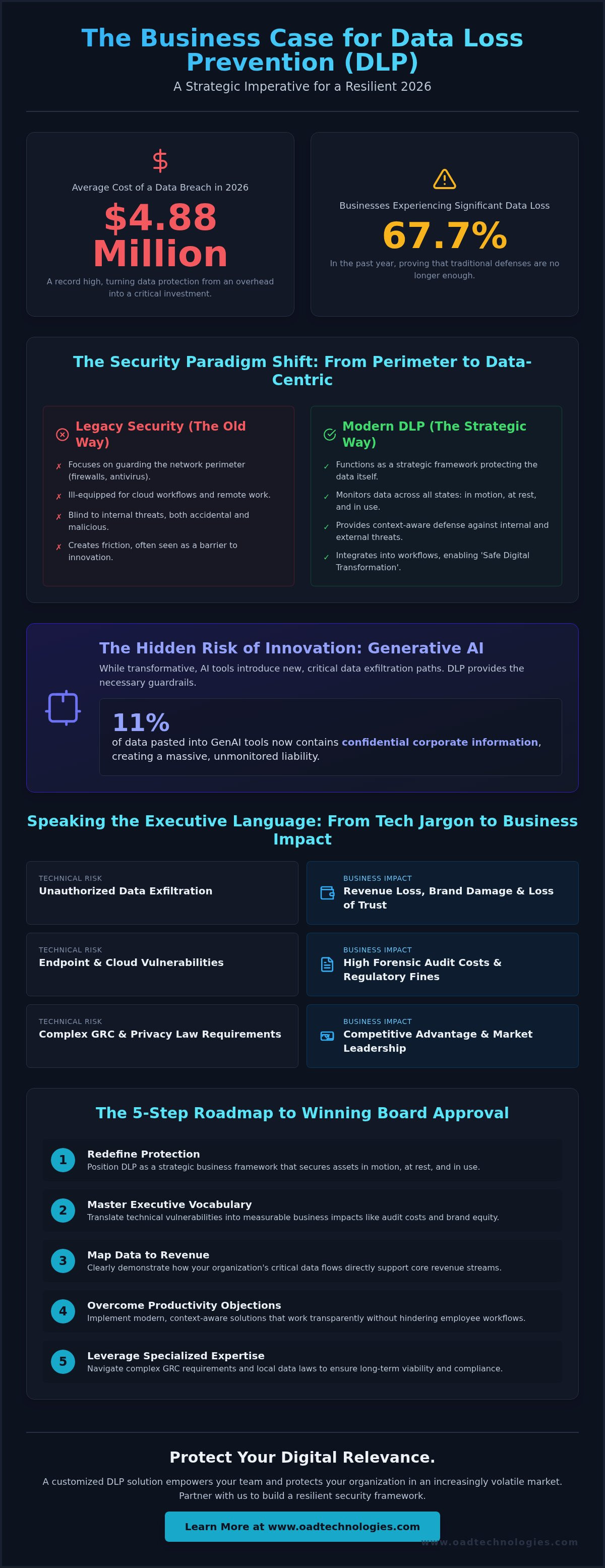
The 5-Step Roadmap to Winning Board Approval
Securing executive buy-in for a new security initiative requires more than a list of technical requirements. It demands a structured, evidence-based plan that aligns with the organization's broader commercial goals. If you're wondering how to convince management we need dlp, you must present a roadmap that minimizes business disruption while maximizing risk reduction. By following this five-step process, you transform a complex technical project into a manageable strategic evolution.
Your goal is to move from a state of reactive concern to one of proactive resilience. This starts with visibility and ends with measurable performance indicators that the board can easily digest. When management sees a clear path from current vulnerabilities to a future state of "safe innovation," the path to budget approval becomes significantly smoother.
Step 1 & 2: Proving the Need with Evidence
Management needs hard data to justify any significant investment. Start by conducting a high-level data discovery, often referred to as a "scare-free" audit. This isn't about pointing fingers; it's about identifying your "Crown Jewels." These are the critical 10% of data assets that represent 90% of your business value. You can use a Vulnerability Assessment (VAPT) to highlight exactly where this sensitive information is exposed across your network. Presenting a "Risk Heat Map" in your executive summary provides a visual representation of these gaps, making the abstract concept of data loss tangible for non-technical leaders.
Step 3: Aligning with the UAE PDPL
In 2026, regulatory compliance is a primary driver for board-level decisions. The UAE Personal Data Protection Law (PDPL) has introduced stringent requirements for how sensitive information is handled. You must demonstrate that a DLP framework is the most efficient way to meet these national mandates. This isn't just about avoiding fines; it's about maintaining the organization's digital relevance in a market that increasingly values data sovereignty and privacy. Framing DLP as a mandatory compliance tool removes the "optional" label from your request.
Step 4 & 5: Demonstrating a Controlled Rollout
One of the fastest ways to lose management's support is by proposing a "Block-All" approach that halts business operations. Instead, pitch a phased implementation plan. Start with a "Monitor-First" phase where you gather data on usage patterns without interfering with workflows. This allows you to fine-tune policies and ensure accuracy before moving into active prevention.
Success should be reported through KPIs that management actually cares about, such as "percentage reduction in high-risk data movements" rather than just the "number of blocked files." For a truly unified security posture, explain how you will integrate your data protection strategy with an existing SIEM solution. This creates a single pane of glass for all security events, increasing operational efficiency. To get started on your evidence-gathering phase, book a strategic data risk consultation with our team today.
Partnering for Resilience: Why OAD Technologies for DLP
Choosing the right partner is just as critical as the technology itself when you are finalizing how to convince management we need dlp. OAD Technologies doesn't just provide software; we act as a strategic extension of your internal team. We understand that a successful data protection strategy requires more than a "set and forget" installation. It demands a deep understanding of the UAE's specific regulatory environment, including the nuances of local GRC requirements and the PDPL. Our role is to bridge the gap between high-level executive strategy and the rigorous technical execution required to maintain digital relevance in 2026.
Our methodology focuses on the synergy between our Data Loss Prevention, Managed Detection and Response (MDR), and Cloud Security services. This unified approach ensures that your data is protected across every potential vector, from the endpoint to the cloud. By integrating these solutions, we provide a proactive defense that evolves alongside the shifting threat landscape, rather than a fragmented set of tools that create operational blind spots. This integrated posture provides the board with the reassurance that their investment covers the entire digital ecosystem.
Customized Integration vs. Standardized Software
We believe that standardized, "one-size-fits-all" deployments are a primary reason why many security projects fail to deliver measurable ROI. OAD Technologies rejects these generic approaches in favor of customized integrations that respect your unique business logic and workflows. We focus on the synergy between human insight and technological capacity, ensuring that our tools empower your people rather than restricting their productivity. This commitment to precision and high-quality craftsmanship guarantees the long-term viability of your investment, positioning your organization as a guardian of client trust in an ever-changing market.
Ready to Build Your Business Case?
If you're preparing for an upcoming budget review, you don't have to build your case in isolation. We provide the technical security assessments and "proof of risk" data points needed to transform a technical request into a compelling business imperative. Our team helps you refine your board presentation, ensuring you have the confidence to address executive pushback with hard evidence and clear financial metrics. Mastering how to convince management we need dlp is much easier when you have a partner who has already navigated these complex digital challenges for other leading UAE firms. When you're ready to secure your organization's future, schedule a strategic DLP consultation with OAD Technologies and let us help you design a system built for resilience.
Securing Your Organization's Digital Future
Transforming your security posture from a cost center to a strategic asset is the ultimate objective for 2026. You've learned that the secret to how to convince management we need dlp lies in shifting the conversation from technical vulnerabilities to financial resilience and competitive advantage. By quantifying the risks associated with the UAE's evolving regulatory landscape and demonstrating a phased, monitor-first implementation, you can overcome traditional productivity objections and prove the ROI of data protection.
Modern security is no longer about rigid restrictions; it's about creating a safe environment where innovation can thrive. With advanced AI-driven data classification and specialized UAE GRC and PDPL expertise, your organization can meet national mandates while maintaining operational speed. Integrating these efforts with comprehensive MDR and SIEM capabilities provides the unified security posture that executive boards demand for long-term viability. We're ready to help you bridge the gap between high-level innovation and practical business results.
Secure Your Enterprise Data with OAD Technologies' Strategic DLP Solutions
Your journey toward a more resilient, data-secure future starts with a single strategic conversation. We look forward to helping you shape the future of your organization's digital safety.
Frequently Asked Questions
Is DLP really necessary if we already use encrypted cloud storage?
Yes, because encryption and storage security only protect data at rest or against external hackers. They don't prevent an authorized employee from accidentally uploading a sensitive file to a public AI tool or a personal cloud. DLP provides the visibility and control over data usage that storage encryption lacks, ensuring that even "secure" data doesn't exit your controlled environment through legitimate channels.
How much does a typical DLP implementation cost for a UAE enterprise?
Implementation costs are highly dependent on the scope of your data environment and the number of protected endpoints. Instead of focusing on a flat fee, consider the cost of a managed service model which offers predictable monthly expenditures. This approach allows UAE enterprises to scale their protection as they grow, avoiding the massive upfront capital investment often associated with legacy on-premise security architectures.
Can DLP help us comply specifically with the UAE Personal Data Protection Law (PDPL)?
DLP is a fundamental technical control for meeting the UAE PDPL requirements. It allows your organization to identify sensitive personal data and enforce strict policies regarding its storage and transfer, especially across borders. By automating these controls, you provide the documented evidence of "due diligence" that regulators look for, which is a key part of how to convince management we need dlp.
Will implementing DLP affect our system performance or internet speed?
Modern DLP solutions are designed to operate with minimal impact on system performance or network latency. By utilizing lightweight endpoint agents and cloud-native API inspections, the system analyzes data in the background without slowing down the user experience. You can further optimize performance by focusing your policies on the "Crown Jewel" data assets rather than scanning every harmless file on the network.
How do we handle employee privacy concerns when monitoring data?
Balancing security with privacy requires clear communication and a focus on corporate data rather than personal activity. Implement role-based access controls and data masking so that security administrators only see the information necessary to mitigate a risk. Transparent policies that explain what is being protected and why help build trust, showing employees that the system is a safety net for the company's intellectual property.
What is the difference between an 'Endpoint DLP' and a 'Network DLP'?
Endpoint DLP resides directly on user devices like laptops and mobile phones, protecting data even when the device is off the corporate network. Network DLP monitors data in motion as it crosses the perimeter through email, web traffic, or file transfers. Using both creates a multi-layered defense that secures information at the source and at the exit point, which is essential for a borderless, cloud-first workforce.
How long does it typically take to see a return on investment from DLP?
You typically see a return on investment as soon as the first high-risk data movement is identified or blocked. While financial ROI is often quantified by the "lack of a breach," the immediate gain is the visibility into where your data lives and how it's being used. This clarity allows for more informed strategic decisions and streamlined compliance audits, providing long-term value beyond mere risk mitigation.
What happens if management still says 'no' after our presentation?
If management remains hesitant, propose a limited "Monitor-Only" pilot phase to gather concrete evidence of risk. Highlighting actual instances of sensitive data leaving the organization often provides the undeniable proof needed in how to convince management we need dlp. This data-driven approach shifts the conversation from hypothetical fears to tangible business impacts, making the need for a full implementation much harder to ignore.
Disclaimer
Content by OAD Technologies is for general informational purposes only and does not constitute professional or cybersecurity advice. No warranties are made regarding accuracy or completeness; reliance is at your own risk. OAD Technologies shall not be liable for any direct or indirect losses arising from use of this content.