

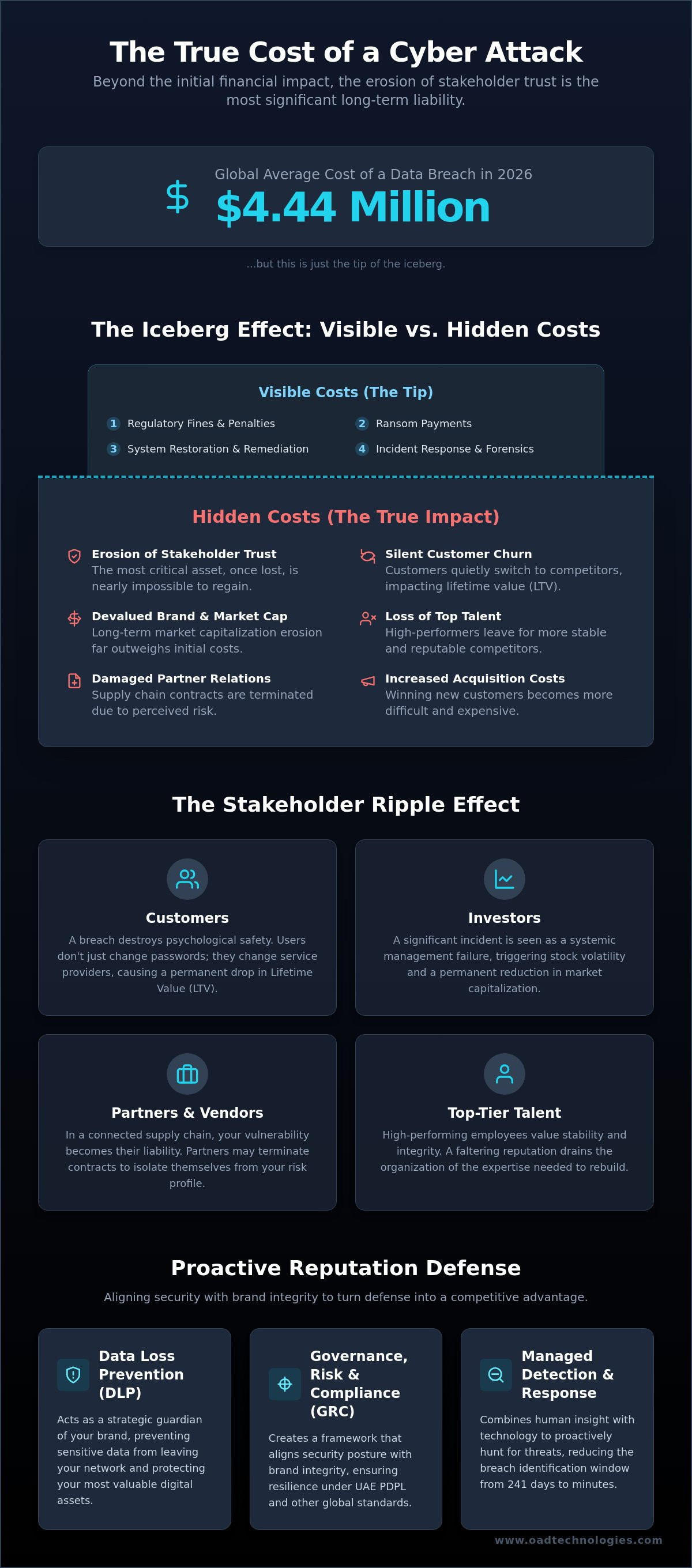
With the global average cost of a data breach reaching $4.44 million in 2026, the immediate financial hit is often just the tip of the iceberg. You likely recognize that while systems can be restored, the reputational damage from a cyber attack often lingers for years, manifesting as silent customer churn and a devalued brand. It's frustrating to watch a decade of hard-won stakeholder trust evaporate because of a single vulnerability. When trust is your most valuable intangible asset, a security failure becomes a direct threat to your market standing and long-term viability.
You don't have to accept this erosion as inevitable. This article explores how to bridge the gap between technical security spend and brand value. You'll discover a strategic framework to explain reputational risk to your board and learn actionable steps to use security as a proactive trust-builder. We'll also examine the critical link between Governance, Risk, and Compliance (GRC) and brand integrity, ensuring your organization stays resilient under the UAE Personal Data Protection Law and other global standards. By the end, you'll see how to transform your defense strategy into a powerful engine for brand growth.
Key Takeaways
- Identify why stakeholder trust has become the most critical metric for assessing the long-term impact of a security incident in 2026.
- Learn to quantify the "Iceberg Effect," distinguishing between visible remediation costs and the invisible erosion of market capitalization.
- Discover how to mitigate the reputational damage from a cyber attack by positioning Data Loss Prevention (DLP) as a strategic guardian of your brand.
- Gain a framework for aligning Governance, Risk, and Compliance (GRC) with brand integrity to turn security posture into a competitive advantage.
- Explore how proactive brand protection and managed detection services create a synergy between human insight and technology to ensure digital relevance.
The Strategic Reality of Reputational Damage from a Cyber Attack in 2026
By 2026, cybersecurity has transcended the server room to become a central pillar of corporate governance. For UAE enterprises, a security incident isn't just a technical failure; it's a profound breakdown in the relationship between a brand and its stakeholders. We define cyber-reputational risk as the delta between expected digital integrity and actual security performance. While the immediate focus often lands on technical recovery, the long-term erosion of stakeholder confidence represents the most significant financial liability an organization can face. It's the difference between a temporary service interruption and a permanent loss of market relevance.
The reputational damage from a cyber attack has emerged as the primary "hidden cost" of digital operations. Unlike ransom payments or system restoration costs, brand devaluation doesn't appear on a single invoice. It manifests through increased customer acquisition costs and diminished market valuation over months or years. Understanding what is a data breach in this context requires looking past the leaked records to the fractured promises they represent. In UAE boardrooms, this has shifted the conversation from an "IT problem" to a top-tier enterprise risk. Leaders now recognize that a single breach can trigger a cascade of scrutiny that impacts every facet of the business.
The Intangible Asset: Why Trust is Your Most Fragile Currency
Digital trust acts as a silent multiplier for business growth. In a market where data sovereignty is now viewed as a fundamental right, 2026 consumers prioritize data integrity over legacy brand loyalty. A breach doesn't just lose data; it destroys the psychological safety users feel when interacting with your platform. When that safety is gone, the "average" user doesn't just change their password; they change their service provider. This shift means that reputational damage from a cyber attack can lead to a sudden, irreversible drop in Lifetime Value (LTV) across your entire customer base.
The Ripple Effect: Beyond the Immediate Ransom
The fallout of an incident extends far beyond the immediate operational downtime. A single event triggers a cascade of stakeholder scrutiny that can be difficult to manage without a pre-established framework. Consider these primary impact areas:
- Regulatory Scrutiny: Immediate investigations under the UAE Personal Data Protection Law (PDPL).
- Investor Confidence: Rapid sell-offs or lowered valuations as markets price in the risk of future negligence.
- Partner Relations: Termination of supply chain contracts as vendors seek to isolate themselves from your risk profile.
Social media acts as an accelerant in this process, turning a localized breach into a global narrative of negligence within hours. This rapid decay of brand value often leads to long-term market cap erosion that far outweighs the initial remediation expenses.
The Stakeholder Ripple Effect: How Cyber Incidents Erode Trust
The fallout from a security failure moves in concentric circles, starting at the point of impact and radiating through every stakeholder group. While the initial technical response focuses on containment, the long-term reputational damage can be just as harmful as the breach itself. Investors often view a significant incident as a symptom of systemic management failure. This perception triggers immediate stock volatility and can lead to a permanent reduction in market capitalization as the risk premium for the brand increases. With an average of 241 days required to identify and contain a breach, the window for stakeholder anxiety remains dangerously wide, allowing doubt to settle into the foundation of the business.
Top-tier talent also reacts to these crises. High-performing employees value stability and professional integrity. When a brand's reputation falters, these individuals often seek opportunities with more secure competitors to protect their own career trajectories. This "internal breach" drains the organization of the very expertise needed to rebuild. Simultaneously, your partners and vendors evaluate the risk of contagion. In a hyper-connected supply chain, your vulnerability becomes their liability, potentially leading to the termination of critical service-level agreements. Consequently, organizations like DPP Logistics Company Ltd maintain rigorous security protocols to ensure the reliability of their terminal and pipeline transportation services.
The Customer Defection Framework
A leak of Personally Identifiable Information (PII) creates an immediate trust gap that traditional marketing cannot bridge. The cost of acquiring a new customer in 2026 is significantly higher than the investment required to retain an existing one, yet retention becomes impossible if the user feels betrayed. Transparency serves as the only viable corrective measure. Organizations that provide clear, honest timelines of the incident can stem the defection rate. Those that obfuscate the truth often find that the reputational damage from a cyber attack leads to a terminal decline in customer lifetime value.
B2B Dynamics: The Breakdown of Partner Ecosystems
In the UAE enterprise market, being labeled a "toxic partner" is a business death sentence. Large-scale entities and government bodies have tightened their procurement standards, often requiring rigorous proof of resilience. A breach indicates a failure in these standards, often leading to the immediate suspension of existing contracts. To restore these relationships, firms must demonstrate a commitment to rigorous testing. Implementing regular Vulnerability Assessment and Penetration Testing (VAPT) signals to partners that you're actively closing the gaps that led to the crisis. Proactive security measures aren't just technical safeguards; they're essential tools for maintaining partner trust. You can evaluate your brand's digital resilience with a strategic partner to ensure your ecosystem remains secure.
Calculating the Economic Fallout: Beyond Immediate Remediation
The financial impact of a security incident follows a specific, often devastating trajectory. Executives often focus on the visible costs, like technical forensics or legal fees. However, the true economic fallout lies beneath the surface in what we call the "Iceberg Effect." Comprehensive research into the cost of malicious cyber activity demonstrates that spillover effects, such as the loss of intellectual property and long-term brand devaluation, often dwarf the initial remediation invoice. This invisible erosion is where the reputational damage from a cyber attack becomes a permanent line item on the balance sheet, affecting everything from credit ratings to future partnership opportunities.
Beyond market capitalization, organizations face a sharp rise in Customer Acquisition Cost (CAC). Negative media coverage forces marketing teams to spend significantly more to overcome the "trust deficit" in the market. It's much harder to convince a new client to share their data when your brand's recent history suggests it's a liability. Simultaneously, the insurance landscape in 2026 has become unforgiving. Post-incident, organizations see a significant spike in cyber insurance premiums, as underwriters reclassify the business into a higher risk tier. These recurring expenses create a drag on profitability that can last for years after the technical recovery is complete.
Market Valuation and Investor Sentiment
Institutional investors now treat cybersecurity as a core component of ESG (Environmental, Social, and Governance) scores. A significant breach suggests a fundamental failure in corporate governance, which often leads to a "trust discount" on share prices that persists long after the systems are restored. The CISO's role has evolved into a strategic protector of shareholder value. By maintaining a transparent and resilient posture, the CISO ensures that technical defenses translate into market confidence, preventing the sharp sell-offs that typically follow opaque or poorly managed incidents.
The Compliance Penalty: UAE Regulatory Scrutiny
In the UAE, the regulatory landscape adds a specific layer of financial and public pressure. Failures in Governance Risk and Compliance (GRC) significantly amplify the reputational damage from a cyber attack. Under the UAE Personal Data Protection Law (PDPL), regulatory actions and fines are often made public. This transparency serves as a formal acknowledgment of a "breach of promise" to the nation's digital vision and its citizens' privacy. For an enterprise, this public record of non-compliance acts as a recurring barrier to new government contracts and large-scale domestic partnerships, as non-compliance is increasingly seen as a failure of national duty.
Proactive Reputation Defense: Technical Controls and GRC Frameworks
Managing the reputational damage from a cyber attack requires a shift from reactive crisis management to proactive technical engineering. By the time a PR firm is drafted to handle the fallout, the erosion of trust is often already irreversible. Resilient organizations treat brand integrity as a measurable metric protected by specific technical controls rather than a vague sentiment. This roadmap begins with identifying where your most sensitive data lives and ensuring it never leaves your perimeter without authorization. By building defense into the architecture, you transform security from a cost center into a trust-enabling asset.
Trust is fortified through Identity and Access Management (IAM), which enforces the principle of least privilege. In 2026, the assumption of a secure perimeter is obsolete; a Zero Trust architecture ensures that even if an attacker gains entry, their movement is restricted. This containment prevents the massive data exfiltration that causes the most severe reputational damage from a cyber attack. This is complemented by Managed Detection and Response (MDR), which provides the continuous monitoring necessary to intercept threats before they become public scandals. Regular VAPT exercises act as a stress test, identifying "reputational holes" in your architecture before malicious actors can exploit them.
DLP as a Brand Preservation Tool
Data Loss Prevention (DLP) serves as the ultimate guardian of the brand. Modern DLP policies shouldn't just block data; they should enable trust by automating data classification in alignment with UAE privacy standards. By protecting intellectual property and sensitive customer records, you maintain a competitive advantage that isn't easily eroded. This technical barrier ensures that a minor internal error doesn't escalate into a "headline breach" that defines your company’s public narrative for years.
The GRC Shield: Compliance as a Competitive Edge
A mature GRC framework demonstrates to global partners that your organization is reliable, disciplined, and forward-thinking. Preparing for the UAE Information Assurance Standards (ISR) provides a clear roadmap for this resilience, signaling to the market that you value data sovereignty. When security culture transcends the IT department and becomes a board-level priority, compliance becomes a competitive edge. It turns your regulatory obligations into a "seal of quality" that reassures investors and customers alike. You can secure your organization’s digital legacy by integrating these strategic frameworks into your core business operations.
Establishing Digital Resilience: The OAD Technologies Approach to Brand Integrity
OAD Technologies doesn't just deploy security software; we architect enterprise resilience. We reject the "one-size-fits-all" model that dominates much of the industry, recognizing that every organization in the UAE has a unique risk profile and brand promise. Our methodology moves beyond basic perimeter defense to ensure your company maintains its digital relevance in a market defined by rapid evolution. By integrating advanced SIEM and EDR solutions with deep human expertise, we create a defensive posture that evolves alongside emerging threats. This synergy ensures that technology empowers your people rather than just replacing manual processes, keeping your brand's integrity intact.
Our approach focuses on the proactive management of intangible risks. We understand that the long-term reputational damage from a cyber attack often stems from what happens outside your network as much as what happens inside. To counter this, we provide a structured, logical roadmap for security that aligns your technical investment with your brand's market value. We act as a strategic partner, working as an extension of your team to ensure your digital growth is grounded in rigorous engineering standards and visionary strategy. This commitment to craftsmanship means we prioritize long-term viability over quick technical fixes.
Brand Protection and External Threat Intelligence
True brand integrity requires looking beyond your own servers. OAD's Brand Protection services actively monitor the dark web for leaked corporate credentials, impersonation attempts, and spoofed assets. This vigilance extends to the physical environment; for instance, smartdetect AG provides advanced sensor technology for outdoor and building areas to prevent unauthorized access. By protecting both the digital and physical footprint, we prevent the reputational damage from a cyber attack before it can manifest as a public crisis, ensuring your brand remains a symbol of reliability in the eyes of your stakeholders.
Securing Your Future with OAD Technologies
UAE enterprises trust OAD Technologies because we bridge the gap between high-level innovation and practical business results. Our expertise in the UAE Personal Data Protection Law (PDPL) and strategic GRC consulting ensures your organization isn't just compliant, but competitively resilient. We serve as the guardian of your digital legacy, providing the stability and expertise needed to navigate the complex 2026 threat landscape. You can secure your reputation today with a comprehensive security assessment and ensure your brand remains protected against the evolving digital risks of tomorrow.
Architecting a Resilient Digital Legacy
By 2026, the distinction between a technical failure and a brand failure has vanished. We've explored how the hidden costs of a breach extend far beyond immediate remediation, manifesting as lost customer lifetime value and eroded investor confidence. Protecting against the reputational damage from a cyber attack requires a shift from reactive containment to a proactive, board-level strategy. This evolution demands a synergy between advanced technical controls like DLP and a robust GRC framework that signals reliability to the entire market. When security is treated as a core business driver, it becomes your most powerful tool for maintaining stakeholder trust.
As UAE-based strategic cybersecurity experts, OAD Technologies serves as a dedicated partner in this journey. We specialize in advanced Brand Protection and Data Loss Prevention, providing national coverage for GRC and VAPT services that ground your innovation in reality. We don't just secure systems; we act as the guardian of your digital relevance in an increasingly complex landscape. Partner with OAD Technologies to protect your brand's digital integrity and ensure your organization moves forward with absolute confidence.
Frequently Asked Questions
What is the most immediate reputational cost after a cyber attack?
The most immediate cost is the rapid erosion of customer trust, which often manifests as a spike in churn within the first 72 hours of public disclosure. Stakeholders react to the perceived lack of control over sensitive data, resulting in a trust deficit that complicates every future transaction. This initial shock triggers a cascade of negative sentiment that's difficult to reverse without a transparent and rapid incident response plan.
Can cyber insurance fully cover reputational damage?
Cyber insurance typically covers tangible remediation costs like forensic investigations and legal fees, but it can't restore a devalued brand. While these policies help manage the immediate financial fallout, the long-term reputational damage from a cyber attack remains a largely uninsurable risk. Insurance won't replace lost market share or the diminished investor confidence that follows a major breach; these require strategic resilience and technical safeguards rather than just financial indemnity.
How does the UAE Personal Data Protection Law (PDPL) affect my company's reputation?
The UAE PDPL imposes strict transparency and notification requirements that directly influence how the public perceives your organization's integrity. Non-compliance or a failure to notify affected individuals within the mandated timeframe can lead to public regulatory actions and fines. In the UAE market, these public disclosures serve as a formal record of negligence, which can disqualify enterprises from lucrative government contracts and strategic partnerships that prioritize data sovereignty.
How long does it typically take for a brand to recover from a major data breach?
Recovery from a major data breach is a multi-year process that extends far beyond the technical containment period. While systems might be restored in weeks, it often takes two to three years for a brand to return to its pre-incident valuation and trust levels. Organizations must demonstrate consistent security integrity over a long period to convince stakeholders that the vulnerability has been permanently resolved and that the corporate culture has fundamentally changed.
Is reputational damage worse for B2B or B2C companies?
Reputational damage affects both sectors, but the nature of the loss differs significantly. B2C companies face high-volume customer defection and a sharp spike in customer acquisition costs. B2B firms face a more terminal risk: becoming a "toxic partner" in the supply chain. A single incident can lead to the termination of high-value, long-term contracts as partners seek to isolate their own networks from potential contagion or regulatory scrutiny.
What role does Data Loss Prevention (DLP) play in reputation management?
Data Loss Prevention (DLP) acts as the primary technical guardian of the brand by identifying and stopping unauthorized data transfers before they become public scandals. By automating the protection of intellectual property and PII, DLP ensures that minor internal errors don't escalate into headline-grabbing breaches. This control is essential for preventing the reputational damage from a cyber attack by maintaining the digital integrity promised to your customers.
How can a company prove its security resilience to stakeholders before an attack?
Organizations can prove their resilience by maintaining mature Governance, Risk, and Compliance (GRC) frameworks and sharing high-level summaries of regular VAPT exercises. Demonstrating alignment with international standards and UAE-specific regulations like the ISR serves as a powerful trust signal. This proactive transparency shows stakeholders that security is a board-level priority and that the organization has a clear roadmap for protecting its most valuable intangible assets.
Disclaimer
Content by OAD Technologies is for general informational purposes only and does not constitute professional or cybersecurity advice. No warranties are made regarding accuracy or completeness; reliance is at your own risk. OAD Technologies shall not be liable for any direct or indirect losses arising from use of this content.