
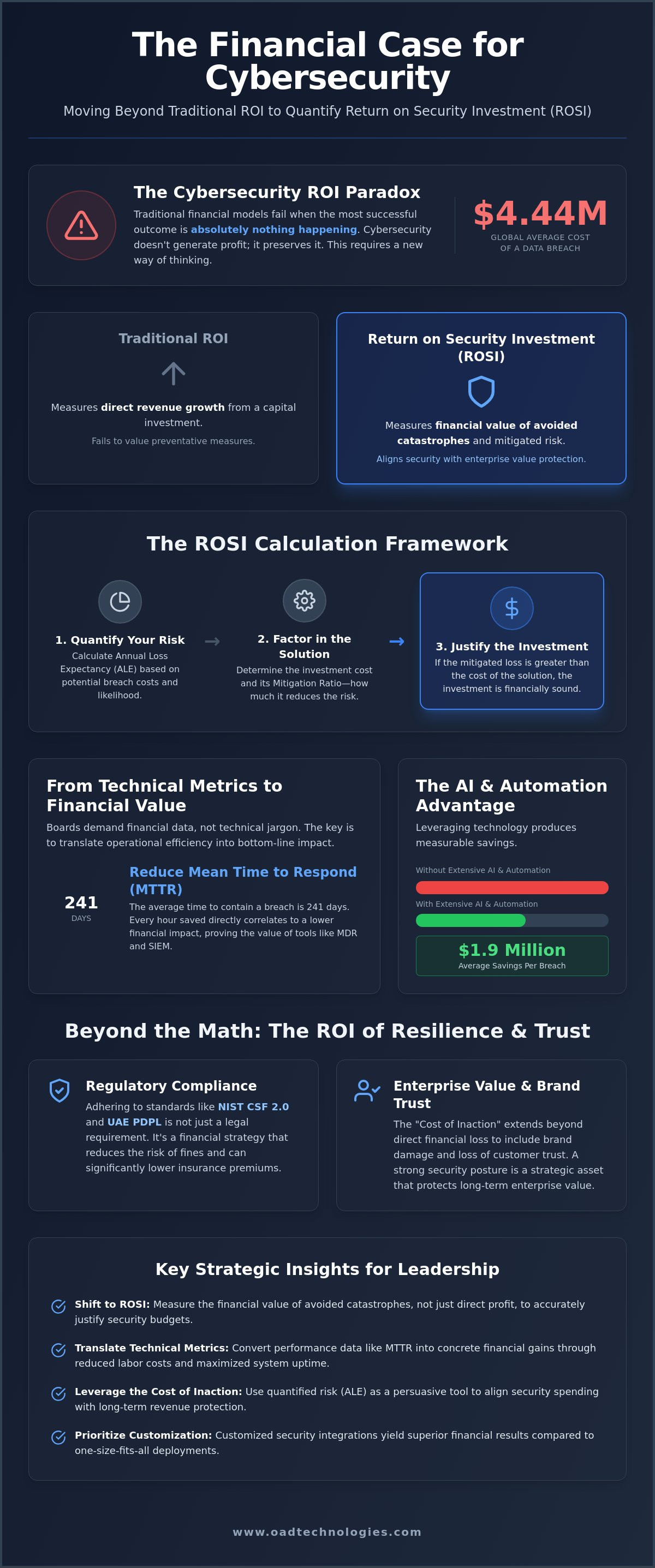
Can you justify a seven-figure security budget when the most successful outcome is absolutely nothing happening? With the global average cost of a data breach reaching $4.44 million in 2026, the stakes for financial precision have never been higher. Most leadership teams struggle with calculating roi of cybersecurity because they mistakenly treat digital defense as a fixed insurance cost. It's a common challenge to face CFO skepticism while trying to translate abstract technical vulnerabilities into the concrete language of financial risk.
We believe security is a strategic asset that protects the future value of your enterprise. This guide provides a sophisticated framework to bridge the gap between high-level innovation and practical business results. You'll master a repeatable Return on Security Investment (ROSI) formula. We'll also show you how to present board-ready data that justifies every investment while aligning with UAE regulatory compliance and NIST CSF 2.0 standards. By shifting the conversation from "cost center" to "quantified risk reduction," you can secure the resources needed to maintain long-term digital relevance. This approach ensures your security posture evolves alongside your business growth.
Key Takeaways
- Shift your perspective from traditional ROI to Return on Security Investment (ROSI) to accurately measure the financial value of avoided digital catastrophes.
- Translate technical performance metrics, such as Mean Time to Respond (MTTR), into concrete gains through reduced labor costs and maximized system uptime.
- Master a strategic framework for calculating roi of cybersecurity that accounts for regulatory resilience, specifically addressing UAE PDPL compliance and its impact on insurance premiums.
- Utilize the "Cost of Inaction" as a persuasive boardroom lever to align security expenditures with long-term enterprise value and revenue protection.
- Identify how customized security integrations provide superior financial yields compared to standardized, one-size-fits-all software deployments.
Defining ROSI: Why Traditional ROI Fails in Cybersecurity
Traditional business investments usually follow a predictable trajectory where capital expenditure leads to direct revenue growth. Cybersecurity disrupts this logic. It doesn't generate profit; it preserves it. This creates the "ROI Paradox" where the most successful outcome is the total absence of measurable events. Traditional ROI models fail in this environment because they aren't designed to value "nothing happening." By 2026, sophisticated decision-makers have moved beyond these limitations, focusing instead on calculating roi of cybersecurity as a measure of risk mitigation and enterprise resilience. With the global average cost of a data breach reaching $4.44 million in 2026, the financial stakes of getting this calculation wrong are severe.
This shift requires a transition from threat-centric thinking to risk-centric financial modeling. Instead of simply counting blocked attacks, leaders must quantify the potential financial impact of those attacks. Integrating foundational principles of information security management allows organizations to align their security posture with broader business objectives. The goal is to establish an Annual Loss Expectancy (ALE) baseline, which serves as the starting point for any meaningful financial justification. Without this baseline, your security spend remains a series of reactive expenses rather than a strategic investment. Calculating roi of cybersecurity starts with understanding exactly what is at risk.
The Core Components of the ROSI Formula
To move from intuition to evidence, you must break down the Return on Security Investment (ROSI) into its mathematical drivers. It begins with Single Loss Expectancy (SLE), which represents the total financial hit from one successful breach, including legal fees, remediation, and operational downtime. You then factor in the Annual Rate of Occurrence (ARO). In 2026, ARO isn't just a guess; it's an estimate informed by real-time threat intelligence and industry-specific breach frequencies. Finally, you apply the Mitigation Ratio. This percentage represents how effectively a specific tool, like Managed Detection and Response (MDR), actually reduces the risk. If a solution costs less than the risk it removes, the investment is logically sound.
Cyber Risk Quantification (CRQ) as a Foundation
Modern boards no longer accept "High" or "Medium" as valid risk descriptions. They demand Cyber Risk Quantification (CRQ) that translates technical debt into Dirham-based financial exposure. By using historical data and global benchmarks, you can set a realistic ALE that reflects your specific industry profile. This move toward precision allows you to justify security spend by showing exactly how many millions in potential loss are being neutralized. Organizations that leverage AI and automation for security are already seeing savings of $1.9 million per breach, proving that technical efficiency has a direct financial footprint. ROSI is the financial expression of mitigated enterprise risk.
The Calculation Framework: Translating Technical Metrics to Financial Value
Calculating roi of cybersecurity requires converting technical performance indicators into financial outcomes. Security leaders often drown in logs, but the board cares about the bottom line. By focusing on operational efficiency, you can demonstrate how tools like SIEM and Managed Detection and Response (MDR) actively lower the "Cost of Response." These systems don't just find threats; they automate the initial stages of the incident lifecycle, which is vital when the average time to identify and contain a breach remains at 241 days. Using a framework for measuring cybersecurity ROI helps bridge this gap between engineering metrics and executive expectations.
Time is the most expensive variable in any breach scenario. Every hour reduced in MTTR correlates to a specific percentage of saved breach impact. In 2026, organizations that extensively use AI and automation for security save an average of $1.9 million per breach compared to those that don't. This isn't just about speed; it's about reducing the "False Positive Tax." Refined detection through EDR reduces the noise that leads to alert fatigue, ensuring your team's labor cost is spent on genuine threats. This precision prevents architectural debt, much like how regular VAPT ensures your infrastructure remains resilient without requiring emergency, high-cost overhauls.
Operational Metrics vs. Business Outcomes
The choice between an in-house SOC and an MDR service often comes down to the total cost of ownership. Maintaining an internal team requires continuous training and 24 X 7 staffing, which often leads to higher MTTR due to resource constraints. Strategic resilience spend shifts the focus from simple "protection" to "containment speed."
| Metric | Traditional Security Spend | Strategic Resilience Spend |
|---|---|---|
| Response Strategy | Reactive/Manual | Proactive/Automated |
| MTTR Impact | High (Days/Weeks) | Low (Minutes/Hours) |
| Cost Structure | High Fixed Capital | Optimized Operational Expense |
Risk Reduction per Security Layer
Each layer of your stack contributes differently to the ROSI. Implementing robust Identity and Access Management (IAM) provides a high return by severely limiting lateral movement during a breach. Similarly, the ROI of Cloud Security Posture Management (CSPM) is found in its ability to prevent misconfiguration-led leaks, which account for a massive portion of cloud-based exposures. To see how these layers integrate into a unified defense, explore how our tailored security architectures can optimize your ROSI.
Beyond the Math: The ROI of Compliance and Brand Equity
Quantifying security value often stops at operational metrics, yet the most significant financial impacts frequently occur in the legal and reputational arenas. In 2026, calculating roi of cybersecurity must account for the heavy cost of non-compliance. Under the UAE Personal Data Protection Law (PDPL), organizations face substantial financial penalties for failing to safeguard sensitive information. These fines aren't just line items; they represent a direct hit to the bottom line that could have been mitigated through a structured GRC framework. Beyond legal fees, regulatory resilience helps stabilize cyber insurance premiums. S&P Global Ratings forecasts a 15% to 20% increase in cyber insurance pricing this year. Organizations with documented, audited controls are better positioned to negotiate lower rates or maintain coverage in a tightening market.
Brand equity remains an intangible asset until a breach makes its value painfully clear. Quantifying the impact of a security event on customer trust and market share is essential for a complete financial picture. A single high-profile incident can lead to immediate churn and long-term damage to B2B relationships. Conversely, a robust security posture creates a "Trust Dividend." In modern B2B contracts, proving your digital resilience acts as a competitive advantage, often accelerating the sales cycle and justifying premium pricing. You're not just buying software; you're securing your right to compete in a high-trust global economy.
Navigating the UAE Regulatory Landscape
Aligning your security spend with local Information Assurance (IA) standards is a strategic necessity. For organizations operating within the UAE, calculating roi of cybersecurity includes the avoidance of "Stop-Work" orders that can arise during national audits. Automated compliance reporting reduces the manual labor required for these audits, turning a weeks-long process into a streamlined data exercise. This proactive approach ensures that your operations remain uninterrupted, preserving revenue streams that would otherwise be at risk during regulatory scrutiny.
Intangible Asset Protection
Your intellectual property (IP) is often your most valuable asset, yet it is frequently the hardest to value on a balance sheet. Implementing Data Loss Prevention (DLP) allows you to put a shield around proprietary data, ensuring that your R&D investments don't end up in the hands of competitors. Similarly, advanced email security solutions provide a high return by preventing Business Email Compromise (BEC). Since ransomware accounts for 60% of large cyber insurance claims, stopping the initial entry point through email is a high-yield tactic. This focus on long-term viability positions your organization as a guardian of digital relevance, ensuring you remain a trusted partner in an ever-changing market.
The Boardroom Pitch: Presenting the ROI Case to Executive Leadership
Boards of directors rarely speak the language of CVE scores or firewall logs; they speak the language of EBITDA, market share, and enterprise value. To secure the necessary budget, you must stop presenting cybersecurity as a technical requirement and start presenting it as a financial safeguard. Calculating roi of cybersecurity involves translating abstract "vulnerabilities" into concrete "potential revenue loss." When you show that the global average cost of a data breach has reached $4.44 million in 2026, the conversation shifts from "how much does this cost" to "how much does this protect." You're not just asking for a budget; you're proposing a strategy to preserve the company's valuation.
The most common objection you'll face is the survivor bias: "We haven't been hit yet, so why increase spending?" This is where you use the "Cost of Inaction" as a psychological and financial lever. With 68% of breaches involving a human element, the lack of a past incident is no guarantee of future safety. By visualizing the security roadmap, you move the perception of your department from a cost center to a business enabler. You're building a resilient architecture that allows the company to take calculated risks and enter new markets with confidence. It is vital to align security metrics with the organization's specific revenue drivers to ensure the board views protection as a growth enabler rather than a friction point.
The CFO-Ready Dashboard
Your presentation should focus on the distinction between predictable operational costs and unpredictable catastrophic losses. CFOs value stability; they prefer a controlled subscription for managed services over a surprise $10 million remediation bill. Frame your security stack as a blend of risk transfer, through insurance and partnerships, and risk mitigation, through technical controls. Emphasize the synergy between human insight and technological capacity. This combination ensures that your reporting isn't just a data dump, but a strategic overview of how the company is actively shaping its digital future.
Scenario-Based Modeling
Use "Best-Case," "Expected," and "Worst-Case" breach scenarios to ground your request in reality. Show how a proactive SIEM implementation flattens the risk curve by drastically reducing the time a threat remains undetected. Since organizations using AI-powered security save an average of $1.9 million per breach, these savings should be central to your expected scenario. This data-driven approach replaces fear with financial logic, making it easier for leadership to approve investments that offer long-term viability. To ensure your next board presentation is backed by rigorous engineering standards, explore our strategic advisory services.
OAD Technologies: Maximizing ROSI Through Strategic Partnership
Standardized security models often fail to deliver promised returns because they ignore the unique architectural nuances of your business. Diluted ROI is the inevitable price of a generic approach. At OAD Technologies, we act as strategic partners and master designers of systems, ensuring that every deployment is customized to your specific risk profile. This precision is essential when calculating roi of cybersecurity, as it allows us to map technical controls directly to your most critical business assets. We reject one-size-fits-all software in favor of individualized solutions that respect your existing infrastructure while preparing it for future growth.
Our Data Loss Prevention (DLP) and Managed Detection and Response (MDR) services provide measurable risk reduction from the moment of integration. By immediately lowering the single loss expectancy of your most sensitive data, we provide a clear financial baseline for your investment. For example, with the average cost per breached record reaching $160 globally and $264 in the U.S. in 2026, our DLP solutions offer a direct, calculable defense against high-volume data theft. We bridge the gap between high-level innovation and practical results, moving beyond empty marketing claims to deliver rigorous engineering standards that satisfy both technical leads and executive leadership.
Tailored Managed Services for the UAE Market
Operating within the UAE requires a deep understanding of localized regulatory requirements, including the PDPL and national Information Assurance standards. OAD Technologies leverages this expertise to ensure your security spend aligns perfectly with compliance mandates, effectively reducing the total cost of ownership (TCO) through integrated security stacks. Our technical assessments, such as VAPT, serve as a periodic proof of value. They identify exactly where risk has been mitigated and where your ROSI is highest, providing the data needed for continuous board-level justification. This proactive approach ensures your organization remains a reliable, forward-thinking entity in the regional market.
To further capitalize on this regional stability, many enterprises leverage the expertise of EmirAds to drive data-driven marketing results that complement their hardened security posture.
The Future of Your Security Investment
Threats don't remain static, and your security investment shouldn't either. We ensure your ROI grows over time through continuous evolution and the synergy of human insight combined with technological capacity. Rather than simply replacing your processes, our tools empower your team to achieve superior operational performance. This proactive mindset positions OAD as a guardian of your digital relevance, ensuring long-term viability in a volatile market. It's about more than a quick fix; it's about a clear roadmap for every project we undertake. Contact OAD Technologies for a Strategic Risk Assessment to begin quantifying your resilience today.
Securing Enterprise Value Through Quantified Resilience
The transition from viewing security as a static expense to a dynamic business enabler is the hallmark of a visionary leader in 2026. You now have the framework to bridge the gap between technical metrics like MTTR and the bottom-line financial health of your enterprise. By mastering the process of calculating roi of cybersecurity, you move beyond reactive guesswork into a realm of data-driven strategic planning. This ensures your organization doesn't just survive threats but thrives by turning regulatory compliance and brand protection into tangible competitive advantages.
OAD Technologies acts as your master designer of systems, providing Dubai-based expertise in UAE ISR and PDPL compliance. Our specialized focus on Data Loss Prevention (DLP) and Managed Detection and Response (MDR) delivers measurable risk reduction that grows alongside your business. We favor a visionary approach to enterprise-wide strategic resilience that empowers your people and protects your intellectual property. Schedule a Strategic Consultation with OAD Technologies to secure your ongoing digital relevance. Your path to a quantified and resilient future starts with a single strategic step.
Frequently Asked Questions
What is the standard formula for calculating cybersecurity ROI?
The industry standard for calculating roi of cybersecurity is the Return on Security Investment (ROSI) formula. This calculation subtracts the cost of the security solution from the value of the risk it mitigates, then divides that number by the solution's cost. It provides a percentage that represents the financial efficiency of your defense strategy. Using this model allows decision-makers to prioritize investments based on their ability to neutralize the highest financial threats.
How do you quantify the financial impact of a data breach in 2026?
Financial impact quantification in 2026 relies on a blend of industry benchmarks and internal operational data. With the global average breach cost at $4.44 million, you must factor in legal fees, remediation labor, and lost productivity. You should also include the cost of customer churn and brand damage, which are often the most significant long-term financial drains. Organizations using AI and automation save an average of $1.9 million per incident, highlighting the value of technical efficiency.
Can cybersecurity be considered a revenue generator for UAE businesses?
How does Managed Detection and Response (MDR) improve ROSI compared to in-house teams?
Managed Detection and Response (MDR) typically offers a higher ROSI than in-house teams by reducing the Total Cost of Ownership (TCO). Building an internal SOC requires significant capital for 24 X 7 staffing and continuous training, whereas MDR provides immediate access to expert insights and advanced tools. This model drastically lowers the Mean Time to Respond (MTTR), which correlates directly to lower breach containment costs. It allows your internal team to focus on strategic initiatives rather than routine log monitoring.
What are the hidden costs of cybersecurity that most ROI models miss?
Most ROI models miss the "False Positive Tax" and the cost of integration complexity. Alert fatigue leads to high staff turnover and missed threats, creating a hidden financial drain on the organization. Architectural debt is another factor; failing to perform regular assessments can lead to expensive emergency overhauls later. A sophisticated approach to calculating roi of cybersecurity must include these operational frictions to provide an accurate picture of long-term viability.
How do UAE regulations like PDPL affect the ROI of security investments?
UAE regulations like the Personal Data Protection Law (PDPL) significantly increase the ROI of security investments by raising the cost of non-compliance. Failing to protect sensitive data can lead to substantial fines and "Stop-Work" orders during national audits. Implementing robust GRC frameworks and Data Loss Prevention (DLP) tools mitigates these specific legal risks. These investments stabilize your financial outlook and ensure your organization remains a trusted entity within the regional regulatory landscape.
Is it possible to calculate ROI for preventative measures like VAPT?
It is possible to calculate the ROI of preventative measures like VAPT by measuring the reduction in Annual Loss Expectancy (ALE). These assessments identify vulnerabilities before they can be exploited, effectively lowering the probability of a high-cost breach. By preventing architectural debt, VAPT ensures that your infrastructure remains efficient and secure without requiring reactive, high-cost patches. This proactive approach preserves enterprise value and maintains your ongoing digital relevance in a high-threat environment.
How often should a company re-evaluate its cybersecurity ROI?
Organizations should re-evaluate their cybersecurity ROI at least annually or after any major shift in infrastructure or the threat landscape. Since global breach costs and insurance premiums fluctuate, an outdated ROI model can lead to misallocated resources. Continuous monitoring of metrics like MTTR and detection speed ensures your security spend remains aligned with current business objectives. This regular cadence of review maintains the synergy between your technological capacity and your strategic financial goals.
Disclaimer
Content by OAD Technologies is for general informational purposes only and does not constitute professional or cybersecurity advice. No warranties are made regarding accuracy or completeness; reliance is at your own risk. OAD Technologies shall not be liable for any direct or indirect losses arising from use of this content.