

If your organization suffers a breach, why would you rely on a standard backup restoration plan designed for simple hardware failure? Many leaders realize too late that restoring a database is not the same as recovering from a sophisticated cyberattack. You have likely felt the tension between stopping an active threat and the looming complexity of UAE PDPL compliance. It is difficult to quantify the impact of "soft" data loss when your primary tools are built to measure "hard" system downtime. We understand that this distinction often creates a gap between immediate incident response and long-term business continuity.
This article provides a strategic framework to master your disaster recovery plan for data breach scenarios as we approach 2026. You will learn how to transition from the chaos of a live incident to a structured recovery process that prioritizes data integrity and regulatory alignment. We will examine how to integrate advanced detection tools like MDR and EDR into your recovery lifecycle. By shifting your focus from mere restoration to validated digital trust, you can protect your organization's long-term viability in an increasingly volatile digital environment. This approach ensures your recovery is as sophisticated as the systems you aim to protect.
Key Takeaways
- Shift your perspective from basic system restoration to a model that prioritizes data integrity and the complete removal of residual threats.
- Implement a structured five phase framework to transform your disaster recovery plan for data breach from a chaotic response into a strategic operation.
- Leverage integrated tools like MDR and DLP to pinpoint lost data and establish a forensic timeline for the most accurate restoration point.
- Align your recovery processes with the UAE Personal Data Protection Law to meet mandatory notification timelines and regulatory standards.
- Build a resilient architecture that values long term digital trust over temporary fixes by combining human expertise with advanced security technology.
The Evolution of Disaster Recovery: Planning for Data Integrity
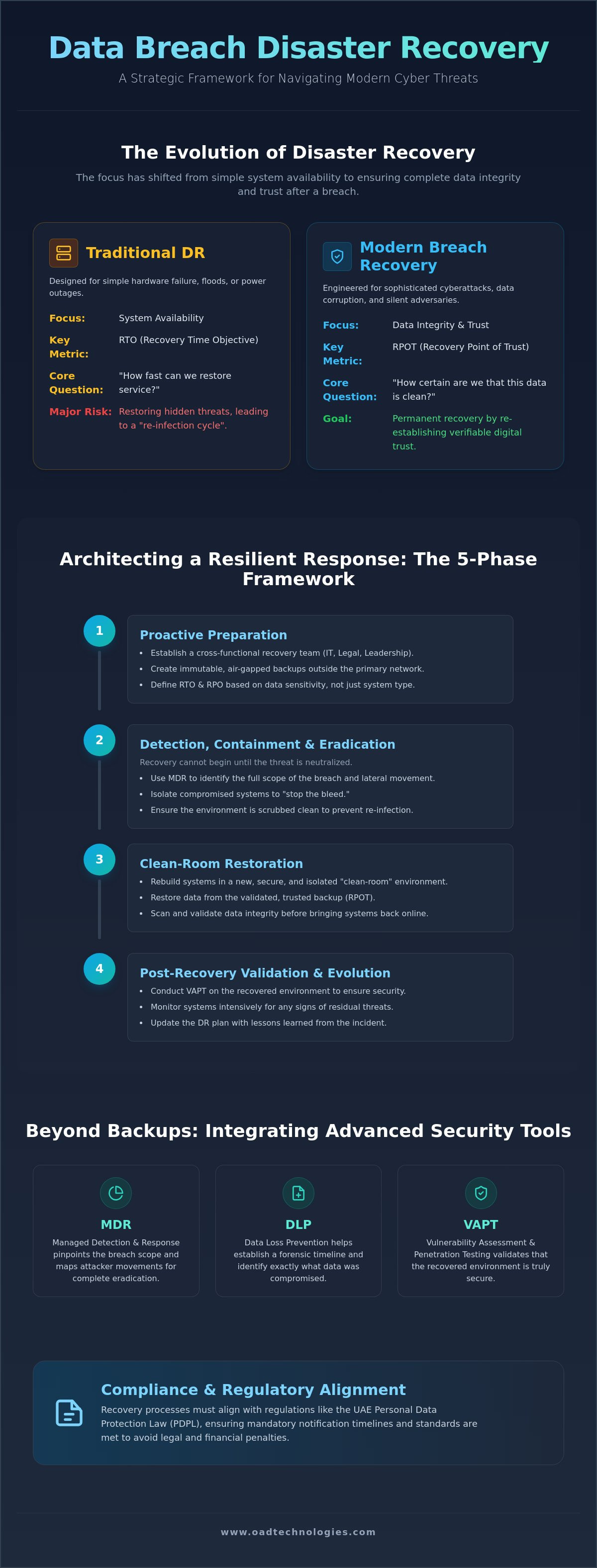
The concept of resilience is undergoing a radical shift. For decades, IT disaster recovery strategies focused almost exclusively on availability. If a server died or a data center flooded, success meant restoring service as quickly as possible. However, a modern disaster recovery plan for data breach requires a more nuanced approach. It's no longer enough to be "online" if the data you're serving is compromised or if the environment remains under the silent control of an adversary.
In the context of a cyberattack, disaster recovery is the process of restoring business operations while ensuring no residual threats remain. While traditional DR prioritizes the Recovery Time Objective (RTO), breach recovery centers on the Recovery Point of Trust (RPOT). This objective shifts the focus from "how fast can we restore?" to "how certain are we that this data is clean?" Restoring from a standard backup without this validation often results in a "re-infection cycle." You inadvertently restore the attacker’s backdoors along with your files, leading to a secondary crisis days later.
Incident Response vs. Disaster Recovery
Distinguishing between these two frameworks is vital for operational clarity. Incident response (IR) represents the immediate, tactical effort to "stop the bleed." It involves isolation, containment, and eradication of the threat. In contrast, disaster recovery is the long term strategy to "rebuild the house." Just as The Solution provides specialized damage repair and restoration for physical assets in the UAE, a disaster recovery plan for data breach officially triggers when the incident causes a significant loss of data integrity or system functionality that standard IR cannot resolve in real time. These frameworks must overlap. If they don't, you risk rebuilding on a foundation that's still compromised.
The High Stakes of Data Integrity
The greatest threat in 2026 isn't system downtime, but silent data corruption. If an attacker has been inside your network for weeks, your most recent backups are likely tainted. Simply rolling back 24 hours solves nothing. This is why we advocate for rigorous vulnerability assessment and penetration testing (VAPT) before any environment is declared "recovered." Validating the integrity of the data and the security of the host infrastructure ensures that your recovery is permanent rather than a temporary fix. You aren't just restoring data; you're re-establishing the digital trust that defines your brand's long term viability.
Architecting a Resilient Response: The 5-Phase Framework
A robust disaster recovery plan for data breach isn't a static document sitting on a shelf. It's an active, operational lifecycle that evolves with the threat landscape. We align our methodology with the NIST 5-Phase Framework, ensuring that every step from initial detection to final evolution is grounded in rigorous engineering standards. This structured approach moves your organization away from reactive "firefighting" and toward a controlled, evidence based restoration of services.
Phase 1: Proactive Preparation
Preparation goes beyond a simple checklist. You need a cross-functional recovery team that bridges the gap between legal counsel, IT specialists, and executive leadership. This team must establish immutable, air-gapped backups that reside entirely outside your primary production network. This physical and logical isolation is critical; it prevents ransomware or wipers from traversing the network to destroy your last line of defense. You must also define your Recovery Time Objective (RTO) and Recovery Point Objective (RPO) based on data sensitivity levels rather than just general system availability.
Phase 2 and Phase 3 focus on Detection, Analysis, Containment, and Eradication. Recovery cannot begin until the threat is neutralized. Organizations leverage Managed Detection and Response (MDR) to identify the full scope of the breach. This phase isn't just about finding the entry point. It's about mapping the attacker's lateral movement and ensuring the environment is scrubbed clean. Any restoration attempt on a compromised network is a wasted effort that risks immediate re-infection.
Phase 4: The Clean-Room Restoration
This is where the concept of "Evidence-Based Recovery" takes shape. Instead of pushing data directly back to production, we utilize a "clean room" or sandbox. This isolated environment allows you to test restored data for dormant malware or unauthorized scripts that might have been embedded weeks before the breach was detected. During this phase, Identity and Access Management (IAM) protocols are essential. You must reset all credentials and rotate cryptographic keys within the recovery environment to ensure the adversary cannot use stolen identities to regain access during the transition.
The final phase, Post-Incident Evolution, involves updating your Governance, Risk, and Compliance (GRC) framework. Forensic findings from the breach should directly inform your next iteration of security policies. If your current strategy lacks this level of technical integration, exploring comprehensive managed security services can help bridge the gap between reactive recovery and proactive resilience. By treating every incident as a blueprint for improvement, you ensure your organization's long term viability in an increasingly volatile digital market.
Beyond Backups: Integrating MDR and DLP into Recovery
Restoring from a backup is a binary action, but recovering from a breach is a forensic operation. A standard disaster recovery plan for data breach often fails when it treats all data as a monolith. In 2026, the complexity of multi-cloud environments and sophisticated lateral movement by attackers means you can't simply "hit reset." You need a recovery process that is guided by real-time security intelligence. By integrating Managed Detection and Response (MDR) and automated detection tools, you stop the re-infection loop where dormant threats are accidentally restored alongside your production data.
Cloud-native recovery adds another layer of complexity. We utilize Cloud Security Posture Management (CSPM) to ensure that the target recovery environment hasn't inherited the same misconfigurations that allowed the initial breach. This validation step is critical in multi-cloud strategies where identity permissions can be overly permissive. Without this automated oversight, your recovery efforts might inadvertently recreate the exact vulnerabilities the adversary exploited.
Leveraging SIEM for Forensic Precision
Precision is the cornerstone of a sophisticated recovery. We utilize SIEM to map the lateral movement of an attacker long before the first server is restored. This allows us to identify compromised service accounts and hidden persistence mechanisms that must be isolated. If you don't know exactly where the attacker went, you don't know what is safe to bring back online. SIEM logs act as the essential "black box" recorder that reconstructs the breach timeline to pinpoint the most reliable last known good state for your systems.
DLP as the Recovery Compass
While SIEM maps the "where," Data Loss Prevention (DLP) identifies the "what." It acts as a recovery compass, helping you prioritize the restoration of your "crown jewel" data assets over less critical systems. During the recovery window, DLP tools verify that sensitive information isn't being exfiltrated through hidden backdoors or unauthorized channels. Integrating these policies into your post-recovery monitoring phase ensures that your data remains within its intended boundaries. This level of granular control transforms recovery from a desperate scramble into a structured, high-integrity operation that protects your organization's digital relevance.
Compliance and Communication: Navigating UAE Regulations
Technical restoration is only half the battle. In the UAE, the success of your recovery is also measured by your alignment with the Personal Data Protection Law (PDPL). A sophisticated disaster recovery plan for data breach must bridge the gap between back-end engineering and front-end regulatory accountability. If your recovery process lacks a documented trail of evidence, you risk significant legal exposure even if your systems are back online. We help organizations integrate these legal requirements into their technical workflows to ensure a compliant, high-integrity restoration.
The role of Governance, Risk, and Compliance (GRC) is central to this transition. GRC tools act as the central repository for every action taken during the recovery lifecycle. By documenting the forensic findings from your SIEM and MDR tools, you create an audit-ready timeline that demonstrates due diligence to the UAE Data Office. This documentation isn't just a bureaucratic hurdle; it's a strategic asset that proves your organization acted decisively to protect the rights of data subjects.
UAE PDPL and Breach Notification
The PDPL mandates specific criteria for what constitutes a "notifiable breach." If the incident poses a risk to the rights and freedoms of individuals, you must report it to the UAE Data Office and, in many cases, the affected individuals themselves. Your disaster recovery plan for data breach should include a predefined checklist for these notifications. This ensures that you provide the necessary information without delay, including:
- The nature and scope of the data breach.
- The categories and approximate number of data subjects involved.
- The measures taken to mitigate the impact of the breach.
- The contact details of your Data Protection Officer (DPO) for further inquiry.
The Stakeholder Communication Strategy
Managing the "reputational disaster" requires a structured communication plan that establishes a single source of truth. Conflicting information between technical teams and public relations can erode trust faster than the breach itself. You must differentiate between internal messaging for employees and external messaging for clients and regulators. Transparency in the recovery process, when handled with professional cadence, actually builds long-term digital trust. It demonstrates that your organization values accountability over quick fixes. If your current framework lacks this level of regulatory precision, it may be time to consult with our GRC specialists to fortify your compliance posture before a crisis occurs.
Strategic Resilience: How OAD Technologies Fortifies Recovery
A plan is only as effective as the architecture it supports. At OAD Technologies, we act as a strategic partner to bridge the gap between technical complexity and practical business results. We don't just provide tools; we design recovery-ready architectures that ensure your disaster recovery plan for data breach is executable under high-pressure scenarios. Just as we design bespoke digital frameworks, UAE specialists like Auto Industries Factory LLC provide customized vehicle engineering to ensure physical operational readiness. By rejecting standardized, "one-size-fits-all" templates, we focus on customized resilience strategies that reflect your organization's specific operational priorities and digital footprint.
Our Managed Security Services, specifically our MDR and SIEM integrations, are engineered to accelerate recovery timelines. They provide the forensic clarity required to validate data integrity before restoration begins, as we discussed in previous sections regarding the "Recovery Point of Trust." This technical precision is backed by our GRC consulting, which ensures your documented recovery efforts survive rigorous regulatory audits. We help you move from a reactive posture to a state of strategic expansion, where technology empowers your people rather than just managing your risks.
Customized Recovery Architectures
We advocate for "resilience by design," a philosophy where security isn't an afterthought but a foundational element of your infrastructure. This approach creates a synergy between human insight and automated response tools within the OAD ecosystem. Our experts work as an extension of your team to build systems that are inherently difficult to compromise and efficient to restore. To understand how your current infrastructure would perform during a crisis, we recommend a comprehensive security assessment to pinpoint and remediate existing DR gaps.
Continuous Improvement and Testing
Strategic resilience requires constant evolution. We facilitate regular tabletop exercises and simulation-based testing to ensure your cross-functional teams are prepared for real-world breach scenarios. These sessions aren't just drills; they're opportunities to refine your disaster recovery plan for data breach based on the latest threat intelligence and forensic findings. This commitment to continuous improvement ensures your organization's long-term viability in a volatile market. It's time to move beyond basic backups and build a foundation of true digital trust. Partner with OAD Technologies for Enterprise Security to fortify your future.
Mastering the Path to Strategic Resilience
True resilience in 2026 demands a shift from simple system availability to absolute data integrity. You've explored how a sophisticated disaster recovery plan for data breach moves beyond basic backups to incorporate forensic validation and regulatory precision. By prioritizing the Recovery Point of Trust and integrating tools like MDR and DLP into your lifecycle, you ensure that your restoration is both clean and compliant. This approach transforms a reactive recovery into a strategic advantage that protects your organization's long-term viability.
OAD Technologies is here to act as your visionary partner in navigating these complex digital challenges. We provide specialized UAE market expertise and a comprehensive approach to MDR and GRC integration that ensures your architecture is resilient by design. Our goal is to empower your team with the tools and strategies needed to shape a secure future for your enterprise. Secure Your Enterprise with OAD Technologies Strategic Security Solutions. You have the framework to lead your organization through any crisis with confidence and technical authority.
Frequently Asked Questions
How is a disaster recovery plan for a data breach different from a standard IT DR plan?
A standard IT DR plan focuses on system availability and getting hardware back online after a failure. In contrast, a disaster recovery plan for data breach prioritizes data integrity and the total removal of persistent threats. You can't simply restore the most recent backup because it likely contains the attacker's backdoors. This specialized framework requires forensic validation to ensure the environment is secure before any services resume for the business.
Does the UAE Personal Data Protection Law (PDPL) require a disaster recovery plan?
The UAE PDPL mandates that data controllers implement technical and organizational measures to protect personal data from unauthorized access or destruction. This includes the ability to restore access to data in a timely manner following a technical incident. While the law doesn't name a specific document, a formal recovery framework is essential to meet these mandatory security standards. It proves your organization has the necessary controls to maintain ongoing digital accountability.
How quickly must a data breach be reported in the UAE?
Under the UAE PDPL, you must notify the UAE Data Office immediately after becoming aware of any breach that prejudices the privacy or security of a data subject. There isn't a fixed 72-hour window like in other jurisdictions; the emphasis is on immediate action. You must also communicate the incident to affected individuals if it poses a high risk to their rights. Delays in reporting can lead to significant regulatory scrutiny and penalties.
Can we use our standard backups to recover from a ransomware-based data breach?
You should only rely on standard backups if they are immutable and logically isolated from your primary network. Modern ransomware often targets backup repositories first to prevent a clean restoration. If your backups were connected to the production environment during the breach, they're likely compromised or deleted. A sophisticated disaster recovery plan for data breach utilizes air-gapped copies that remain untouched by an attacker's encryption scripts or lateral movement.
Who should be on the data breach disaster recovery team?
A resilient recovery team must be cross-functional to address technical, legal, and reputational risks simultaneously. It should include IT infrastructure leads, cybersecurity specialists from your MDR or SOC, legal counsel for PDPL compliance, and executive leadership. You also need communications professionals to manage stakeholder messaging. This diversity ensures that your technical restoration doesn't conflict with legal obligations or public relations strategies during the high-pressure recovery window.
What are RTO and RPO in the context of a cybersecurity incident?
Recovery Time Objective (RTO) measures the duration of downtime your business can tolerate before facing critical damage. Recovery Point Objective (RPO) defines the maximum amount of data loss acceptable, measured in time from the last clean backup. In a breach scenario, these metrics are often dictated by the sensitivity of the data involved. You might accept a longer RTO to ensure a higher level of forensic integrity and data validation during the restoration process.
How often should we test our data breach disaster recovery plan?
You should conduct full simulation tests at least once a year, though high-risk enterprises often move to a quarterly cycle. These tests should involve tabletop exercises that simulate realistic 2026 threat actors and lateral movement scenarios. Regular testing identifies gaps in your response logic and ensures your recovery team remains familiar with the forensic tools and communication protocols required. It's the only way to guarantee your strategy survives the pressure of a real incident.
Disclaimer
Content by OAD Technologies is for general informational purposes only and does not constitute professional or cybersecurity advice. No warranties are made regarding accuracy or completeness; reliance is at your own risk. OAD Technologies shall not be liable for any direct or indirect losses arising from use of this content.