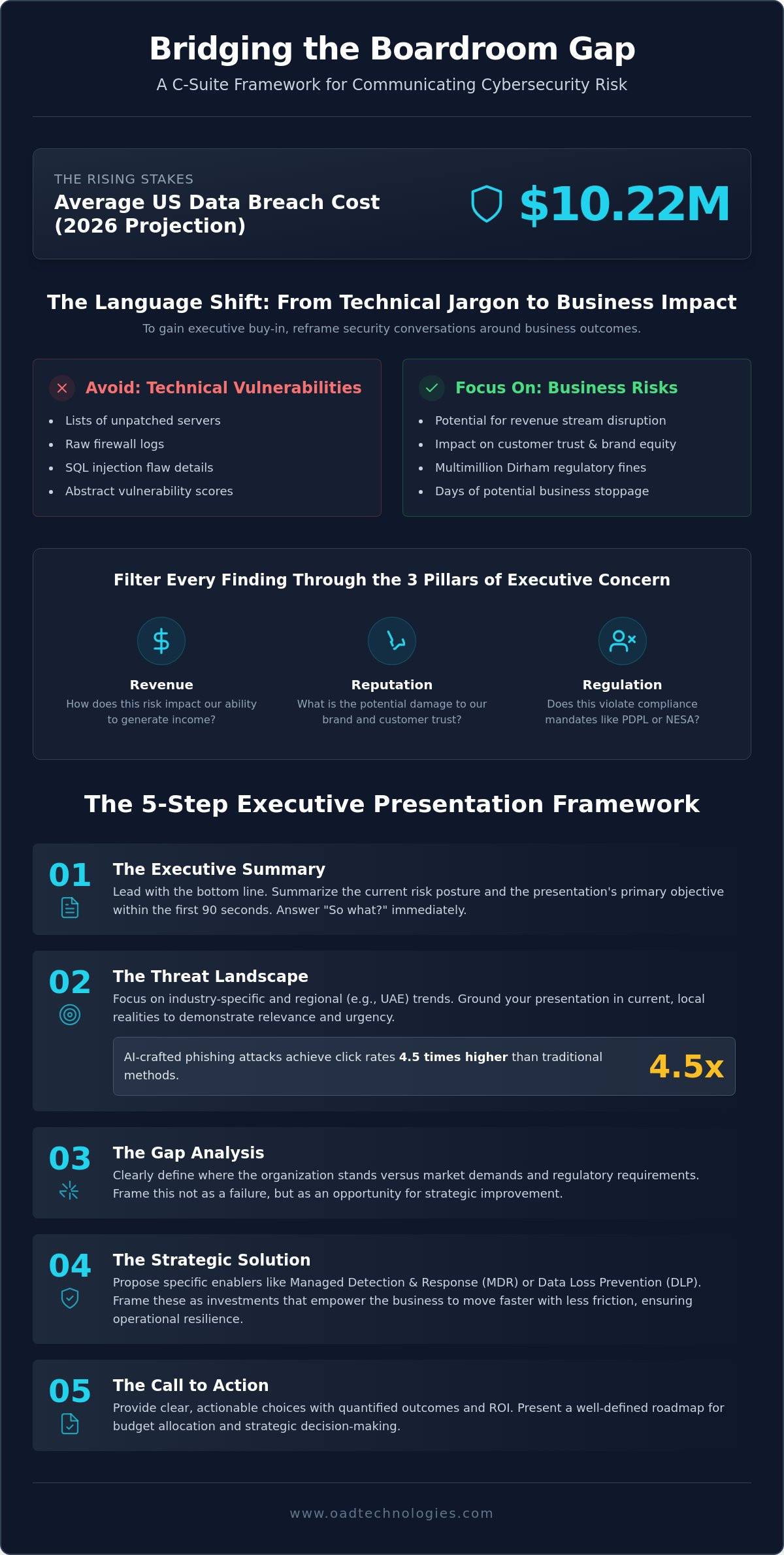
With the average cost of a data breach in the United States reaching an all-time high of $10.22 million in 2026, a communication gap between the security team and the C-suite is a liability you can't afford. You already know that technical vulnerabilities represent significant business threats, but mastering how to present cybersecurity risks to executives requires more than just showing a dashboard of blocked attacks. It's about translating complex telemetry into the language of capital allocation, regulatory compliance, and operational continuity.
It's frustrating when critical budget requests for Data Loss Prevention (DLP) or Managed Detection and Response (MDR) are sidelined because the ROI feels abstract to those outside the SOC. This guide will show you how to bridge that gap by framing security spend within the context of the latest SEC mandates and high-level board priorities. We'll provide a structured roadmap to help you strip away the jargon, quantify the impact of cyber-enabled fraud, and position your security strategy as a genuine competitive advantage that protects the firm's long-term digital relevance.
Key Takeaways
- Shift your communication strategy from technical vulnerabilities to business risks, focusing on operational resilience as the primary executive priority for 2026.
- Master a proven 5-step framework for how to present cybersecurity risks to executives that emphasizes the bottom line and specific industry threat landscapes.
- Quantify the value of Data Loss Prevention (DLP) by linking it directly to the protection of intellectual property and your organization's competitive advantages.
- Align your security roadmap with UAE-specific mandates like PDPL and NESA to transform compliance from a regulatory burden into a strategic asset.
- Frame Managed Detection and Response (MDR) as a results-oriented investment in business continuity rather than just another software expense.
The Language Shift: Translating Technical Vulnerabilities into Business Risk
Executives in 2026 aren't interested in a list of unpatched servers or firewall logs. They operate in a world of market volatility and tight margins. To capture their attention, you must master how to present cybersecurity risks to executives by pivoting from technical debt to business impact. A vulnerability is a technical weakness; a risk is the potential for that weakness to disrupt a revenue stream or erase brand equity.
The shift toward operational resilience marks a turning point in executive communication. Leaders have accepted that total security is an impossible myth. Instead, they want to know how quickly the business can recover from an inevitable incident. This means replacing technical jargon with metrics that matter to the C-suite, such as potential loss in Dirhams or the impact on customer trust. For industrial firms, this resilience extends to physical systems, and you can find out more about securing operational technology to prevent downtime. Moving from the "Department of No" to a strategic partner requires you to demonstrate how security enables growth rather than just acting as a cost center.
Defining Business-Centric Cyber Risk
Cyber risk is the specific intersection where the probability of a threat meets the tangible financial impact on the organization. This definition aligns with fundamental IT risk management principles, which emphasize that security isn't a siloed IT issue but a core business function.
When building your deck, filter every technical finding through the three pillars of executive concern: Revenue, Reputation, and Regulation. If a slide doesn't pass the "So What?" test, it doesn't belong in the boardroom. For instance, instead of explaining a SQL injection vulnerability, explain how an unaddressed flaw could lead to a 30 day business stoppage or a multimillion Dirham fine under UAE PDPL. Master how to present cybersecurity risks to executives by making the consequences felt in the ledger, not just the server room.
Identifying the Executive Persona
Effective communication requires tailoring your message to specific personas. The CEO focuses on growth and vision; they want to hear how security protects the 2026 strategic roadmap and provides a competitive edge. Conversely, the CFO prioritizes ROI and stability. They need to see how a budget request for Vulnerability Assessment and Penetration Testing (VAPT) or Endpoint Detection and Response (EDR) mitigates specific financial liabilities.
The Board of Directors holds a fiduciary responsibility regarding digital assets. They're legally accountable for oversight, especially with stricter global disclosure rules. Your role is to provide the clarity they need to fulfill this duty without drowning them in bits and bytes. By aligning your security goals with the company's broader objectives, you position yourself as a master designer of resilient systems.
The 5-Step Executive Presentation Framework for Cybersecurity
Mastering how to present cybersecurity risks to executives isn't about the volume of data you collect; it's about the sequence of the story you tell. Executives value a logical flow that leads to a clear decision. When you walk into the boardroom, your goal is to transition from a technical reporter to a strategic advisor who understands the company's pulse. This five step framework ensures your message resonates with leaders who prioritize operational resilience and financial stability.
- Step 1: The Executive Summary. Lead with the bottom line. Executives want the "so what" within the first ninety seconds. Summarize the current risk posture and the primary objective of your presentation immediately.
- Step 2: The Threat Landscape. Focus on industry specific UAE trends. In 2026, AI crafted phishing attacks achieve click rates 4.5 times higher than traditional methods. Use these local realities to ground your presentation in the present.
- Step 3: The Gap Analysis. Clearly define where the organization stands compared to market demands and regulatory requirements. This isn't about pointing out failures; it's about identifying opportunities for growth.
- Step 4: The Strategic Solution. Propose specific enablers like Managed Detection and Response (MDR) or Data Loss Prevention (DLP). Frame these as tools that empower the business to move faster with less friction.
- Step 5: The Call to Action. Provide clear choices with quantified outcomes. A decision maker should leave the room knowing exactly what approval is needed and what the expected return on that investment will be.
Structuring the Narrative Arc
Don't start your presentation with a list of blocked attacks or firewall logs. This approach often causes eyes to glaze over because it lacks business context. Instead, use a "Stoplight" dashboard (Red, Amber, Green) to provide an instant visual cue of the organization's health. This high level view allows you to dive into details only where they matter most. Benchmarking your performance against UAE competitors adds a layer of healthy pressure, showing the board exactly where the firm sits in the regional ecosystem. If you're looking to refine this narrative, a comprehensive security assessment can provide the baseline data you need.
Quantifying the Unquantifiable
To secure a budget, you must master measuring cybersecurity performance through financial metrics. Use Annual Loss Expectancy (ALE) to justify your requests. By presenting the "Cost of Inaction" (the potential $10.22 million breach cost) versus the "Cost of Implementation," you transform security from a cost center into an insurance policy for uptime. Incorporating results from Vulnerability Assessment and Penetration Testing (VAPT) provides a rigorous, evidence based baseline. This data driven approach is essential when learning how to present cybersecurity risks to executives, as it grounds every request in mathematical reality rather than technical fear.
Protecting the Crown Jewels: Quantifying Data Loss Prevention (DLP)
Executives often find cybersecurity abstract, but Data Loss Prevention (DLP) grounds the conversation in physical reality. It's the easiest security concept for a board to grasp because it treats data as tangible property. When you discuss how to present cybersecurity risks to executives, focusing on "Crown Jewels" like intellectual property and trade secrets changes the tone from technical maintenance to asset protection. In the UAE's highly competitive market, where brand equity is a primary differentiator, a leak isn't just a technical failure. It's a public breach of trust that can't be easily repaired.
Just as a discerning individual might learn more about Javda Jewelry to understand the meticulous craftsmanship behind physical high-value assets, the C-suite should recognize the same level of care required to secure the firm's digital "crown jewels."
Aligning your strategy with Cybersecurity & Infrastructure Security Agency (CISA) guidelines helps frame these risks as strategic business questions. Instead of talking about packet inspection, you're talking about who has the keys to the firm's most valuable secrets. This approach positions security as a facilitator for digital transformation, ensuring that as you move to the cloud, your most sensitive assets remain under your control. It transforms the security team from a barrier into a guardian of the company's ongoing digital relevance.
DLP as a Revenue Safeguard
Effective Data Loss Prevention (DLP) acts as a shield against the hidden costs of insider threats, whether they're malicious or accidental. Globally, intellectual property theft is the most expensive type of breach, costing an average of $178 per record in 2026. This directly impacts market valuation. If a competitor gains access to your proprietary algorithms or client lists, the damage is permanent. By framing DLP as a business enablement tool, you show how it allows for a secure remote workforce without compromising data integrity.
Visualizing Data Flow for the Board
Visual aids like heat maps are incredibly effective when explaining how to present cybersecurity risks to executives. Show them exactly where sensitive data resides and how it moves through its lifecycle, from creation to secure disposal. A single leaked customer database in the UAE can lead to massive regulatory fines and a permanent loss of customer loyalty. By visualizing these flows, you help the board fulfill their fiduciary duties while securing the necessary budget for robust protection layers that keep the business operational and compliant.
Leveraging GRC and UAE Compliance for Strategic Advantage
Executives often view regulatory requirements as a burden on the balance sheet. However, in the UAE's evolving digital ecosystem, compliance is the foundation of enterprise credibility. Navigating the UAE Personal Data Protection Law (PDPL) is now a non-negotiable business requirement. When you master how to present cybersecurity risks to executives, you must frame these laws as a competitive advantage. Meeting ISR compliance and NESA standards signals to global partners that your organization is a reliable link in the supply chain. It proves your commitment to international standards of digital craftsmanship.
By presenting Governance Risk and Compliance (GRC) as a framework for "Defensible Security," you provide the board with a legal and operational safety net. This approach moves the conversation from "why are we spending" to "how are we protecting our license to operate." Technical assessments like Vulnerability Assessment and Penetration Testing (VAPT) become the evidence needed to satisfy these regulatory mandates. They prove that your defenses are active rather than just theoretical, providing a roadmap for long-term success.
Compliance vs. Security: The Executive Nuance
It's vital to explain that being compliant doesn't automatically mean being secure. Compliance is a snapshot in time; security is a continuous state of vigilance. GRC automation reduces the operational overhead that often bogs down executive reporting, allowing for real-time risk visibility. Additionally, UAE-specific data residency requirements dictate your cloud strategy. You can't ignore where data lives if you want to remain within the bounds of PDPL. If you're struggling to align your current posture with these laws, you can schedule a strategic GRC consultation to bridge the gap.
Identity as the New Perimeter
As the traditional network perimeter dissolves, Identity and Access Management (IAM) has emerged as a dual solution for compliance and security. It ensures that only the right people have access to the right data, a core requirement of both ISR and PDPL. Executives play a critical role here by setting the "Tone at the Top" for access governance. A robust IAM strategy doesn't just stop threats; it improves employee productivity by reducing login friction and streamlining workflows. This is a powerful angle for how to present cybersecurity risks to executives, as it links security directly to operational efficiency and system growth.
From Presentation to Protection: Building the Managed Security Roadmap
The final stage of mastering how to present cybersecurity risks to executives is moving from the boardroom deck to a tangible, multi-year protection strategy. Leaders in 2026 are weary of tool sprawl. They've seen significant investments in disconnected software that fails to stop sophisticated breaches. Instead, they're looking for predictable outcomes. This is why the conversation must shift toward managed services that provide guaranteed coverage and operational uptime. It's about moving from a reactive posture to a proactive, resilient architecture.
A SIEM solution offers the "Single Pane of Glass" visibility that executives need to feel in control of their digital estate. It aggregates complex telemetry into a coherent story of resilience. When you combine this visibility with a 3-year maturity roadmap, you demonstrate that security isn't a one-time project but an evolving discipline. This roadmap should include clear milestones, such as reducing dwell time or achieving full regulatory alignment, which help the board track the return on their security investment over time.
The Business Case for MDR
Presenting Managed Detection and Response (MDR) as an insurance policy for uptime is a highly effective tactic. Building an in-house 24 X 7 Security Operations Center (SOC) requires massive capital for talent acquisition and infrastructure. In contrast, an MDR model provides immediate access to expert designers of systems without the operational overhead. This allows the internal team to focus on strategic growth rather than just fire fighting.
The most compelling metric for the C-suite is the reduction in "Mean Time to Remediation" (MTTR). In 2026, the average time to identify a data breach is 181 days, with an additional 60 days to contain it. MDR services aim to slash these windows significantly. By integrating MDR into your existing stack, you maximize the ROI of previous investments while ensuring the business remains operational during a crisis. This is a core pillar of how to present cybersecurity risks to executives because it focuses on recovery speed and financial preservation.
Securing the Future: Cloud and Beyond
As organizations expand their digital footprint, Cloud Security Posture Management (CSPM) becomes essential. Multi-cloud environments are now the standard, yet they introduce complex visibility gaps that can lead to catastrophic data leaks. A unified strategic approach to cloud security ensures that your growth doesn't outpace your ability to protect it. It's about maintaining digital relevance in an ever-changing market.
Ultimately, the CISO's role has evolved into that of an Architect of Trust. By moving beyond simple risk ratings and focusing on managed, outcome-based protection, you secure the company's long-term viability. You aren't just managing threats; you're building a resilient foundation that allows the business to innovate with confidence in a digital-first economy. This strategic partnership is what defines the most successful security leaders of 2026.
Designing a Resilient Digital Future
Mastering how to present cybersecurity risks to executives is the vital bridge between technical excellence and long term business viability. By shifting your focus from isolated vulnerabilities to operational resilience and aligning with UAE specific mandates like the PDPL, you transform security into a strategic enabler. You now have the tools to quantify the value of your most critical assets through DLP and use a structured framework to secure essential boardroom buy-in.
The transition from reporting threats to managing outcomes marks your evolution as a strategic partner. This journey requires a blend of human insight and rigorous engineering standards to maintain your firm's digital relevance. OAD Technologies acts as a visionary extension of your team, providing the technical authority and local expertise needed to navigate the complex 2026 landscape. Secure your enterprise with OAD Technologies' strategic GRC and Managed Security services. Our Dubai based expertise in UAE compliance ensures that your MDR and DLP solutions are perfectly tailored for national enterprise success. Let's build a secure, ambitious foundation for your organization's future.
Frequently Asked Questions
What is the single most important metric to show executives?
The single most important metric is the potential financial impact on business continuity. Executives care about how long the company can stay operational during an incident. Instead of showing a high volume of blocked attacks, focus on the risk score of your most critical revenue generating processes. This allows them to see security as a safeguard for the company's bottom line rather than just a technical expense.
How do I handle an executive who thinks we are 'too small to be a target'?
Remind them that automated attack tools don't discriminate based on company size. Modern hackers often target smaller entities as a gateway into larger supply chains or simply because they're perceived as having weaker defenses. Use the argument that being small doesn't protect digital assets like customer data or intellectual property, which are valuable to criminals regardless of the firm's total headcount.
Should I use 'fear-based' reporting to get budget approval?
Avoid fear based reporting as it often leads to budget fatigue and a loss of credibility over time. Instead, focus on how to present cybersecurity risks to executives using a risk based approach that highlights business enablement. Show how security investments empower the team to innovate faster and enter new markets with confidence. This shifts the narrative from avoiding a disaster to building a resilient, competitive organization.
How often should I present cybersecurity risks to the board?
You should present a formal cybersecurity risk update at least quarterly. However, high level metrics should be available in real time through an executive dashboard. This ensures that the board remains informed about the organization's risk posture without feeling overwhelmed by technical details. Regular reporting builds a culture of transparency and keeps security aligned with the firm's evolving strategic goals.
What is the difference between a technical threat and a business risk?
A technical threat is a specific event, like a ransomware strain, while a business risk is the potential consequence of that threat on the organization. For example, the threat is a phishing email; the risk is the loss of intellectual property or a regulatory fine. Mastering this distinction is crucial for effective communication, as it translates technical telemetry into the language of business impact and operational performance.
How can I explain the ROI of a security service like MDR?
Explain the ROI of Managed Detection and Response (MDR) by focusing on cost avoidance and reduced Mean Time to Remediation (MTTR). Compare the predictable cost of a managed service against the significant capital required to recruit and retain a 24 X 7 in house SOC. Highlighting how MDR provides immediate access to expert designers of systems demonstrates a clear path to operational efficiency and long term stability.
What UAE-specific regulations should I mention in my presentation?
You should prioritize the UAE Personal Data Protection Law (PDPL), NESA standards, and ISR compliance. These regulations are the primary legal frameworks governing digital assets in the region. Mentioning them shows that your security strategy is grounded in local reality and protects the organization from heavy fines. This alignment is a key part of how to present cybersecurity risks to executives who are concerned with regulatory standing.
How do I justify the cost of Data Loss Prevention (DLP) tools?
Justify Data Loss Prevention (DLP) by linking it directly to the protection of your most valuable trade secrets and customer databases. Frame the cost as a fraction of the potential damage caused by a data leak, which includes lost market valuation and reputational harm. By positioning DLP as a tool for protecting intellectual property, you make the investment a logical choice for any executive focused on long term growth.
Disclaimer
Content by OAD Technologies is for general informational purposes only and does not constitute professional or cybersecurity advice. No warranties are made regarding accuracy or completeness; reliance is at your own risk. OAD Technologies shall not be liable for any direct or indirect losses arising from use of this content.
Gireesh Sooryanarayanan
Co-founder & General Manager, OAD Technologies
Gireesh Sooryanarayanan is Co-founder and General Manager of OAD Technologies, a Dubai Silicon Oasis-based cybersecurity and IT infrastructure company serving enterprise and government clients across the UAE and GCC. He oversees OAD's operations and client engagements across managed security, infrastructure and cloud.
Connect with Gireesh on LinkedIn