

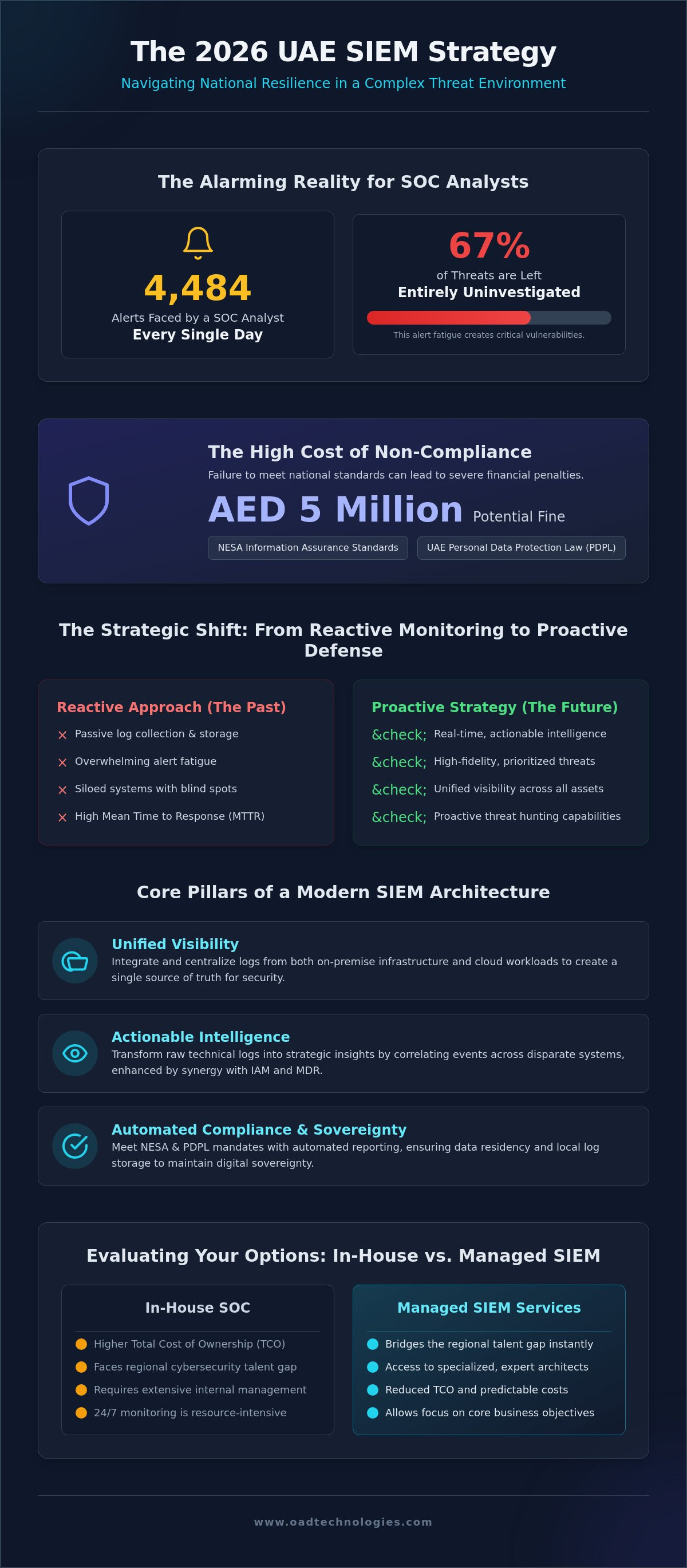
Did you know that the average SOC analyst now faces 4,484 alerts every single day, with a staggering 67% of those threats left entirely uninvestigated? This level of alert fatigue isn't just an operational bottleneck; it's a critical vulnerability for any organization seeking SIEM services in the UAE to protect their digital assets. You likely recognize the frustration of managing high-volume technical logs while trying to map them to strict NESA Information Assurance Standards or the UAE Personal Data Protection Law (PDPL). It's a complex balancing act where the risk of a missed threat could lead to fines reaching AED 5 million.
We've designed this 2026 guide to help you move beyond reactive monitoring and toward true national enterprise resilience. You'll learn how to implement a strategic framework that reduces your mean time to detect (MTTD) and automates compliance reporting for your next national audit. We'll explore how to unify visibility across your cloud and on-premise assets while ensuring your security operations act as a proactive guardian of your digital relevance in an increasingly complex threat environment.
Key Takeaways
- Understand the shift toward SIEM as the central nervous system of your enterprise, providing unified visibility across both cloud and on-premise assets.
- Discover how to automate compliance reporting for NESA and PDPL to meet 2026 continuous monitoring mandates and mitigate legal risks.
- Compare the total cost of ownership between building an in-house SOC and leveraging specialized siem services dubai to bridge the regional talent gap.
- Learn how bespoke system integration and the synergy between SIEM and MDR transform raw technical logs into actionable strategic intelligence.
The Strategic Role of SIEM Services in National Resilience
The 2026 digital landscape in the UAE demands more than a simple repository for security logs. Modern Security Information and Event Management (SIEM) has evolved into the central nervous system of the enterprise security stack. It's no longer about collecting data for a rainy day; it's about synthesizing vast streams of telemetry into actionable intelligence in real time. National enterprises now face sophisticated adversaries who exploit the gaps between siloed systems. Without a unified view, these gaps become blind spots that threaten the very continuity of critical operations.
At OAD Technologies, we approach these challenges as expert architects. We don't believe in off-the-shelf security. Instead, we design bespoke frameworks that align technical depth with your specific business objectives. This ensures that your investment in siem services dubai results in a resilient, future-proof infrastructure capable of withstanding the pressures of a rapidly shifting threat environment. By moving beyond basic log collection, we help you build a SIEM strategy that acts as a foundation for long-term digital relevance.
Digital Sovereignty and the 2026 Threat Landscape
National infrastructure remains a primary target for state-sponsored actors and cyber-criminal syndicates. In 2026, maintaining digital sovereignty requires strict adherence to data residency requirements and local log storage. This ensures that sensitive information stays within UAE borders, complying with NESA mandates and the PDPL. SIEM acts as the bridge between raw event data and strategic decision-making, providing the clarity needed to protect the nation's digital interests. By centralizing visibility, organizations ensure they aren't just meeting compliance checkboxes but are actively contributing to the UAE's broader national resilience strategy.
From Reactive Monitoring to Proactive Defence
Traditional SIEM deployments often failed because they were treated as passive archives. They generated thousands of alerts that overwhelmed analysts, leading to the alert fatigue that plagues many security operations centers. Today, the focus has shifted to real-time correlation and reducing the Mean Time to Response (MTTR). High-quality siem services dubai utilize advanced analytics to filter out noise and highlight high-fidelity threats that require immediate attention.
The inclusion of proactive threat hunting transforms the SIEM from a necessary cost center into a strategic asset. Instead of waiting for an alarm to trigger, analysts use the platform to search for subtle indicators of compromise that automated tools might miss. This synergy between human expertise and technological capacity defines a modern security posture. It ensures that your organization doesn't just survive an attack but actively prevents it from escalating into a full-scale breach.
SIEM Architecture: Integrating Technical Depth with Enterprise Visibility
Effective security begins with the quality of your data. A SIEM platform is only as powerful as the telemetry it ingests, making high-fidelity data ingestion a non-negotiable requirement for modern siem services dubai. To achieve true visibility, you must capture logs from every corner of your infrastructure, including network devices, endpoints, and cloud workloads. Following the NIST Guide to Computer Security Log Management, we prioritize structured ingestion processes that ensure data integrity and accessibility for real-time analysis.
The core of a resilient SIEM strategy lies in its ability to unify disparate environments. In 2026, most UAE enterprises operate across hybrid-cloud architectures, where data sits both on-premise and in multiple cloud regions. A fragmented view of these assets is a significant vulnerability. By centralizing this data, you create a single source of truth that allows for cross-environment correlation, ensuring that a threat detected in a cloud bucket is immediately linked to suspicious activity on a local workstation.
This visibility is further enhanced through a deep synergy with identity and access management (IAM). When identity data is integrated into your SIEM, alerts gain critical context. You're no longer just seeing an IP address; you're seeing a specific user profile and their typical behavior patterns. This integration powers the "remediation loop," where a detected anomaly can automatically trigger configuration changes, such as revoking access or forcing multi-factor authentication. If you're currently evaluating your security architecture, focusing on this loop is essential for reducing your exposure window.
The Power of Integrated Security Ecosystems
A siloed SIEM is a liability in the 2026 threat landscape. To maximize protection, your SIEM should act as the orchestrator for other specialized tools. For instance, feeding SIEM data into your data loss prevention (DLP) protocols allows for more nuanced detection of data exfiltration attempts. Similarly, integrating Endpoint Detection and Response (EDR) with your siem services dubai provides a holistic view of the attack surface, from the initial entry point to the final lateral movement attempt. This interconnected ecosystem ensures that no signal is lost in the noise.
Advanced Analytics and Artificial Intelligence in SIEM
With the average SOC analyst receiving 4,484 alerts per day, manual triaging has become impossible. Machine Learning (ML) is now a fundamental component of SIEM architecture, specifically designed to reduce false positives and mitigate alert fatigue. By utilizing AI-driven behavior analysis, systems can detect insider threats and subtle anomalies that traditional rule-based systems would miss. High-fidelity alerts are the direct result of this rigorous correlation and context enrichment, ensuring your team only spends time on the threats that actually matter.
This shift toward intelligent data synthesis is mirrored in other sectors as well; for instance, Nodal AI leverages an AI-powered insights and analytics platform to help businesses in the hospitality industry transform their operational data into actionable strategic intelligence.
Evaluating Managed SIEM vs. In-House Security Operations
Deciding whether to build an internal Security Operations Center (SOC) or leverage professional siem services dubai is a defining moment for any enterprise. This choice goes beyond mere technical preference; it's a strategic calculation of human capital and long-term financial commitment. In the UAE, the talent gap remains a significant hurdle. Recruiting and retaining senior analysts who possess deep expertise in local mandates, such as NESA and PDPL, is both challenging and expensive. High demand for these specialists often leads to aggressive poaching and inflated salary expectations, which can destabilize an in-house team's continuity.
Managed services solve this by providing immediate access to a mature security posture. Professional providers operate on a 'Follow the Sun' model, ensuring that your infrastructure is monitored 24 X 7 by experts who don't experience the fatigue associated with isolated internal teams. This continuous oversight is vital for maintaining national resilience. As your organization grows, a managed provider scales their resources alongside you, removing the need for the significant capital expenditure required to expand physical SOC facilities or upgrade hardware.
The Hidden Costs of In-House SIEM Management
The total cost of ownership (TCO) for an in-house SIEM often surprises leadership teams. Beyond the initial software license, you must account for the ongoing costs of high-performance infrastructure, data storage, and continuous rule tuning. Without constant refinement, systems quickly become noisy and ineffective. We see the impact of this in the data; with analysts facing an average of 4,484 alerts daily, burnout is inevitable. This turnover doesn't just increase recruitment costs; it creates institutional knowledge gaps that leave your assets vulnerable. Partnering for siem services dubai offers a superior ROI by sharing the burden of expert overhead and high-tier technology across a broader client base.
Hybrid SIEM: The Best of Both Worlds?
For larger national enterprises, a hybrid model often provides the most sophisticated path forward. This approach allows your internal security team to focus on high-level strategy, governance, and internal policy while the managed partner handles the intensive 24 X 7 monitoring and initial alert triaging. Success in this model relies on transparent communication and shared dashboards. It ensures that your team stays in control of the narrative while benefiting from the proactive threat hunting and technical depth of an external partner. This collaborative framework aligns perfectly with ambitious digital transformation goals, allowing you to innovate without compromising on foundational security.
Navigating National Compliance: Selecting a SIEM for NESA and PDPL
Compliance in the UAE has transitioned from a periodic audit exercise to a continuous operational requirement. For national enterprises, the regulatory environment is defined by the full enforcement of the UAE Personal Data Protection Law (PDPL) and the evolving NESA Information Assurance Standards. Failing to meet these mandates carries significant weight; non-compliance with the PDPL can result in fines reaching AED 5 million. Professional siem services dubai provide the technical scaffolding necessary to manage these risks. By centralizing log data and automating detection, a SIEM ensures you meet the 72-hour breach notification window required by the UAE Data Office.
Meeting NESA and ISR mandates requires more than just data collection. It requires a structured approach to evidence. NESA-aligned standards mandate a minimum of 180-day log retention, a requirement that can quickly overwhelm poorly designed storage architectures. Your SIEM provider must possess deep expertise in the local regulatory landscape to ensure that your system isn't just capturing data, but is preserving it in a way that remains forensic-ready for national audits. This level of precision transforms a technical tool into a robust instrument of corporate governance.
Mapping Technical Logs to Regulatory Controls
One of the primary challenges for security teams is translating raw technical events into the language of regulatory controls. Modern SIEM platforms solve this by automating the mapping of security events to specific NESA or ISO 27001 requirements. Compliance-ready dashboards provide immediate visibility for stakeholders and regulators, demonstrating your organization's commitment to "due diligence." In the event of a national audit, having a clear, measurable trail of evidence significantly reduces the complexity of the review process. To ensure your infrastructure meets these rigorous standards, you can consult with our GRC experts to align your SIEM architecture with national mandates.
Data Residency and Sovereignty in SIEM Operations
Data sovereignty is a cornerstone of national resilience. National laws regarding cross-border data transfers are strict, making the physical location of your SIEM operations a critical selection factor. In 2026, the strategic importance of local SOC operations cannot be overstated. Utilizing siem services dubai that respect UAE data residency ensures that sensitive metadata and logs never leave the country. This approach protects your organization from jurisdictional conflicts and aligns with the broader goal of maintaining national digital autonomy. We focus on building architectures that prioritize local storage and processing, ensuring your security stack remains a sovereign asset rather than a third-party liability. Just as we architect high-performance digital systems, Dubai's luxury sector offers world-class standards through providers like Delta Rentals Dubai, catering to those who demand excellence in every aspect of their professional presence.
Why OAD Technologies is the Architect of Your National SIEM Strategy
Building a resilient defense requires more than just deploying software; it necessitates a master designer who understands the intricate relationship between data, identity, and national mandates. OAD Technologies positions itself as the architect of your security infrastructure, ensuring that our siem services dubai are never just another line item in your budget. We recognize that every enterprise has a unique technical stack and a specific risk profile. By moving away from generic configurations, we create a system that reflects your organization's actual operational reality while maintaining the rigorous engineering standards required for national resilience.
Our approach achieves its highest potential through the synergy between our SIEM operations and managed detection and response (MDR). While the SIEM provides the centralized visibility and historical record needed for continuous compliance, MDR adds the layer of active threat hunting and rapid incident containment. This combined ecosystem ensures that your security posture is both broad in its visibility and deep in its technical response. We believe in technology-empowered security that places human insight at the center, ensuring that automated tools are guided by expert strategy.
The OAD Difference: Beyond Standardised Templates
We explicitly reject the 'one-size-fits-all' approach that dominates much of the market. Standardized templates often lead to the very alert fatigue and visibility gaps that leave national enterprises vulnerable. Instead, we focus on bespoke system integration tailored to your unique environment. This allows us to build a robust remediation loop. When a threat is detected, the system doesn't just trigger an alarm; it informs a strategic configuration change that hardens your posture against future attempts. The result is a SIEM that supports business growth and digital evolution rather than creating operational friction or slowing down your development lifecycle.
Partnering for National Digital Excellence
We don't view ourselves as a distant third-party vendor. OAD Technologies acts as an extension of your internal security team, sharing the burden of 24 X 7 vigilance and strategic planning. As a guardian of your digital relevance, we stay ahead of evolving NESA audit requirements and the shifting UAE threat landscape. This partnership ensures your organization isn't just reacting to the market but is actively shaping its own secure future. Our commitment to long-term viability means we design systems that remain effective as your enterprise scales. Consult with OAD Technologies on your SIEM strategy today to begin designing a framework for long-term national resilience and operational excellence.
Architecting a Future of Secure Digital Sovereignty
The transition from legacy log management to a sophisticated, integrated security engine is the defining challenge for UAE enterprises in 2026. You've seen how a unified visibility framework bridges the gap between raw data and strategic resilience, ensuring that your organization isn't just checking compliance boxes but is actively hardening its defenses against advanced adversaries. By prioritizing bespoke enterprise integration over standardized templates, you can transform your security posture into a proactive guardian of your digital relevance.
Selecting the right siem services dubai is about more than technology; it's about finding a partner with deep expertise in UAE national mandates like NESA, ISR, and the PDPL. OAD Technologies provides an integrated technical security ecosystem that empowers your team to act with precision and speed. We're ready to help you navigate the complexities of the modern threat landscape while maintaining the highest standards of data sovereignty. Secure your national operations with OAD Technologies' SIEM services and build a foundation for long-term operational success. Your journey toward a more resilient digital future starts with a strategic architecture designed for the challenges of tomorrow.
Frequently Asked Questions
What is the primary role of a SIEM service for UAE enterprises?
SIEM services act as the central nervous system of your security stack, aggregating telemetry from across your enterprise to provide real-time visibility. By centralizing logs from cloud and on-premise assets, these platforms identify suspicious patterns that siloed systems miss. Utilizing professional siem services dubai ensures that your organization moves beyond basic log collection toward proactive threat intelligence, which is essential for maintaining national resilience against sophisticated cyber adversaries.
How does SIEM support compliance with the UAE Personal Data Protection Law (PDPL)?
A SIEM platform facilitates PDPL compliance by providing the forensic evidence needed to identify and report personal data breaches within the mandatory 72-hour window. It tracks data subject access requests and ensures that all processing activities are logged for auditing. Given that non-compliance can result in fines of up to AED 5 million, having a robust SIEM is a practical necessity for demonstrating due diligence to the UAE Data Office.
Can SIEM help in achieving NESA and ISR compliance in the UAE?
Yes, SIEM is a foundational tool for meeting the 188 security controls of the NESA Information Assurance Standards. It specifically addresses requirements for continuous monitoring and the mandatory 180-day log retention period. By automating compliance reporting, a SIEM provides the measurable evidence required for national audits, helping organizations transition from manual spreadsheets to a structured, audit-ready security posture that aligns with UAE Signals Intelligence Agency standards.
What is the difference between a traditional SIEM and a Managed SIEM service?
A traditional SIEM is a software tool that requires your internal team to manage ingestion, rule tuning, and monitoring. In contrast, a Managed SIEM service provides a comprehensive ecosystem, including 24 X 7 expert oversight and proactive threat hunting. This model bridges the regional talent gap by giving you immediate access to senior analysts who understand the local threat landscape, significantly reducing the total cost of ownership compared to building an in-house SOC.
How often should SIEM correlation rules be updated for national security?
Correlation rules should be updated continuously to reflect the latest threat intelligence and evolving attack vectors. In the 2026 landscape, static rules aren't sufficient to stop AI-driven fraud or sophisticated lateral movement. National enterprises should prioritize siem services dubai that integrate automated threat feeds and regular manual tuning. This ensures your detection logic remains relevant as new vulnerabilities emerge, maintaining the integrity of your security stack and protecting your digital relevance.
What are the benefits of integrating SIEM with DLP and EDR?
Integrating SIEM with DLP and EDR provides a unified view of your entire attack surface, linking endpoint activity directly to data movement. This synergy allows you to trace a potential breach from the initial entry point on a laptop to the final attempt to exfiltrate sensitive files. By breaking down these silos, you create a more resilient remediation loop that can automatically block suspicious identities or revoke access before a minor incident becomes a major breach.
How does a SIEM service improve incident response times for national organisations?
SIEM services improve response times by drastically reducing the Mean Time to Detect (MTTD) through automated correlation of disparate events. Instead of analysts manually searching through millions of logs, the system highlights high-fidelity threats that require immediate action. This clarity allows your response team to focus on containment and eradication rather than investigation, ensuring that critical national infrastructure remains operational even during an active cyber incident.
Should I choose a global SIEM provider or a local UAE-based specialist?
Choosing a local UAE-based specialist is often the superior choice for national enterprises due to their deep understanding of NESA and PDPL nuances. Local providers ensure that your log data and metadata remain within UAE borders, satisfying strict data residency and sovereignty requirements. While global tools provide the technology, a local partner acts as an extension of your team, offering the customized integration needed to align your security architecture with national digital goals.
Disclaimer
Content by OAD Technologies is for general informational purposes only and does not constitute professional or cybersecurity advice. No warranties are made regarding accuracy or completeness; reliance is at your own risk. OAD Technologies shall not be liable for any direct or indirect losses arising from use of this content.