
Federal Decree-Law No. 45 of 2021 establishes the UAE's federal framework for protecting personal data. Enterprises should confirm how the law, its exemptions and any sector-specific requirements apply to their processing activities, while monitoring official Executive Regulations and Cabinet decisions for operational detail. Cross-border transfers and legacy systems can create practical challenges, so organisations need evidence-led legal, governance and technical controls rather than unsupported assumptions about fixed penalties or deadlines.
This guide offers a practical roadmap for approaching Federal Decree-Law No. 45 of 2021. It explains the law's core principles, data-subject rights, breach reporting, cross-border transfers and the role of technical controls such as DLP and GRC. These controls can support compliance readiness, but they do not replace legal interpretation or guarantee compliance.
Key Takeaways
- Understand the role assigned to the UAE Data Office as the federal data regulator and monitor official publications for implementing detail.
- Learn to implement the six core data processing principles, focusing on purpose limitation and transparency to ensure foundational regulatory alignment.
- Identify critical operational differences between UAE mandates and the GDPR, specifically regarding Data Protection Officer (DPO) appointments and reporting structures.
- Discover a technical roadmap for achieving "privacy by design" through automated data discovery and classification workflows.
- Explore how to integrate GRC strategy with technical execution using Data Loss Prevention (DLP) and Identity and Access Management (IAM) to secure long-term digital relevance.
Understanding the UAE Personal Data Protection Law (PDPL)
Federal Decree-Law No. 45 of 2021 provides the federal framework for personal-data processing in the UAE. Official UAE guidance identifies the UAE Data Office, affiliated with the Cabinet, as the federal data regulator. Enterprises should treat privacy governance as an ongoing legal and operational responsibility and monitor official sources for Executive Regulations, Cabinet decisions and regulatory guidance.
The law has broad territorial reach. Subject to its stated exemptions, it covers controllers and processors in the UAE that process personal data, as well as certain organisations outside the UAE that process personal data relating to people located in the UAE. Scope should be assessed carefully because the law excludes, among other categories, government data and entities, certain security and judicial activities, personal processing, and health or banking data governed by sector-specific legislation. This approach reflects established global data privacy principles.
To master this framework, you must first understand its core definitions. "Personal Data" includes any info that identifies a natural person, such as names or IP addresses. "Sensitive Personal Data" requires even stricter controls, covering biometric data, health records, and religious beliefs. The individual whose data is being processed is the "Data Subject," and they hold specific rights that your systems must be engineered to respect.
Key Objectives of the Federal Law
The UAE isn't just adopting rules; it's building a foundation for a digital economy where trust is a measurable asset. By ensuring data sovereignty, the law protects the nation's interests while fostering a secure environment for high-level innovation. This alignment with international standards like GDPR and CCPA allows UAE-based firms to scale globally. It creates a predictable environment for strategic expansion, ensuring that technological capacity always stays in sync with human rights and privacy expectations.
Consequences of Non-Compliance in 2026
Non-compliance can create legal, operational and reputational exposure. Article 26 provides for a Cabinet decision to specify violations and administrative penalties; the federal law itself does not state the fixed AED 50,000-to-AED 5,000,000 range previously claimed here. A structured Governance Risk and Compliance (GRC) framework can help organisations map requirements, controls, evidence and remediation, but it should be paired with qualified legal advice.
The 6 Core Principles of UAE Data Processing
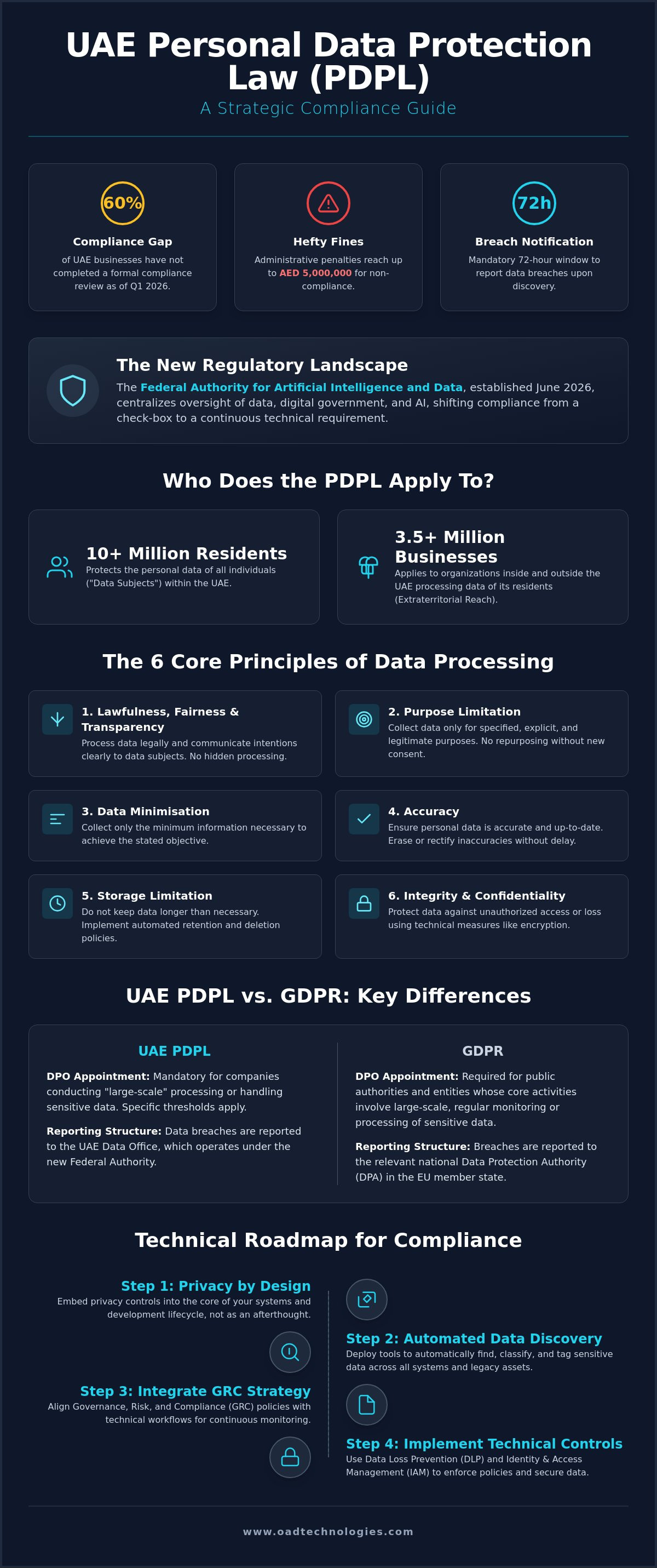
Adherence to the uae personal data protection law requires more than just a policy update; it demands a fundamental re-engineering of how data moves through your enterprise. The law establishes six core principles that act as the technical and ethical guardrails for all processing activities. These pillars, which align with Official UAE Government guidance, ensure that your data operations remain transparent and secure. Success here depends on precision and high-quality craftsmanship in your data architecture.
- Lawfulness, Fairness, and Transparency: You must process data through legitimate legal channels and communicate your intentions clearly to the data subject. Hidden processing or vague privacy terms are no longer viable.
- Purpose Limitation: Data should only be collected for specified, explicit, and legitimate purposes. You can't repurpose collected assets for secondary projects without new authorization.
- Data Minimisation: Efficiency is key. Collect only the minimum amount of information necessary to achieve your stated objective, reducing your overall digital footprint and risk profile.
- Accuracy and Up-to-dateness: Your systems must ensure that personal data is accurate and kept current. Inaccurate data must be erased or rectified without delay to maintain system integrity.
- Storage Limitation: You shouldn't keep data longer than necessary. Implementing automated retention and deletion policies ensures you don't accumulate "dark data" that creates unnecessary liability.
- Integrity and Confidentiality: This principle focuses on the long-term viability of your security. It requires technical measures, such as encryption and access controls, to protect against unauthorized processing or accidental loss.
Managing Data Subject Rights
The law gives data subjects rights that include obtaining information, data transfer, correction or erasure, restriction and objection in specified circumstances. Response periods and procedures should be checked against the current Executive Regulations rather than assumed to be a universal 30 days. An Identity and Access Management (IAM) framework can support identity verification, controlled access and auditable request handling.
Consent and Lawful Basis for Processing
Where processing relies on consent, it must satisfy the law's requirements and be demonstrable. The PDPL also provides specified circumstances in which processing may occur without consent, so organisations should document the applicable legal condition for each activity rather than assume consent is always the correct basis. OAD Technologies can help translate approved privacy requirements into technical controls, while legal interpretation remains the responsibility of qualified advisers.
UAE PDPL vs. GDPR: Critical Differences for UAE Businesses
Many organizations assume that their existing GDPR framework automatically satisfies the UAE Personal Data Protection Law. This is a strategic misconception. While the PDPL draws inspiration from European standards, it introduces unique nuances tailored to the Emirates' digital economy. For instance, the criteria for appointing a Data Protection Officer (DPO) in the UAE focus heavily on high-risk processing activities and the scale of sensitive data, rather than the broader public authority triggers found in Europe. Relying on a "copy-paste" compliance model creates gaps in your technical architecture that could lead to significant regulatory friction.
Cross-border transfers follow the conditions in Articles 22 and 23. Transfers may be permitted where an adequate level of protection is available or through specified safeguards and exceptions, including contractual measures, express consent and certain contractual or judicial necessities. Enterprises should map data flows and confirm the applicable legal basis for each transfer rather than assume that every transfer requires one form of approval.
Cross-Border Transfers and Data Governance
The federal PDPL does not create a blanket requirement to keep all personal data within the UAE. Transfer conditions vary by destination, safeguard, purpose and any applicable sector-specific rule. For multinational organisations, Cloud Security Posture Management (CSPM) can improve visibility into where data is stored and transmitted, helping teams apply the correct legal and security controls.
Breach Notification Mandates
Article 9 requires a controller to notify the UAE Data Office upon becoming aware of a personal-data breach that would prejudice the privacy, confidentiality or security of the data, following the period, procedures and conditions set by the Executive Regulations. The federal law itself does not state a universal 72-hour deadline. Managed Detection and Response (MDR) can support timely detection, containment and evidence collection so legal and privacy teams can assess and report an incident promptly.
Technical Roadmap for UAE PDPL Compliance
Translating the uae personal data protection law into a functional IT environment requires a shift from policy-driven compliance to architecture-driven resilience. Organizations can't rely on manual processes to manage the personal data of millions of residents. Instead, you need a structured lifecycle that embeds privacy into the very fabric of your digital systems. This roadmap provides the technical milestones necessary to bridge the gap between high-level innovation and practical regulatory results.
For specialized professional services such as accounting, achieving this resilience often involves implementing a formal Written Information Security Plan (WISP). Firms can look to Apex Tech 4 Tax Pros for customized cybersecurity solutions that help tax and accounting professionals align their internal data protocols with global security standards.
- Step 1: Conduct a Comprehensive Data Discovery and Classification. Automation is your primary tool here. You must identify where personal and sensitive data resides across your entire network, from legacy on-premise servers to modern cloud environments.
- Step 2: Support Privacy by Design through Data Loss Prevention (DLP). DLP can help discover sensitive data, apply handling rules and reduce the likelihood of unauthorised disclosure. Its effectiveness depends on accurate classification, configuration, monitoring and governance.
- Step 3: Secure the Perimeter with Identity and Access Management (IAM). Granular control over who can access specific data sets is a non-negotiable requirement. IAM ensures that only authorized personnel interact with sensitive assets, maintaining a clear audit trail.
- Step 4: Establish a Continuous Monitoring and Incident Response Cycle. Maintain monitoring, escalation and evidence-preservation procedures that support prompt assessment and notification within the period applicable under current regulations and sector rules.
The Role of DLP in Data Governance
DLP can support data governance by discovering sensitive personal data, applying policy controls and producing evidence for investigation. It can help organisations detect unapproved transfers and enforce approved handling rules, but it does not establish the legal basis for a transfer or guarantee PDPL compliance.
VAPT: Identifying Compliance Gaps
Risk-based VAPT can help identify weaknesses in systems that process personal data. Testing and incident exercises support assurance that safeguards operate as intended, although the appropriate assessment programme depends on the organisation's risk profile and applicable legal or sector requirements. To discuss technical controls that support privacy risk management, contact OAD Technologies.
Strategic Compliance with OAD Technologies
Achieving long-term viability under the uae personal data protection law requires more than a standard legal review. It demands a master designer of systems who can translate regulatory ambiguity into a high-performance technical architecture. OAD Technologies acts as your strategic partner, bridging the gap between high-level Governance, Risk, and Compliance (GRC) strategy and the ground-level technical execution of security controls. We move beyond "check-box compliance" to build a resilient security posture that protects your digital relevance in an ever-evolving market.
OAD's approach integrates security layers such as Data Loss Prevention (DLP) and Identity and Access Management (IAM) within a defined scope. These controls can support approved UAE privacy requirements and provide a more resilient foundation for growth, but they do not eliminate regulatory or operational risk.
Our GRC and DLP Synergy
OAD combines governance expertise with tools that support reporting and data classification. This can reduce manual effort, improve evidence quality and support ongoing compliance readiness. Technology is one part of a broader programme that also requires accountable owners, documented decisions, legal interpretation and regular review.
For organizations looking to expand their outreach, utilizing AI-powered solutions like Nexdial can streamline business communications through intelligent automation, ensuring that scaling sales remains both efficient and compliant with evolving privacy standards.
Maintaining organizational resilience in an ever-changing market requires a proactive, solution-oriented mindset. We don't settle for quick fixes that might fail during the next regulatory update. Instead, we focus on system growth and digital evolution, ensuring that your privacy controls are as dynamic as the threats they are designed to prevent. This commitment to precision ensures that your compliance framework remains a strategic asset rather than a technical bottleneck.
Partnering for Future-Proof Data Privacy
Long-term success in the Emirates depends on rigorous engineering standards and deep collaborative partnerships. We act as an extension of your internal team, providing the specialized expertise needed to manage the complexities of national and international data mandates. Our solutions are never standardized; they are highly customized to reflect the unique needs of your enterprise and the specific sensitivity of the data you process. By choosing a partner that values precision and high-quality craftsmanship, you ensure your ongoing digital relevance.
If you're ready to transform your compliance obligations into a competitive advantage, it's time to align your technical architecture with the highest standards of data sovereignty. Secure your enterprise data with OAD Technologies and build a roadmap for a secure, compliant, and visionary digital future.
Securing Your Enterprise Digital Future in the UAE
Applying the uae personal data protection law requires more than legal documentation. Organisations need accountable governance, data mapping, appropriate safeguards and an incident-response capability that supports prompt assessment and reporting under the current rules. The objective is to protect individual rights while enabling responsible business operations.
OAD Technologies can support this work through GRC advisory, DLP and managed security capabilities delivered within a defined scope. These services help organisations improve visibility, evidence and incident readiness; they do not replace legal advice or guarantee compliance outcomes.
Request a Strategic PDPL Compliance Assessment with OAD Technologies
Your journey toward a resilient, privacy-first business model starts with a single, proactive step. We're ready to act as an extension of your team, ensuring your digital relevance remains secure in an ever-changing landscape.
Related services: Managed Detection & Response (MDR)
Not sure where your organisation stands? Take the free Cyber Readiness Check.
Take the Free Cyber Readiness CheckFrequently Asked Questions
Does the UAE Personal Data Protection Law apply to small businesses?
Company size alone does not determine whether the federal PDPL applies. Organisations should assess the territorial scope in Article 2, the law's stated exemptions, the nature of their processing and any sector-specific or free-zone regime. Small businesses within scope still need proportionate governance and security controls.
What is the role of a Data Protection Officer (DPO) under UAE PDPL?
A Data Protection Officer supports monitoring, advice on data-protection impact assessments and the handling of data-subject rights, while acting as a contact point with the UAE Data Office. Article 10 requires designation in specified higher-risk circumstances, including certain high-risk technology-based processing, large-scale sensitive-data processing and systematic profiling or automated processing.
How long do I have to report a data breach to the UAE Data Office?
Article 9 requires notification to the UAE Data Office upon awareness of a breach that would prejudice the privacy, confidentiality or security of personal data, within the period and procedure set by the Executive Regulations. The federal law itself does not specify a universal 72-hour deadline. Organisations should investigate and escalate promptly, document the incident and confirm any sector-specific reporting duties.
Can I transfer personal data outside of the UAE under the new law?
Personal data may be transferred outside the UAE where the conditions in Articles 22 or 23 are met. Depending on the circumstances, this can involve an adequate level of protection, contractual safeguards, express consent or another specified necessity. Organisations should document the applicable route and apply proportionate technical and organisational safeguards.
What are the specific penalties for non-compliance with the PDPL?
Article 26 states that a Cabinet decision will specify violations and administrative penalties. The federal law itself does not provide the fixed AED 50,000-to-AED 5,000,000 range previously stated here. Organisations should rely on current official instruments and qualified legal advice when assessing penalty exposure.
Is there a difference between the UAE PDPL and the ADGM or DIFC data laws?
Yes, there's a distinct difference in jurisdiction. The PDPL is the primary federal legislation applying across the seven Emirates, while financial free zones like the Abu Dhabi Global Market (ADGM) and the Dubai International Financial Centre (DIFC) maintain their own independent regulations. Businesses operating within these zones must prioritize their specific free zone laws, though federal mandates may still apply to their onshore operations.
How does Data Loss Prevention (DLP) help with PDPL compliance?
Data Loss Prevention can help discover and classify sensitive data, apply handling policies and alert on or block selected transfers. It supports privacy risk management, but it does not determine whether processing is lawful or ensure compliance by itself.
What is the 'Privacy by Design' requirement in the UAE?
Privacy by design means considering proportionate data-protection measures when systems and processing activities are designed, and applying appropriate defaults and controls throughout their lifecycle. Data minimisation, access control, retention rules and testing can reduce risk, but no design guarantees that a breach will not occur.
Disclaimer
Content by OAD Technologies is for general informational purposes only and does not constitute professional or cybersecurity advice. No warranties are made regarding accuracy or completeness; reliance is at your own risk. OAD Technologies shall not be liable for any direct or indirect losses arising from use of this content.