
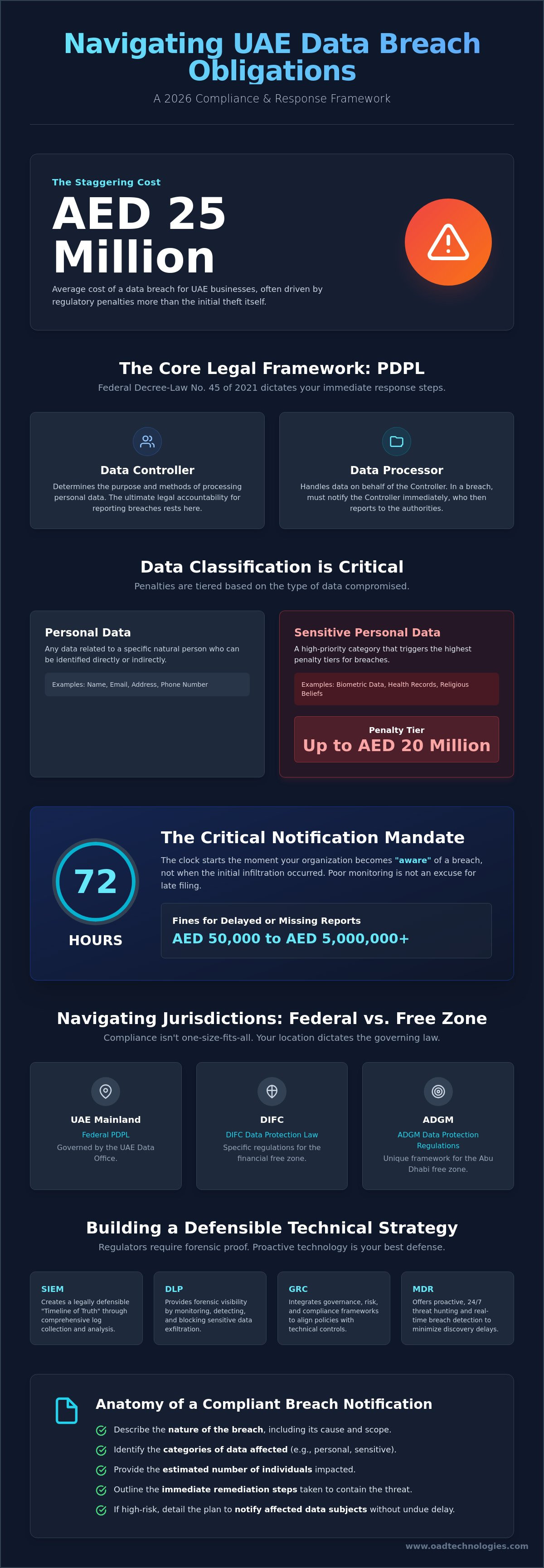
The average cost of a data breach for UAE businesses has climbed to AED 25 million, a figure that often stems more from regulatory penalties than the initial theft. Fulfilling the legal obligations after a data breach in uae requires more than just a reactive stance; it demands a precise understanding of the federal PDPL and free-zone regulations like those in the DIFC and ADGM. It's exhausting to track which notification duties apply, under the PDPL, a free-zone regime or a sector regulator such as the CBUAE, while simultaneously trying to contain a live threat.
We understand that the pressure to maintain compliance while managing technical recovery is immense. This guide offers a clear, strategic framework to help you master the 2026 regulatory landscape with confidence. We'll break down the essential notification checklists and show how tools like Managed Detection and Response (MDR) and Data Loss Prevention (DLP) provide the forensic visibility required to satisfy regulators. By the end, you'll have a roadmap for building long-term resilience that balances high-level innovation with strict legal accountability.
Key Takeaways
- Understand when PDPL breach notification applies and the specific "discovery" triggers that start your response clock.
- Understand your exact legal obligations after a data breach in uae, including the critical differences between federal PDPL mandates and sector-specific rules for financial or virtual asset entities.
- Learn how to leverage SIEM and DLP to maintain a legally defensible "Timeline of Truth" that satisfies the forensic requirements of the UAE Data Office.
- Explore the synergy between GRC frameworks and Managed Detection and Response (MDR) to build a proactive strategy that mitigates the risk of multi-million dirham fines.
- Clarify how to manage compliance across multiple jurisdictions, ensuring your reporting strategy aligns with both federal laws and free-zone regulations in the DIFC and ADGM.
The UAE Legal Framework: Federal Decree-Law No. 45 of 2021 (PDPL)
Federal Decree-Law No. 45 of 2021, known as the PDPL, serves as the cornerstone of data privacy in the Emirates. By 2026, the regulatory environment has matured from initial guidance into a phase of active enforcement. The UAE Data Office now operates as the central authority, overseeing how organizations handle personal information and ensuring that legal obligations after a data breach in uae are met with technical precision. Your organization's status as either a Data Controller or a Data Processor dictates your immediate response steps. Whether you are a large financial institution or a specialized UAE retailer like REP Store, identifying your role is the first step toward compliance. While the Controller determines the purpose and method of processing, the Processor handles data on their behalf. In a breach scenario, Processors must notify Controllers immediately, but the ultimate legal accountability for reporting to the Data Office rests with the Controller.
The enforcement priorities in 2026 emphasize forensic proof and proactive risk mitigation. Regulators no longer accept "unawareness" as a defense. Organizations are expected to have established technical frameworks that detect breaches in real-time. This shift means that your compliance strategy must move beyond simple policy documents into active system monitoring and verifiable log retention.
Key Definitions: Personal vs. Sensitive Data
According to Article 1 of the PDPL, Personal Data is any data related to a specific natural person or a person who can be identified directly or indirectly by linking data. While all personal data requires protection, the law identifies "Sensitive Personal Data" as a high-priority category. This includes biometric data, health records, and religious beliefs. Breaches involving sensitive data carry the greatest regulatory and reputational risk; administrative penalties under the PDPL are set by Cabinet decision. Because health data must be stored within the UAE and retained for 25 years under separate healthcare regulations, a breach in this sector involves a complex intersection of multiple federal laws.
Territorial Scope and Cross-Border Implications
The PDPL's reach extends to any organization processing the data of UAE subjects, regardless of where the company is headquartered. This extraterritorial application aligns closely with General Data Protection Regulation (GDPR) principles, making it vital for international firms to harmonize their local security controls with global standards. However, it's critical to distinguish between federal and free-zone jurisdictions. If your entity operates primarily within the Dubai International Financial Centre (DIFC) or the Abu Dhabi Global Market (ADGM), you're governed by their respective data protection laws rather than the federal PDPL. Understanding these boundaries is the first step in managing legal obligations after a data breach in uae without duplicating effort or missing localized deadlines.
Breach Notification Under the PDPL: When the Clock Starts
Your notification duty is driven by awareness, not by when a threat actor first infiltrated your perimeter: Article 9 of the PDPL requires the controller to notify the UAE Data Office once it becomes aware of a breach that would prejudice the privacy, confidentiality or security of personal data. This distinction is vital for meeting your legal obligations after a data breach in uae. Awareness is often defined by the point at which your security team or automated systems confirm that personal data has been compromised. In 2026, the UAE Data Office expects organizations to have robust detection capabilities, meaning a delay in discovery due to poor monitoring won't excuse a late filing. If you don't have the visibility to spot a breach, you're already in technical non-compliance.
When reporting to the Data Office, you must provide a specific set of data. This includes the nature of the breach, the categories of data affected, and the estimated number of impacted individuals. You'll also need to outline the immediate remediation steps taken to contain the leak. If the breach poses a high risk to the rights and freedoms of individuals, you must also notify the affected data subjects without undue delay. Silence is a high-stakes gamble. The federal PDPL leaves administrative penalties to be set by Cabinet decision (Article 26), so confirm current penalty levels with qualified counsel rather than rely on headline figures.
The Anatomy of a Compliant Breach Notification
A defensible notification is rooted in technical evidence. You must document the exact scope of the leak, identifying whether it involves standard personal identifiers or sensitive biometric data. Your submission must include the contact details of your Data Protection Officer (DPO), who will serve as the primary liaison for the Data Office. To ensure your team is ready for this high-pressure window, consider performing a Vulnerability Assessment and Penetration Testing (VAPT) to identify gaps in your incident response plan before a crisis occurs.
Managing the Processor-Controller Relationship
The relationship between Data Controllers and Processors is a critical compliance link. Processors are legally required to notify the Controller immediately upon discovering a breach. While statutory requirements set the floor, your contractual agreements should define the specific technical logs the Processor must provide to support your investigation. Integrating these requirements into your governance risk and compliance framework ensures that third-party vulnerabilities don't become your legal downfall. For more details, the UAE government provides official guidance on data protection that clarifies these cross-entity responsibilities.
Technical Obligations: Using SIEM and DLP for Forensic Readiness
In the wake of a security incident, the UAE Data Office requires more than a simple admission of a breach; they demand a detailed forensic account. Meeting your legal obligations after a data breach in uae hinges on your ability to produce immutable logs that reconstruct the attacker's path. Log retention is no longer a discretionary security practice but a statutory necessity to prove compliance with the UAE's Personal Data Protection Law. Without a preserved trail of events, an organization cannot verify if sensitive biometric or health data was accessed, leaving them vulnerable to the highest tier of administrative fines. Forensic integrity is paramount, as digital evidence must be admissible in UAE courts to defend your remediation actions.
The 2026 regulatory landscape expects a level of technical maturity where "we didn't know" is no longer a valid response. Regulators look for evidence that you've implemented specific controls to monitor data movement and system access. By treating security logs as legal records, you bridge the gap between technical defense and regulatory resilience. This shift ensures that your organization isn't just reacting to a crisis but is providing the "Timeline of Truth" that authorities require for a closed investigation.
Data Loss Prevention (DLP) as a Compliance Tool
Modern data loss prevention (DLP) systems act as a real-time auditor for sensitive UAE data. These tools automate the identification of PII by scanning for specific local identifiers, such as Emirates ID numbers or regional financial records. By categorizing data as it moves, DLP allows your team to report exactly what was exfiltrated within hours of discovery. This precision reduces the "Time to Detect" and ensures that your notification to the regulator is based on hard telemetry rather than speculation. It's the difference between a vague report and a strategically sound disclosure that demonstrates control.
SIEM and EDR: Building the Audit Trail
To satisfy the forensic standards of the UAE legal system, your security stack must provide a unified view of the incident. Deploying a SIEM platform provides the necessary correlation of events across your entire national infrastructure. While EDR captures granular activity at the endpoint level, the SIEM aggregates these logs to show how a breach originated and spread. Automated log correlation supports prompt breach assessment and notification by filtering out noise and surfacing the specific sequence of events that constitute a reportable breach. This technical synergy ensures that your organization remains resilient, transforming raw security data into a robust legal defense.
Beyond the PDPL: Sector-Specific Obligations in the UAE
While the federal PDPL establishes a foundational baseline for data privacy, several key sectors in the Emirates operate under significantly more stringent requirements. Navigating your legal obligations after a data breach in uae requires a granular understanding of these overlapping jurisdictions. For organizations in finance, virtual assets, or healthcare, sector regulators may impose their own, often shorter, incident-reporting timelines that leave little margin for technical hesitation. Failure to align your incident response with these specific regulators can lead to compounded penalties that exceed federal limits.
The UAE's shift toward mandatory cyber resilience means that critical infrastructure providers must also adhere to NESA (National Electronic Security Authority) and Information Security Regulation (ISR) standards. These frameworks prioritize the availability of essential services, meaning a breach that causes operational downtime triggers different reporting streams than a standard data leak. In the healthcare sector, the Ministry of Health and Prevention (MOHAP) enforces strict data localization, requiring all patient records to be stored within the country for 25 years. A breach in this space often requires proving that data residency was maintained throughout the incident.
The CBUAE Consumer Protection Regulation
Banks, insurance firms, and fintech entities licensed by the Central Bank of the UAE (CBUAE) may face accelerated timelines to report significant cyber incidents, followed by fuller forensic reporting. Confirm the current deadlines in the applicable CBUAE regulations and notices. Under the Consumer Protection Regulation, financial institutions also bear specific liability frameworks for unauthorized transactions resulting from a breach. Integrating managed detection and response (MDR) into your financial sector resilience strategy is essential for meeting these timelines. MDR provides the continuous monitoring needed to detect anomalies before they escalate into reportable CBUAE events.
VARA and the Virtual Asset Sector
The Virtual Assets Regulatory Authority (VARA) has introduced some of the world's most rigorous oversight for Virtual Asset Service Providers (VASPs). To maintain market stability, VARA's rulebooks require prompt notification of incidents that compromise customer assets or systemic integrity; VASPs should confirm the exact timelines in the current rulebook. This isn't just about privacy; it's about preventing market contagion. Proactive preparation through vulnerability assessment and penetration testing (VAPT) allows VASPs to identify and patch the specific vectors that lead to VARA fines. Ensuring your technical controls are validated through regular testing is the only way to avoid the scrutiny of a VARA audit after a breach.
Secure your organization against sector-specific risks by booking a comprehensive GRC and security audit today.
Strategic Response: Integrating GRC and Managed Security
Fulfilling your legal obligations after a data breach in uae requires shifting from a reactive "firefighting" mindset to a proactive governance strategy. Proactive Governance, Risk, and Compliance (GRC) frameworks, often supported by business advisory experts like AccouConsult, allow organizations to demonstrate that they didn't just respond to a threat; they anticipated it. Regulators often look for evidence of pre-existing controls when determining the severity of administrative fines. Managed Detection and Response (MDR) functions as a technical insurance policy, providing the continuous oversight and forensic telemetry required to meet the strict reporting windows discussed in previous sections while protecting your long-term investment returns.
OAD Technologies acts as a visionary partner, bridging the gap between high-level UAE regulatory mandates and the technical architectures needed to sustain them. We don't just provide software; we act as master designers of systems that empower your people to handle complex digital challenges with precision. We help you build a "Compliance-First" incident response plan that prioritizes both containment and the documentation required to fulfill legal obligations after a data breach in uae. By aligning your security posture with the UAE’s National Cybersecurity Strategy 2023–2026, we ensure your organization remains digitally relevant and legally protected against sophisticated AI-driven threats.
The Role of GRC in Post-Breach Litigation
Documented security assessments are your primary defense during post-breach audits. Regulators examine whether the organization exercised due diligence before the incident. Regular VAPT audits provide a verifiable record of remediating vulnerabilities, which significantly reduces legal liability. Integrating identity and access management (IAM) serves as a preventative legal control, ensuring only authorized personnel access sensitive data tiers. These measures prove to authorities that the breach occurred despite rigorous engineering standards.
Continuous Monitoring and Regulatory Peace of Mind
24 X 7 monitoring is no longer a luxury; it's a prerequisite for meeting UAE reporting mandates. Moving from "check-box compliance" to true operational resilience requires a system that correlates infrastructure events in real-time. This visibility ensures your team identifies "discovery triggers" immediately, managing notification timelines with data-driven confidence. Partnering with OAD Technologies provides a collaborative team that values long-term viability, acting as a guardian of your digital reputation.
Contact OAD Technologies for a comprehensive GRC and Security Assessment to ensure your organization is ready for the 2026 regulatory landscape.
Securing Your Regulatory Future in the Emirates
Maintaining compliance in 2026 requires more than a standard response plan; it demands a fusion of technical visibility and strategic foresight. You've seen how PDPL notification duties and sector-specific mandates from the CBUAE or VARA leave no room for manual errors. Successfully managing legal obligations after a data breach in uae depends on your ability to produce forensic evidence through SIEM and DLP while maintaining a proactive GRC posture. These tools provide the "Timeline of Truth" that regulators now expect as a baseline for due diligence.
OAD Technologies brings specialized Dubai-based expertise to help you navigate the federal PDPL and complex free-zone regulations. Our advanced MDR and DLP solutions are specifically tailored for the UAE market, ensuring your organization remains resilient against sophisticated threats. By combining comprehensive GRC and VAPT services, we act as a strategic partner in your digital evolution. Ensure your organization is compliant with UAE Data Laws; Consult our GRC experts today. With the right technical foundation, you can turn regulatory requirements into a roadmap for long-term operational success.
Frequently Asked Questions
What is the maximum fine for a data breach under the UAE PDPL?
Administrative penalties under the federal PDPL are to be set by Cabinet decision (Article 26), so confirm current levels with qualified counsel. Penalties may apply to failures in meeting legal obligations after a data breach in uae, such as missing notification deadlines. Free zones like the ADGM have even higher caps, reaching USD 28 million. Maintaining technical proof of your response efforts is the only way to mitigate these significant financial risks.
Do I need to notify the UAE Data Office if the breach involves non-UAE residents?
You must notify the UAE Data Office if your UAE-based organization processes personal data, regardless of the data subjects' residency. The PDPL's territorial scope includes any controller or processor located in the UAE. If the breach would prejudice the privacy, confidentiality or security of data subjects' personal data, the Article 9 notification duty applies. This ensures that even international firms operating locally remain accountable to the central regulator for all data they handle.
How does UAE breach notification differ from the GDPR?
Unlike the GDPR, which sets a 72-hour deadline, the federal PDPL itself does not state a fixed number of hours; notification follows the mechanisms set for the UAE Data Office. Entities regulated by the CBUAE or VARA may also face shorter sector-specific reporting timelines. This multi-layered approach means UAE businesses often face tighter windows for initial alerts than their European counterparts. Your response strategy must account for these accelerated local deadlines to avoid technical non-compliance.
What constitutes a "high risk" breach requiring immediate data subject notification?
A high risk breach involves incidents likely to cause significant harm, such as identity theft, financial loss, or damage to an individual's reputation. This category almost always includes the compromise of sensitive personal data, such as biometric records or health information. When these risks are present, you're legally obligated to notify the affected data subjects without undue delay. This transparency is a core component of the legal obligations after a data breach in uae.
Can a company be held liable if a third-party processor loses their data in the UAE?
Data Controllers remain legally liable for breaches occurring at a third-party processor under the PDPL framework. While the processor must notify the controller immediately, the controller is responsible for reporting the incident to the UAE Data Office. This makes vendor risk management a critical compliance pillar. Ensure your contracts specify the technical logs and forensic evidence the processor must provide to support prompt reporting during an investigation.
Is encrypted data exempt from notification requirements under UAE law?
Encrypted data may be exempt from subject notification requirements if the organization can prove the data is unintelligible to unauthorized parties. If the encryption remained robust and the keys weren't compromised, the breach might not pose a high risk to individuals. However, you should still document the incident internally. You must still evaluate whether a report to the UAE Data Office is necessary based on the overall risk assessment of the incident.
What are the reporting requirements for cyberattacks on UAE critical infrastructure?
Entities in critical sectors must comply with NESA and ISR standards, which often mandate immediate reporting of cyberattacks to the UAE Cyber Security Council. These requirements prioritize national security and the availability of essential services over individual privacy alone. If an attack impacts critical infrastructure, the reporting stream is separate from and often faster than the standard PDPL notification. Organizations must maintain separate playbooks for these high-priority national security incidents.
How often should UAE businesses update their data breach response plans?
UAE businesses should update and test their data breach response plans at least annually or whenever significant changes occur in their technical architecture. The rapid evolution of the UAE regulatory landscape, including new 2025 regulations on child digital safety, requires constant policy refinement. Regular testing through VAPT or tabletop exercises ensures your team can meet notification deadlines under pressure. Continuous updates turn a static document into a functional tool for operational resilience.
Disclaimer
Content by OAD Technologies is for general informational purposes only and does not constitute professional or cybersecurity advice. No warranties are made regarding accuracy or completeness; reliance is at your own risk. OAD Technologies shall not be liable for any direct or indirect losses arising from use of this content.