
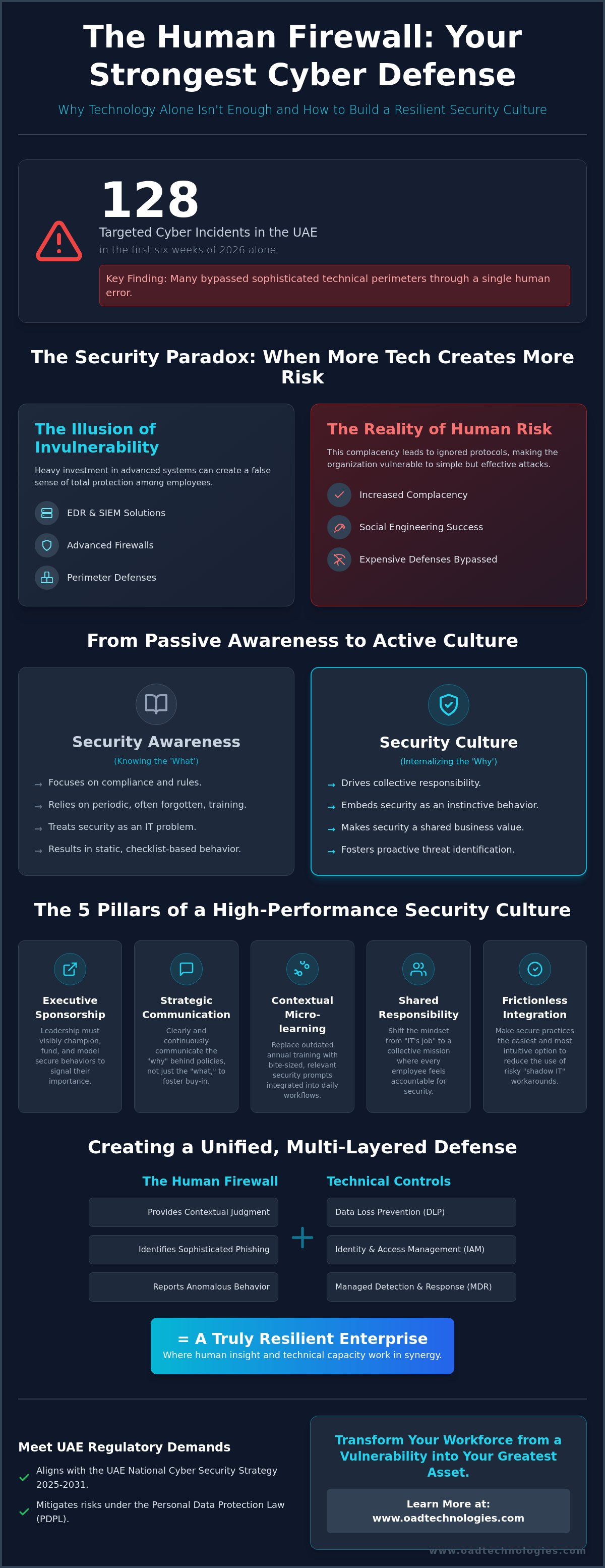
In the first six weeks of 2026 alone, the UAE Cybersecurity Council confirmed 128 targeted cyber incidents, many of which bypassed sophisticated technical perimeters through a single human error. You've likely invested heavily in advanced systems like EDR and SIEM, yet your security posture remains fragile if employees view protocols as obstacles rather than essentials. We recognize that building a culture of security awareness is the only way to bridge the gap between high-level technical innovation and practical, day-to-day resilience.
This article provides a strategic roadmap to transform your workforce from a passive vulnerability into a robust human firewall. You'll discover how to foster a sustainable mindset shift that reduces incident response costs while maximizing the efficacy of tools like DLP and Identity and Access Management. We'll explore how to align these cultural initiatives with the UAE National Cyber Security Strategy 2025-2031 and the Personal Data Protection Law (PDPL), ensuring your enterprise maintains its digital relevance through a deliberate synergy of human insight and technical capacity.
Key Takeaways
- Recognize the limitations of technical controls and how social engineering exploits the "Security Paradox" in the modern threat landscape.
- Master the strategic framework for building a culture of security awareness to ensure employees prioritize safety even when they aren't being monitored.
- Replace outdated, compliance-heavy training models with contextual micro-learning that integrates security prompts seamlessly into the daily workflow.
- Establish five core pillars of cultural excellence, focusing on executive sponsorship and strategic communication to secure long-term organizational buy-in.
- Align your human firewall with technical solutions like Data Loss Prevention (DLP) and Identity and Access Management (IAM) to create a unified, multi-layered defense.
The Human Element: Why Technical Controls Alone Fail
The UAE Cybersecurity Council confirmed 128 targeted incidents in the opening weeks of 2026, a figure that underscores a harsh reality for regional enterprises: technical perimeters are no longer sufficient. While your organization might deploy the latest EDR or SIEM solutions, these tools often fall prey to the "Security Paradox." This phenomenon occurs when an abundance of security software creates a false sense of invulnerability among employees, leading to increased complacency. When staff believe the system is unhackable, they're more likely to ignore basic protocols, effectively opening the door for social engineering attacks that bypass even the most expensive defenses. Building a culture of security awareness isn't just an HR initiative; it's a strategic necessity to ensure your technical investments actually deliver on their promise.
True resilience requires more than just knowing what a threat looks like. It demands a foundational shift in how individuals interact with data. Organizations must move beyond static Security Awareness programs and toward a model where security is an instinctive behavior. In the UAE, where phishing remains the primary entry point for breaches, your employees must function as a proactive human firewall. This human layer doesn't replace technology but rather optimizes it, ensuring that insider threats, whether malicious or accidental, are identified before they can escalate into a full-scale crisis.
The Limitations of Traditional Perimeter Defense
Identity-based attacks now render traditional firewalls insufficient. Modern adversaries don't break in; they log in using stolen credentials. In this environment, the role of human judgment is critical for validating managed detection and response (MDR) alerts. Automated systems can flag an anomaly, but a culture-driven workforce provides the context needed to stop a lateral move before it becomes a breach. The gap between technical detection and human reaction is where most data breaches find their footing.
UAE Regulatory Pressures and Human Risk
Beyond the immediate threat of data loss, UAE enterprises face significant pressure from the Personal Data Protection Law (PDPL). Human behavior is the primary variable in maintaining compliance. Within a robust governance risk and compliance (GRC) framework, culture acts as a risk mitigator. Employee negligence, such as misconfiguring a cloud bucket or falling for a sophisticated prompt injection attack, can lead to severe regulatory penalties. By prioritizing culture, you lower your organization’s risk profile and avoid the ballooning costs of non-compliance driven by preventable human error.
Defining Security Culture: Beyond Simple Awareness
Security awareness is often mistaken for security culture, but the two concepts exist on different planes of organizational maturity. While awareness represents the knowledge your staff possesses, culture defines the shared values, beliefs, and habitual behaviors that dictate how that knowledge is applied. It's the difference between knowing that a suspicious link shouldn't be clicked and instinctively reporting it to the IT team even under the pressure of a tight deadline. By building a culture of security awareness, an enterprise moves beyond static checklists and toward a dynamic environment where digital safety is a core business value.
According to ISACA's framework for a security culture, this transformation requires shifting the focus from individual compliance to collective responsibility. Two psychological drivers dictate this shift: responsibility and friction. When employees feel a personal stake in the company's digital health, they're more likely to follow protocols. Conversely, if security measures create excessive friction without a clear "why," staff will inevitably seek workarounds. A strong culture actively reduces the "shadow IT" phenomenon by ensuring employees understand that unauthorized tools aren't just convenient; they're potential entry points for adversaries.
If your current strategy relies solely on automated alerts, you might be overlooking the human nuances that drive long-term resilience. Partnering with experts to evaluate your organizational risk posture can reveal where cultural gaps are undermining your technical defenses.
The Three Pillars of Behavioral Security
- Knowledge: This is the cognitive foundation. Employees must understand the specific risks associated with their roles and the logical reasoning behind each security protocol.
- Attitude: This represents the emotional buy-in. It's the belief that security is everyone's job, not just a burden imposed by the IT department.
- Behavior: This is the final output. It's the habitual, consistent execution of best practices, such as locking screens and using multi-factor authentication, until they become second nature.
Measuring Cultural Maturity in the Enterprise
Measuring success shouldn't be limited to "phish-click" rates. While these metrics provide a snapshot of vulnerability, they don't capture the underlying sentiment. High-performing organizations use qualitative surveys to gauge how employees feel about security protocols. Do they see them as enablers or obstacles? Identifying "Security Champions" within non-technical departments like Marketing or Finance further decentralizes security. These individuals act as peer influencers, making building a culture of security awareness a collaborative, grassroots effort rather than a top-down mandate.
Moving Beyond Compliance-Based Training
The traditional "once-a-year" compliance video is a relic of a bygone era. It fails because it treats security as a hurdle to be cleared rather than a skill to be mastered. For UAE enterprises, building a culture of security awareness requires moving away from these passive, check-the-box models. When training is isolated from the daily workflow, retention drops significantly. Instead, we advocate for micro-learning and contextual security prompts that meet employees where they work. This approach transforms security from a boring annual requirement into a continuous, engaging part of the corporate identity.
Gamification and real-world simulations provide the necessary stakes to make learning stick. By utilizing interactive scenarios, you can address the common objection that security training is uninspiring. These simulations should directly reflect the 2026 threat landscape, including sophisticated phishing and social engineering attempts. Crucially, the success of these programs directly impacts the efficacy of your technical controls. For instance, robust identity and access management (IAM) policies only work if employees understand why they shouldn't share credentials or bypass multi-factor authentication.
From Passive Consumption to Active Participation
The shift toward continuous engagement marks the end of "check-the-box" security. By implementing just-in-time training based on specific user behaviors, you provide relevance that annual videos lack. If a user attempts to access a restricted cloud resource or clicks a simulated phishing link, the system should offer immediate, constructive guidance. Integrating real-time feedback loops ensures that every interaction becomes a learning opportunity, which strengthens your organization's overall security posture.
The Role of Leadership in Behavioral Change
Executive visibility is the single most important predictor of cultural success. When leadership treats security as a strategic priority, the rest of the organization follows suit. You must align security goals with broader business KPIs to demonstrate value to stakeholders. Fostering a "no-blame" culture is equally vital. Employees should feel empowered to report potential incidents without fear of retribution. This transparency is essential for building a culture of security awareness that identifies threats before they escalate into breaches.
5 Pillars of a High-Performance Security Culture
High-performance security is never a byproduct of chance; it's a result of deliberate architectural design. When building a culture of security awareness, enterprises must move beyond passive training and establish five structural pillars that support long-term behavioral change. The first pillar, Executive Sponsorship, ensures that security isn't just an IT line item but a core business strategy backed by vocal, visible support from the C-suite. Second, Strategic Communication translates technical jargon into business-relevant narratives. Instead of discussing packet loss or encryption protocols, leaders should explain how security maintains the trust required for the organization's next strategic expansion in the UAE market.
The remaining pillars focus on the practical mechanics of daily operations. Incentivization shifts the focus from punishing mistakes to rewarding proactive security behaviors, such as reporting a suspicious email before it spreads. Empowerment provides employees with the tools and the explicit authority to challenge unusual requests, even those appearing to come from leadership. Finally, Feedback Loops use empirical data from vulnerability assessment and penetration testing (VAPT) to refine training modules. This ensures your educational efforts address the specific technical and social gaps identified during actual testing scenarios.
Implementing a Security Champion Program
Peer influence is often more effective than top-down mandates. By identifying influencers in non-technical departments like HR, Finance, and Operations, you create a decentralized network of advocates. These "Security Champions" receive advanced training and act as the primary point of contact for their colleagues' security concerns. This peer-to-peer network provides a high ROI by reducing the burden on your central security team and ensuring that best practices are integrated into every departmental workflow.
Continuous Improvement and Adaptability
A high-performance culture must evolve alongside the 2026 threat landscape. As AI-driven deepfakes and sophisticated prompt injection attacks become more prevalent, your culture framework must adapt to include these emerging vectors. Regularly auditing the cultural health of your organization through sentiment surveys and behavioral analysis is essential for long-term viability. For a truly holistic view of risk, integrate these cultural metrics into your SIEM. This allows you to correlate human behavioral trends with technical security events, providing a complete picture of your organization's resilience. Ready to transform your workforce into a strategic asset? Partner with us to design a customized security framework that aligns your people with your technical capacity.
Integrating Culture with Technical Resilience
Technical resilience isn't a destination reached through software procurement alone. It's an ongoing state of readiness maintained by the people who operate within your digital ecosystem. While we've discussed the behavioral pillars of security, it's vital to understand how these human factors amplify the ROI of your existing tech stack. Building a culture of security awareness serves as the final, most adaptive layer of a data loss prevention (DLP) strategy. When employees internalize the value of data, they become the primary defense against the subtle missteps that automated systems might miss.
This synergy extends to Identity and Access Management (IAM). Even the most granular IAM policies fail if employees find ways to share credentials or grant excessive permissions to colleagues to "save time." A high-performance culture ensures that the principle of "Least Privilege" is respected as a safety standard rather than viewed as a bureaucratic hurdle. Similarly, in cloud environments, human vigilance complements Cloud Security Posture Management (CSPM). While CSPM tools flag misconfigurations, it's a security-conscious engineer who prevents the misconfiguration from happening in the first place. OAD Technologies acts as your strategic partner in this journey, bridging the gap between rigid GRC frameworks and the fluid nature of human behavior.
Culture as a Strategic Asset for DLP
Educated users are the best defense against accidental data exfiltration. When staff members understand data classification, they develop better handling habits that significantly reduce the volume of "false positives" your security team must investigate. This efficiency allows your analysts to focus on genuine threats rather than chasing shadows created by uninformed user actions. Human awareness validates technical DLP rules by providing the critical context that automated triggers often lack.
The Future of Human-Centric Cybersecurity in the UAE
As the UAE Cyber Security Council continues to update national standards, the emphasis on the "human firewall" will only intensify. Organizations must prepare for a future where cultural maturity is a measurable component of regulatory compliance. OAD Technologies specializes in designing customized security cultures that don't just follow a template but reflect your specific operational needs and risk profile. By building a culture of security awareness, we ensure your team is empowered to navigate the complexities of the 2026 threat landscape with confidence and precision. Partner with OAD Technologies for a comprehensive security assessment to ensure your technical defenses are matched by a resilient organizational culture.
Securing Your Enterprise Future Through Cultural Alignment
The transition from a vulnerable workforce to a resilient human firewall requires more than just technical deployment. It demands a fundamental shift in organizational values. By building a culture of security awareness, you ensure that every employee acts as a proactive guardian of your digital assets. We've established that moving beyond compliance-based training and implementing five core pillars of behavioral security creates a vital synergy between human insight and technical controls. This alignment is essential for navigating the complexities of the UAE's 2026 threat landscape while maintaining strict adherence to the Personal Data Protection Law (PDPL).
OAD Technologies provides the strategic partnership needed to bridge the gap between technical infrastructure and human behavior. Our UAE-based GRC expertise and comprehensive MDR and DLP integration ensure your organization remains resilient against evolving threats. Strengthen your human firewall with OAD Technologies’ GRC and Security Assessments. We're ready to help you design a security framework that empowers your people and protects your long-term digital relevance. Your journey toward a more secure, culture-driven enterprise starts today.
Frequently Asked Questions
What is the difference between security awareness and security culture?
Security awareness is the foundational knowledge employees possess about digital threats. Security culture is the collective mindset and habitual behavior that dictates how that knowledge is applied in real-world scenarios. While awareness focuses on what people know, culture focuses on how they act when no one is watching. Building a culture of security awareness ensures that security becomes an instinctive reflex rather than a forced compliance task.
How long does it take to build a sustainable security culture?
Establishing a sustainable culture is a multi-year journey. While initial behavioral shifts can be observed within 6 to 12 months, a truly ingrained culture typically takes 2 to 3 years of consistent reinforcement to become self-sustaining. This timeline depends on the maturity of your existing GRC framework and the frequency of contextual training sessions that move beyond outdated annual compliance videos.
Can a strong security culture replace technical tools like DLP?
A strong security culture is a critical defensive layer, but it cannot replace technical tools like Data Loss Prevention (DLP) or Identity and Access Management (IAM). Instead, culture acts as a strategic force multiplier. It ensures that employees respect the technical guardrails you've put in place, reducing the likelihood of accidental data exfiltration and ensuring that technical alerts are validated by informed human judgment.
How do you measure the ROI of security awareness programs?
Measuring the ROI of cultural initiatives involves tracking both qualitative and quantitative metrics. Key indicators include a reduction in successful phishing clicks, lower incident response costs, and a decrease in policy violations. Organizations also see improved operational performance and lower cyber insurance premiums as their risk profile stabilizes. A mature culture also mitigates the risk of heavy fines under the UAE Personal Data Protection Law (PDPL).
What is the biggest challenge in building a security culture in the UAE?
The primary challenge in the UAE is the current cybersecurity skills gap, where demand for professionals significantly outpaces supply. This makes building a culture of security awareness more difficult as internal advocacy requires dedicated leadership. To help bridge this expertise gap, you can visit Roise Uddin for professional guidance on cybersecurity and network security instruction. Additionally, the rapid adoption of AI and IoT technologies creates a fast-moving threat landscape that can overwhelm employees if they aren't provided with continuous, manageable micro-learning modules.
How can leadership help in fostering a culture of security awareness?
Leadership serves as the primary catalyst for cultural change. When executives vocally support security initiatives and align them with business KPIs, employees view security as a core company value rather than an IT burden. Executive visibility ensures that security budgets are protected and that the organization maintains a no-blame reporting environment, which is essential for identifying and mitigating threats early in the attack lifecycle.
Is gamification effective for security training in professional environments?
Gamification is highly effective in professional environments because it replaces passive learning with active participation. By introducing competitive elements, leaderboards, and real-world simulations, you increase engagement and long-term retention. This methodology is gaining traction across industries; for instance, Olympus AI Technologies leverages gamification to convert complex laboratory data into interactive patient dashboards. This approach addresses the common objection that security training is boring, transforming it into an interactive experience that mirrors the actual challenges employees face in the 2026 threat landscape.
How does security culture impact UAE PDPL compliance?
Security culture is the practical engine of PDPL compliance. While the law provides the legal framework for data protection, culture ensures that employees actually follow the rules regarding data handling and privacy. A culture-driven organization is less likely to suffer from the negligence-based breaches that lead to severe regulatory penalties, making cultural maturity a critical component of any robust governance, risk, and compliance strategy.
Disclaimer
Content by OAD Technologies is for general informational purposes only and does not constitute professional or cybersecurity advice. No warranties are made regarding accuracy or completeness; reliance is at your own risk. OAD Technologies shall not be liable for any direct or indirect losses arising from use of this content.