
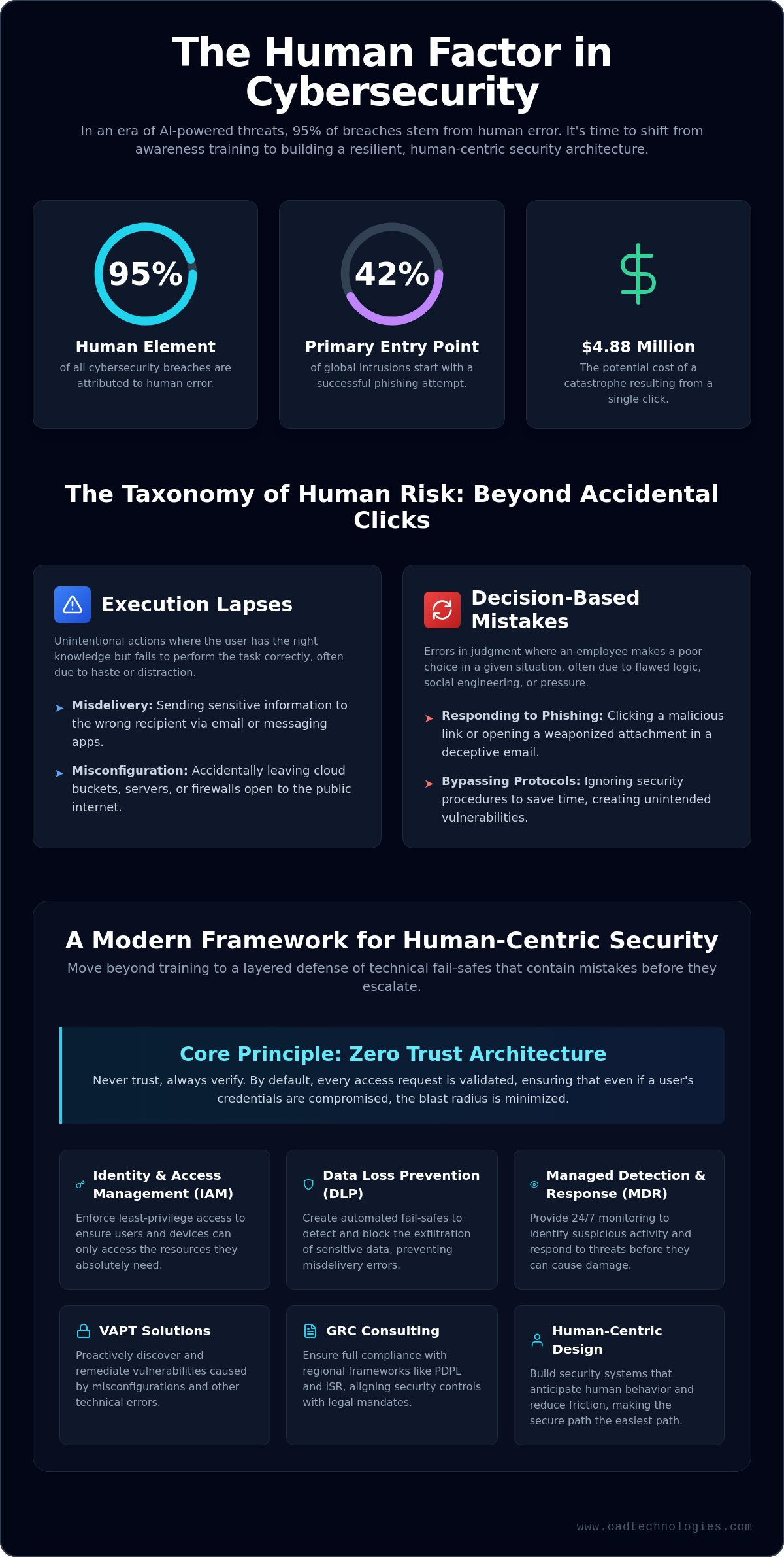
With 95% of all cybersecurity data breaches now attributed to human error, it's clear that traditional training alone isn't keeping pace with 2026's AI-powered threats. You've likely invested heavily in simulations, yet phishing remains a primary entry point, accounting for over 42% of global intrusions this year. The pressure is mounting as UAE regulatory frameworks like the PDPL and ISR demand rapid incident reporting and uncompromising data protection. Focusing on reducing the risk of human error in security is no longer just about awareness; it's about building a system where a single click doesn't lead to a $4.88 million catastrophe.
We understand that your team is exhausted by constant security alerts and complex protocols. You need a strategy that acknowledges human fallibility while maintaining a rigorous defense. This article outlines a framework to transform your workforce from a perceived liability into a strategic asset through advanced technical controls and human-centric design. We'll examine how layering Identity and Access Management (IAM) with robust Data Loss Prevention (DLP) creates a fail-safe posture. By the end, you'll have a roadmap to achieve measurable incident reduction and full compliance with national security standards, ensuring your organization remains resilient even when mistakes happen.
Key Takeaways
- Identify the critical distinction between execution lapses and decision-based mistakes to deploy more precise defensive measures across your organization.
- Discover why moving beyond "soft" training to technical fail-safes is the most effective method for reducing the risk of human error in security.
- Adopt a Zero Trust framework to ensure that individual mistakes are contained by an architecture that validates every access request by default.
- Learn how a combination of GRC consulting and Managed Detection and Response (MDR) creates a resilient posture that accounts for inevitable human fallibility.
- See how customized VAPT and DLP solutions can secure your data against common technical errors like misdelivery and misconfiguration.
Understanding the Impact of Human Error on Modern Cybersecurity
Human error in cybersecurity is often mischaracterized as a simple lack of technical literacy. In reality, it involves unintentional actions, or the failure to act, that facilitate a breach. Whether it is a misconfigured cloud bucket or a response to a spoofed email, these events represent a friction point between human psychology and digital infrastructure. Reducing the risk of human error in security requires a fundamental shift in perspective. We must view these incidents not as individual failures but as failures of system design that do not account for human limitations or the high-pressure environments of 2026.
Psychological factors like cognitive load and decision fatigue are exacerbated by today's hyper-connected workflows. Employees juggle dozens of SaaS applications, each requiring constant attention and authentication. This leads to the "illusion of invulnerability," where users believe that established protocols are sufficient to stop every threat. When systems are designed without empathy for the user's mental state, they become inherently fragile. If a security protocol is too cumbersome, humans will naturally find workarounds that inadvertently create new vulnerabilities. A resilient system is one that anticipates these behaviors and builds fail-safes around them.
The 95% Statistic: Why It Persists in 2026
For years, industry reports have claimed that 95% of breaches involve the human element. This number has not moved because while our firewalls have improved, the sophistication of social engineering has scaled alongside them. In 2026, generative AI allows attackers to create perfectly localized, context-aware messages that bypass traditional "common sense" training. The human causes of data breaches are also rooted in the increasing complexity of enterprise digital environments. With more moving parts in the stack, the likelihood of a human making a configuration error increases. As our systems grow more intricate, the surface area for accidental mistakes expands proportionally.
The Cost of Complacency in UAE Enterprises
In the UAE, the risks associated with human error are magnified by a high-growth market where trust is the primary currency. Organizations must navigate the UAE Personal Data Protection Law (PDPL), which mandates strict safeguards for resident data. A single human mistake that leads to data leakage can result in severe regulatory fines and permanent brand damage. Beyond the immediate financial impact, the loss of trust from regional partners can take years to rebuild. Protecting the human element is therefore a strategic necessity for long-term viability in the Emirates. Companies that fail to adapt their architecture to account for human fallibility risk falling behind in a region that prioritizes national security and digital excellence.
The Taxonomy of Human Risk: Beyond Accidental Clicks
Effective strategies for reducing the risk of human error in security begin with a granular understanding of how people fail. We cannot treat a typo in a firewall rule the same way we treat a deliberate policy violation or a lapse in judgment during a high-pressure deadline. The Human Factors Analysis Classification System provides a professional framework for this, helping us categorize risks into specific buckets of vulnerability. This classification isn't just academic; it's the foundation of a robust defense that survives real-world corporate environments. By identifying whether an error is a failure of execution or a failure of intent, we can deploy more precise technical interventions.
Technical human errors often manifest as misdelivery or misconfiguration. Misdelivery occurs when sensitive information is sent to the wrong recipient, often due to auto-complete features or simple haste. Misconfiguration is more systemic, involving servers or cloud buckets left open to the public internet because a technician missed a single checkbox. These aren't malicious acts, but in the context of UAE regulatory standards like the ISR, they carry the same weight as a targeted attack. Environmental stressors, such as the rapid digital transformation seen across Dubai and Abu Dhabi, increase these error rates by placing immense cognitive loads on IT teams. Just as companies rely on NovoTech for high-quality facility renovations, they must also invest in technical resilience to safeguard their digital expansion.
Skill-Based Slips vs. Knowledge-Based Mistakes
Skill-based slips are lapses in the execution of a familiar task. Think of a developer who accidentally deletes a production database or a staff member who clicks a link because they were distracted by a notification. These are physical or cognitive "glitches" that happen to even the most experienced professionals. Knowledge-based mistakes are different. These occur when an employee makes a wrong choice because they lack the necessary information or misunderstand the risk. For instance, using a weak password because they believe the internal network is "safe" is a knowledge failure. While training addresses the latter, architectural resilience is the only permanent solution for reducing the risk of human error in security across a distributed workforce.
The Role of Privilege Creep and Identity Risk
The impact of any human error is directly proportional to the level of access the user holds. Privilege creep happens when employees accumulate permissions over time that they no longer need for their current roles. This magnifies the "blast radius" of a single compromised account or a negligent mistake. If a user with administrative rights accidentally executes a malicious file, the entire network is at risk. This is why a modern Identity and Access Management (IAM) framework is essential. By eliminating "Ghost Accounts" of former employees and enforcing the principle of least privilege, organizations can ensure that human fallibility doesn't lead to a total system collapse. A proactive vulnerability assessment can often reveal these hidden identity risks before they are exploited.
Strategic Controls: Technical Fail-Safes vs. Security Awareness
Most CISOs today identify human error as their top cybersecurity risk, yet many organizations still rely almost exclusively on soft controls like annual training. While awareness programs provide a necessary foundation, they suffer from high decay rates; research indicates that phishing susceptibility often begins to creep back up within months of a simulation. Training informs your team, but it doesn't prevent a tired employee from making a split-second mistake at the end of a long shift. Reducing the risk of human error in security requires a shift toward hard controls, automated technical fail-safes that intervene the moment a human lapse occurs.
Hard controls act as a digital safety net, ensuring that even if an employee clicks a malicious link or attempts to share a restricted file, the system prevents the error from escalating into a full-scale breach. This architectural approach acknowledges that human mistakes are inevitable. Instead of demanding perfection from staff, we build systems that are resilient to imperfection. By integrating automated enforcement with real-time visibility, you can maintain a high security posture without relying solely on the memory and diligence of your workforce.
DLP: The Ultimate Safety Net for Human Error
A sophisticated Data Loss Prevention (DLP) solution is the most direct method for stopping accidental data egress. These systems don't care about a user's intent; they focus on the data itself. If an employee tries to upload a document containing PII or sensitive financial records to a personal cloud drive, the DLP tool blocks the action instantly. This is particularly vital for meeting UAE ISR standards, which mandate strict protection of national data assets. Beyond just blocking, these tools provide an educational moment by alerting the user to the specific policy they've violated in real-time, reinforcing training through practical application rather than theoretical slides.
MDR and SIEM: Detecting the "Human Signature"
When a human error bypasses initial filters, you need the visibility to catch it before it's exploited. A well-configured SIEM platform correlates actions across your entire stack, identifying the human signature of a mistake, such as a user suddenly logging in from an unusual location or accessing files they've never touched before. This visibility is most effective when paired with Managed Detection and Response (MDR). Managed Detection and Response (MDR) is a proactive, human-led monitoring service that supplements automated tools to identify and neutralize threats that bypass initial defenses. This combination ensures that when a staff member accidentally creates a vulnerability, a professional team is already working to close it.
Implementing a Zero Trust Approach to Mitigate Human Vulnerability
Zero Trust shifts the burden of security from the user's behavior to the system's architecture. It operates on the fundamental premise that every user, device, and network flow is a potential threat until proven otherwise. This "Never Trust, Always Verify" mindset is the most effective way of reducing the risk of human error in security because it removes the assumption of inherent reliability. By implementing micro-segmentation, you ensure that even if an employee accidentally compromises their credentials, the attacker is confined to a small, isolated segment of the network. This containment prevents a single human mistake from escalating into a catastrophic lateral movement across your entire infrastructure.
Adopting this framework directly aligns with UAE regulatory requirements, specifically the Information Assurance Regulation (ISR). The ISR emphasizes the protection of critical information infrastructure through rigorous access controls and continuous monitoring. A Zero Trust architecture provides the technical evidence needed to demonstrate compliance, showing that your organization has moved beyond "hope-based" security to a posture of verified, granular control. It transforms the network into a series of secure enclaves where human fallibility is anticipated and neutralized by design.
The Principle of Least Privilege (PoLP)
The Principle of Least Privilege (PoLP) is the practical application of Zero Trust at the user level. It ensures that staff members only have the minimum access rights required for their specific job functions. If a marketing coordinator's account is phished, the attacker shouldn't have the permissions to access financial databases or modify firewall rules. This significantly limits the blast radius of any human-centric incident. To maintain this posture, your team should follow a structured approach to privilege management:
- Map every user role to specific, documented data assets.
- Remove local administrative rights from all standard workstations by default.
- Implement "Just-in-Time" (JIT) access for sensitive administrative tasks.
- Conduct quarterly access reviews to prune dormant permissions and "privilege creep."
Adaptive Authentication and IAM
Standard Multi-Factor Authentication (MFA) is no longer a sufficient barrier against 2026's sophisticated social engineering. Modern strategies require adaptive authentication, which changes verification requirements based on real-time context. If a user logs in from a known office in Dubai, the system might only require a biometric check. However, if they attempt to access sensitive records from an unfamiliar IP at 2:00 AM, the system should trigger step-up authentication or block the request entirely. This level of oversight is particularly vital for remote workforces, where Cloud Security Posture Management (CSPM) ensures that human misconfigurations in cloud environments don't bypass your Identity and Access Management policies. You can consult with our Zero Trust architects to design a customized authentication flow that protects your team from their own inevitable mistakes.
How OAD Technologies Secures the Human Element
OAD Technologies approaches the human element not as a problem to be solved with a one-off seminar, but as a core architectural component that requires continuous refinement. We recognize that even the most advanced technical controls fail if they aren't aligned with the way your team actually works. By acting as a master designer of systems, we bridge the gap between high-level innovation and practical business results. Our methodology for reducing the risk of human error in security centers on a proactive, solution-oriented mindset that treats your workforce as a strategic asset rather than a liability.
We move beyond standardized approaches by creating highly customized security roadmaps. This isn't just about deploying software; it's about building a partnership where we act as an extension of your own team. We provide the technical authority and visionary guidance needed to navigate the complexities of 2026’s digital landscape, ensuring your organization remains resilient against both external threats and internal lapses. Our goal is to provide a sense of stability and expertise, giving you a clear roadmap for every stage of your digital evolution.
Strategic GRC and Technical Assessment
Operational excellence begins with a clear understanding of the regulatory and psychological landscape. Our GRC services are designed to align human behavior with strict UAE national standards, ensuring that policies aren't just documents on a shelf but active drivers of secure behavior. We supplement this strategic layer with rigorous technical validation. Our VAPT process is specifically tuned to uncover human-induced vulnerabilities, such as misconfigured cloud permissions or insecure API integrations that automated tools often overlook. Security is a design challenge where the human is the most complex variable. By identifying these gaps early, we help you build a posture that accounts for inevitable mistakes before they can be exploited.
Managed Resilience: The OAD Advantage
True resilience requires the synergy of human insight and technological capacity. OAD’s Managed Detection and Response (MDR) service provides continuous oversight, utilizing expert analysts who understand the specific threat landscape of the UAE. This local expertise is vital for navigating regional regulations and identifying industry-specific social engineering tactics. We don't just alert you to problems; we provide the engineering standards and strategic expansion plans needed to solve them. This collaborative approach ensures long-term viability and guards your digital relevance in an ever-changing market. You can partner with OAD Technologies to secure your enterprise against human risk and transform your security culture into a competitive advantage.
Securing Your Digital Future through Human-Centric Architecture
Transitioning from a culture of blame to a culture of resilience requires a fundamental shift in how we design our digital environments. We've explored how technical fail-safes like DLP and the architectural rigors of Zero Trust provide the safety net that traditional training simply can't match. By focusing on reducing the risk of human error in security, you're not just preventing breaches; you're empowering your workforce to operate with confidence in an increasingly complex regulatory landscape. Architecture should protect people, not just processes.
OAD Technologies stands as your strategic partner in this journey, offering Dubai-based expertise that ensures full compliance with local PDPL and ISR standards. Our comprehensive portfolio, spanning MDR, DLP, and GRC, is designed to act as a seamless extension of your team. We don't believe in standardized fixes; we provide the precision engineering required for long-term enterprise resilience. Take the next step toward a visionary security posture and secure your enterprise against human risk with OAD Technologies. Your team's potential shouldn't be limited by the fear of a single accidental click.
Frequently Asked Questions
What is the most common type of human error in cybersecurity?
Phishing remains the most frequent point of failure, often leading to credential theft through social engineering. However, technical misconfigurations represent the most severe risks in modern enterprise environments. Leaving cloud storage buckets publicly accessible or failing to patch known vulnerabilities are common mistakes that often stem from high cognitive loads or a lack of peer review in fast-paced development cycles.
Can security awareness training completely eliminate the risk of human error?
No, training cannot eliminate error because human fallibility is a biological constant. While awareness programs are essential for building a security-conscious culture, they shouldn't be your only line of defense. Effective strategies for reducing the risk of human error in security rely on technical fail-safes that assume a mistake will eventually occur, ensuring that a single slip doesn't lead to a total system breach.
How does Data Loss Prevention (DLP) help in reducing human error?
DLP functions as an automated safety net by monitoring data movement and enforcing policies without relying on user judgment. If an employee accidentally attempts to send sensitive files to an unauthorized recipient or upload them to a personal cloud drive, the system blocks the transfer instantly. This provides immediate protection and serves as a real-time educational tool, alerting the user to the specific policy violation as it happens.
What is the "human element" in the UAE Personal Data Protection Law (PDPL)?
The PDPL focuses on the accountability of data controllers for the actions of their personnel. It mandates that organizations implement appropriate technical and organizational measures to prevent unauthorized access or disclosure. This includes managing the human element through strict access controls and ensuring that staff are equipped to handle personal data in accordance with national privacy standards to avoid accidental leaks that trigger heavy fines.
How does Zero Trust architecture address the problem of human mistakes?
Zero Trust architecture assumes that every user request is a potential threat, requiring continuous verification regardless of the user's location. By implementing micro-segmentation, you limit the "blast radius" of a human mistake. If a user accidentally compromises their credentials, the architecture ensures they only have access to a tiny portion of the network, preventing an attacker from moving laterally to your most sensitive assets.
What should a business do immediately after a breach caused by human error?
Immediate steps include isolating the affected systems to contain the damage and conducting a rapid assessment to determine the scope of the exposure. Under UAE regulations like the ISR, you must follow specific incident reporting timelines, sometimes within 24 hours. Once the threat is neutralized, focus on root-cause analysis to identify the systemic failure that allowed the error to occur, rather than simply penalizing the individual.
Is human error considered an "insider threat" in security frameworks?
Yes, human error is categorized as an "unintentional insider threat." Security frameworks distinguish between malicious insiders who intend to cause harm and negligent or accidental insiders who cause incidents through poor judgment. Both require different management strategies; while malicious threats need behavioral monitoring, accidental threats are best mitigated through technical fail-safes and simplified workflows that reduce the likelihood of a mistake.
How often should we conduct VAPT to identify human-induced vulnerabilities?
Organizations should conduct Vulnerability Assessment and Penetration Testing (VAPT) at least quarterly or whenever significant changes are made to the network. Frequent testing is necessary to identify human-induced vulnerabilities, such as new misconfigurations or insecure shadow IT applications, that emerge as teams evolve. Regular assessments provide a baseline for your security posture and ensure your technical controls are functioning as intended.
Disclaimer
Content by OAD Technologies is for general informational purposes only and does not constitute professional or cybersecurity advice. No warranties are made regarding accuracy or completeness; reliance is at your own risk. OAD Technologies shall not be liable for any direct or indirect losses arising from use of this content.